Sometimes all that glitters is, in fact, real gold. But it would have been difficult to sell that idea to the many European traders who journeyed along the coast of West Africa during the age of exploration.
As their vessels plied what was known as the Gold Coast, records of the era show that the English, Dutch, Swedish and other Europeans often viewed their trading partners with suspicion. There was a longstanding belief that people in that part of Africa were intentionally mixing their gold with lesser metals like silver or copper, or even with bits of glass.
“It’s a recurring theme that they’re stretching the gold,” said Tobias Skowronek, a geochemist who studies archaeology at the University of Bonn in Germany.
But a recent study of artifacts recovered from the wreck of a pirate ship suggests that the West African traders were not passing off adulterated gold. These results were published in March in the journal Heritage Science.
In the spring of 1717, the Whydah Gally, a ship captained by the pirate Samuel Bellamy, sank off the coast of Massachusetts. Bellamy, known as Black Sam, and his crew had commandeered the ship in the Caribbean and were most likely heading for Maine when they encountered a fierce nor’easter. The Whydah broke apart, over 100 men perished and whatever bounty was aboard — rumored to include riches plundered from more than 50 other ships — settled on the seafloor and slowly sank under the sand.
Stories of the Whydah were a mainstay of Brandon Clifford’s childhood. His father, Barry, had grown up on Cape Cod and was an accomplished underwater explorer. Searching for such a storied wreck in what was practically his own backyard proved irresistible for Barry Clifford.
The young Mr. Clifford would sometimes tag along during his father’s expeditions. “I remember these divers who were kind of like astronauts to me,” Mr. Clifford said. “They’d disappear into the blue depths below.”
In 1984, the search paid off. Barry Clifford’s team discovered fragments of gold, and the Whydah’s distinctive bell was unearthed soon afterward. That experience was formative to Mr. Clifford, who is now an underwater archaeologist and the executive director of the Whydah Pirate Museum in Yarmouth, Mass.
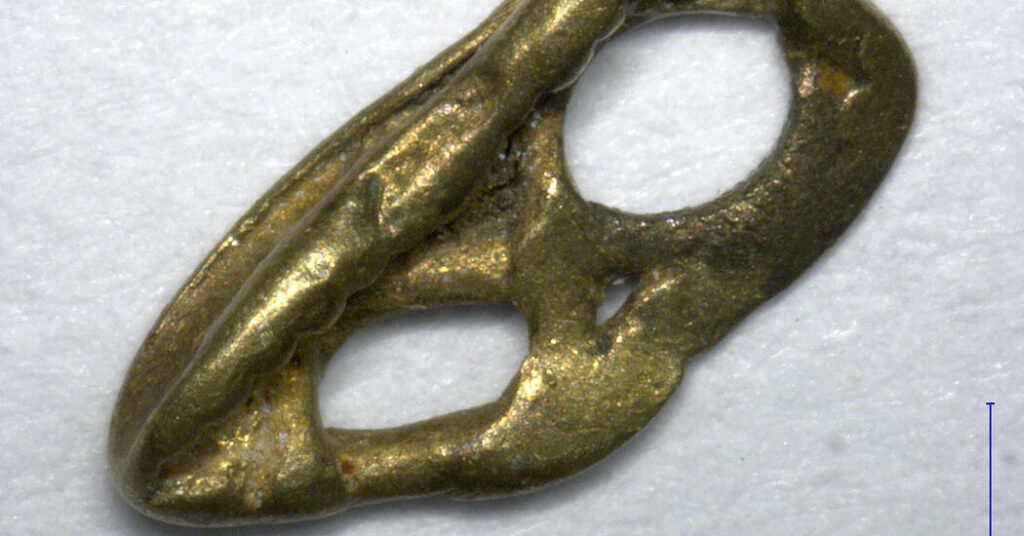
Several hundred thousand objects have since been recovered from the Whydah, including gold artifacts that look to have been made by the Akan people of West Africa.
“These gold artifacts are very, very distinctively 18th-century Akan goldwork,” said Christopher DeCorse, an archaeologist at Syracuse University.
Those artifacts presented an intriguing opportunity to Dr. Skowronek, who was familiar with the record of European assertions of contaminated West African gold.
Working with Dr. DeCorse and Mr. Clifford, Dr. Skowronek analyzed 27 gold artifacts from the Whydah that appeared to be from West Africa. Those objects included fragments of cast artifacts, some of which featured the delicate threadwork that was characteristic of Akan gold.
The largest artifact was no more than half an inch across. “These are not big pieces,” Dr. DeCorse said.
The team fired a beam of electrons at each artifact and measured the X-rays emitted in response. Every molecular element has a unique X-ray signature, so this technique reveals an object’s elemental composition.
The researchers found that the 27 artifacts ranged from 70 to 100 percent gold by weight.
When an artifact wasn’t pure gold, the most common metals present were silver, copper, iron and lead.
While it’s true that some objects were far from pure gold, these results don’t imply that West African traders were being deceitful, the team concluded. That’s because the gold ore that comes from the Ashanti Gold Belt — the purported birthplace, in modern-day Ghana, of these artifacts — also naturally contains a similar range of silver and other metals by weight.
“It’s not 100 percent gold ore that you find,” Dr. Skowronek said.
The notion that Europeans were being systematically cheated by West African gold traders therefore appears to be “nonsense,” Dr. Skowronek said.
Kathleen Bickford Berzock, an anthropologist and chief curator of a gold-focused exhibition at the Block Museum of Art at Northwestern University, was not involved in the study. She said the Whydah gold was useful for analyzing this facet of the European-African gold trade.
She added that some impurities, like copper, in Akan gold could be explained more innocently. “Maybe they’re using the same crucible” to process multiple metals, she said.
These findings are a good example of science informing our understanding of history, said Francesca Casadio, the vice president of conservation and science at the Art Institute of Chicago, who was not involved in the research.
“The science adds another element,” she said.
The post Pirate’s Booty Corrects a Myth About West African Gold appeared first on New York Times.