This article is part of our Museums special section about how institutions are commemorating the past as they move into the future.
They went searching for human ancestors but instead came upon an abundance of dinosaur, mammal and reptile fossils. So they kept going back.
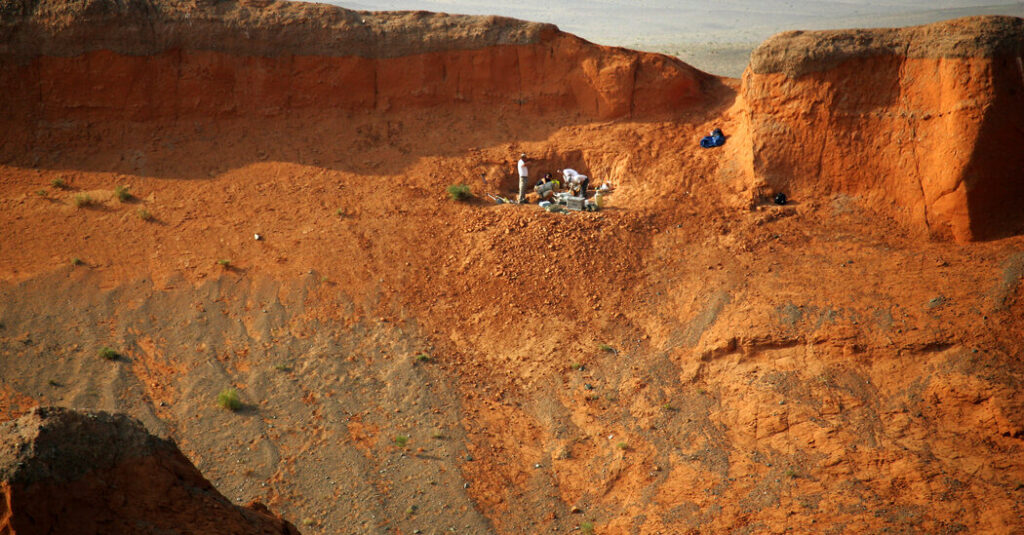
Those expeditions in the vast and remote Gobi Desert of Mongolia led to some of the biggest discoveries in paleontology. And now, more than a century later, the American Museum of Natural History in New York has a new exhibition to honor its intrepid explorers, whose work in the region uncovered species, as well as important clues to the relationship between dinosaurs and birds.
The early expeditions, led by the legendary fossil hunter Roy Chapman Andrews (1884 to 1960), turned up new species of fossil dinosaurs and mammals, including the largest land mammal ever found, Paraceratherium, a hornless ancestor of the rhinoceros that could grow 16 feet tall and weigh 15 to 20 tons.
Even bigger was news of Andrews’ discovery of dinosaur eggs in 1923.
Andrews’s successor, in spirit if not in fact, was Mark A. Norell, who was the curator in charge of fossil amphibians, reptiles and birds in the natural history museum’s division of paleontology and the scientist credited with affirming the link between dinosaurs and birds. He and Michael Novacek, the museum’s provost of science, led dozens of expeditions to the Gobi since 1990.
In honor of Norell, who died at 68 last September, the museum has opened “Fossils of the Flaming Cliffs,” named for the once-remote rock formation where Andrews discovered his first dinosaur eggs.
The exhibit highlights 12 of the museum’s important fossil discoveries in the Gobi, one of the Earth’s richest sources of fossils, and includes 27 photographs documenting the evolution of expeditions over the decades. It opened on April 17 in a space adjacent to the other dinosaur halls and will run indefinitely.
Before his death, Norell worked with Novacek on organizing the exhibition. In reporting on Norell’s death, the Journal of Vertebrate Paleontology said he was “perhaps the most accomplished vertebrate paleontologist of his generation.”
Celebrating the museum’s treks to Mongolia and its many discoveries within a single exhibition has not been easy. Andrews, whose adventures have been likened to those of the fictional swashbuckling archaeologist Indiana Jones, found the first eggs that were scientifically linked to dinosaurs — a spectacular find on its own, made more so because it affirmed ties between dinosaurs and birds.
Members of those early expeditions also uncovered fossils of Velociraptors and Protoceratops, which are in the exhibition. The museum and Mongolian scientists also found evidence that dinosaurs coexisted with early nonplacental mammals — that is, marsupials, whose offspring develop in external pouches, and or monotremes, which lay eggs. It is still not clear why placental mammals appeared only after most dinosaurs died out.
Mongolia became part of the Soviet Union in 1924 and banned Western scientists. Andrews’s final expedition to the Gobi was in 1930. Six decades later, when the Soviet Union was dissolving, the Mongolian Academy of Sciences invited the American Museum of Natural History back.
Norell and Novacek, with teams of postdoctoral students and technicians alongside scientists from the Mongolian Academy of Sciences, resumed scrutinizing old fossil beds and began looking for new ones, rarely spending more than a couple of nights in one spot.
In 1993, Norell and the team hit a jackpot: a remarkable sandstone formation called Ukhaa Tolgod (OOK-uh TALL-gud) 350 miles south of the capital city, Ulaanbaatar. “Ukhaa Tolgod is so rich, with hundreds and hundreds of fossils of many different dinosaurs, mammals and lizards,” Novacek said in a telephone interview last month. “It’s extraordinary. There’s no other locality in the Gobi that approaches the wealth or the richness of the place.” Ukhaa Tolgod fossils are also in the exhibition.
When a museum expedition arrives in July, one goal is to find rock sequences where “you can actually see the line for extinction going from dinosaurs to the age of mammals,” Novacek said.
Such an achievement could rival the museum’s landmark travail of 1993, during which Norell discovered what he said at the time was “the best thing I’ve ever found in my life”: a fossil of a cracked Oviraptor egg containing a curled up embryo that appeared to have been close to hatching.
He also found the fossil of an adult Oviraptor, a small omnivorous dinosaur mistakenly given a name that means “egg eater” after a fossil was found atop eggs in a Cretaceous-era nest. Scientists have since concluded that the Oviraptor was most likely brooding over a clutch of its own eggs in the nest. Novacek described the scene as a “Pompeii situation,” in which the dinosaurs were caught unawares by a natural disaster and buried alive on an ordinary day.
Embryos in such good condition are extremely rare.
“Dinosaur eggs may look like they are covered by solid shells,” Novacek said, “but they have tiny pores just like birds’ eggs that allow for the passage of air and gas for the developing embryo. These pores also allow the entrance of bacteria and other microscopic organisms that can destroy the biological tissue and the embryo inside the eggs.”
Such attention-grabbing discoveries are why Norell and Novacek characterized the Gobi as “a paradise for paleontologists” in a Scientific American article.
“Its eroding terrain exposes nearly complete skeletons of creatures hitherto known only through painstaking reconstructions from a few scattered bones,” the scientists wrote. “Freshly exposed skeletons sometimes look more like the recent remains of carcasses than 80-million-year-old fossils.”
The museum’s scientific team is expanding its focus beyond finding fossils. They also want to better understand the fossils’ ages and the environmental settings in which they were created. This is possible because of new methods of chemical and radiometric dating.
“The work is very early, but I’m optimistic maybe we’ll get a very, very interesting result in terms of this major transition from one biological empire to the next,” Novacek said.
Visitors to the new exhibition may have a sense of how difficult it is to find these fossils, but not necessarily what a grueling exercise it is simply to get to the Gobi’s fossil fields from New York. Air travel alone approaches 24 hours. In Ulaanbaatar, expedition members retrieve Russian-made military trucks and other rugged vehicles that previous expeditions bought in Mongolia and stored there over winters, while others round up provisions, like food, fuel and plaster for encasing fossils for shipping.
Then comes the hard part: driving to the fossil beds. Mongolia is more than five times the size of Colorado. The Flaming Cliffs are 420 miles from Ulaanbaatar, a distance that can be driven in eight to 12 hours thanks to a recently paved road. The trek to Ukhaa Tolgod can take three days because the pavement stops 60 to 65 miles away from the site.
Still, travel is an improvement over Andrews’ arduous treks to the region. He and his colleagues went by railroad from New York to San Francisco, boarded a steamship to China, took a Chinese railroad to the end of the line in Zhangjiakou and finally drove a caravan of Dodge automobiles and camels for the final 700 miles across the desert.
“He used the camels to carry a lot of their supplies. He had no big trucks, only those Dodge motorcars,” Novacek said. “We can carry stuff in our big Soviet trucks. We also have a Mercedes Unimog, a monster four-wheel-drive truck with giant wheels, 10 gears forward and 10 gears back. We carry all our gasoline on that, in barrels.”
Before acquiring the Unimog, expeditions carried fuel in a less-hardy tanker truck that Novacek had to buy to obtain the gasoline inside.
The museum’s expedition team is not alone in using new tools to search for fossils in the Gobi. Six or seven expeditions travel to Mongolia from Canada, China, Japan, Russia and the United States every summer. “There’s a lot of work going on, but there’s still so much to do,” Novacek said.
“It’s been going on for 100 years. And there are another 100 coming.”
The post A New York Museum Honors Its Real-Life ‘Indiana Jones’ Dinosaur Hunters appeared first on New York Times.