This article is part of our Museums special section about how institutions are commemorating the past as they move into the future.
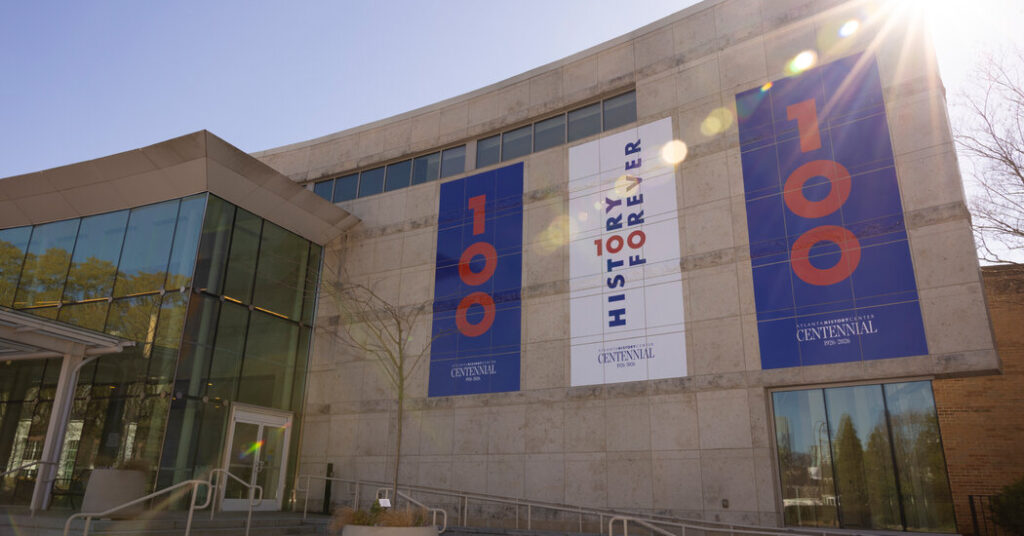
A century ago, a dozen or so prominent Atlantans founded a historical society. It was little more than a discussion group, with a rented office, a modest collection of artifacts and the seemingly quixotic aspiration that their city would some day be globally recognized as a capital of commerce and culture, not just of the state of Georgia.
Around the same time, the widow of a wealthy merchant named Harriet Harwell Wilson High donated her family’s Tudor-style mansion to the Atlanta Art Association, giving it the space its leaders had long wanted with which to open a museum.
Since then, those fledgling projects have blossomed into two of Atlanta’s cultural anchors, the Atlanta History Center and the High Museum of Art. These days, the history center is spread over 33 acres, with exhibitions, preserved houses and gardens and a collection that includes 55,000 artifacts. And the High Museum shifted from the mansion to buildings designed by the architects Richard Meier and Renzo Piano, with an area of well over 300,000 square feet, housing more than 20,000 works of art.
Taken together, their trajectory over the past 100 years has mirrored that of Atlanta itself, as the city has been transformed from the regional heart of the Old South into a vibrant and diverse hub plugged into the rest of the world.
This year, both institutions are approaching their centennials as an opportunity, not only to look back at how they have figured in the city’s rise, but to take stock of how their ambitions will evolve along with those of Atlanta as a whole.
The two museums now share a similar challenge: to reach across racial, economic, educational and even geographic lines to feel vital and necessary to a vast cross-section of people who constitute Atlanta. And to do so at a time when it seems there is more competition for attention and resources than ever before.
“It’s important that we do stay relevant, that we represent meaning and value for our visitors,” said Pola Changnon, the history center’s chief content officer. “Value is a little bit about ticket price, but it’s as much about how they spend time, and I think there’s a sense of time scarcity for people right now.”
Atlanta, a railroad terminus that exploded to become a metropolis of more than 6.4 million people, has long been defined by its relentless pursuit of prosperity and clout. It made itself an international hub, quite literally, by building an airport that is the busiest in the world, year after year. It further asserted itself on the global stage when it hosted the Olympics in 1996. Atlanta has become a cultural engine, exporting its influence through its music, reality television, and scripted shows and films. This year it will also draw international attention as one of the host cities for the World Cup.
“I feel like people are going to look back at this moment and say, ‘You know what, that’s when Atlanta believed it was more than the airport,’” said Randall Suffolk, the director of the High since 2015. “I think this is a future city in so many ways. We have our issues, like so many other big cities. But there is so much that, directionally, is going right for us as a community, and I think it’s really exciting in terms of what the future can hold.”
Visitors to the Atlanta History Center require several hours to put just a dent in the expanse of offerings on display.
There is the restored locomotive, named Texas, part of an exhibition highlighting the role of railroads in building Atlanta. There is a farmhouse with a functioning loom and real livestock, including three sheep (Daisy, Maribelle and Hercules) and two angora goats (Claud and Dorothy). And there is an installation called the Cyclorama: the Civil War Battle of Atlanta portrayed in a panoramic mural standing 49-feet high, and including the detailed rendering of thousands of uniformed soldiers.
The history center also operates the Margaret Mitchell House, named for the author of “Gone With the Wind.” It reopened in 2024 after major renovations and explores the rich and complicated history of the book and film that once defined the antebellum South in the popular imagination.
For its 100th year, the history center is adding an exhibit devoted to the Muscogee Nation of Native Americans, forced from Georgia in the 19th century. It has also undertaken a wholesale overhaul of its Civil War exhibits; the newest iteration, opening this year, expands a narrower accounting of military history into one that examines the roots of the conflict and its enduring consequences, from Reconstruction through to the civil rights movement.
“We feel like we can do something new, fresh, that nobody else has done,” Gordon L Jones, a senior military historian and curator at the center, said recently as he walked through exhibit, still under construction. “That’s the objective. We have super cool artifacts to do it. We have the space to do it with.”
The High Museum’s collection includes modern and contemporary art, African art, European paintings and photography. Just last year, the museum added 361 pieces, including a recently rediscovered painting by Jacob Lawrence, a Matisse painting and dozens of prints by the photographer Ralph Eugene Meatyard.
The aim of museum officials has been to make its collections and the facilities that house them feel essential and approachable to as many Atlantans as possible. “We want to be a place where all of Atlanta is comfortable coming together,” Suffolk said.
Yet those efforts have meant navigating the limitations, real or perceived, potential visitors might feel when it comes to accessing and understanding the art, officials said. They said they have had to figure out how to move past that. “What breaks down the barrier of feeling like, ‘Gosh, I can’t go there,’ ” said Julia Forbes, the museum’s associate director of institutional research. “ ‘I don’t know anything about art.’ ”
The museum has turned to programming to draw people in, like High Frequency Fridays, a monthly event bringing in crowds with its D.J.s and drinks, and open access to the museum’s exhibits. It has sold out — all 3,000 tickets — for 38 consecutive months.
Museum officials said they had success in attracting younger crowds (slightly more than half of visitors in recent years have been under 35) as well as a more diverse audience (just over half of visitors have been people of color).
The museum has also sought to expand its footprint by investing in curating exhibitions that can be exported to museums around the world. This year, those have included the collected drawings of the artist Minnie Evans, spanning decades of her work, and scenes captured by Meatyard, a self-taught Kentucky photographer. A retrospective of the work of the designer Isamu Noguchi opens this spring, featuring nearly 200 objects, including sculpture, furniture, lighting and theatrical sets.
The hope, Suffolk said, is that those who visit, whether as regulars or newcomers, feel at home in the space and with the art. Maybe it will spur them to contemplate some of the weighty subjects addressed by the works, including race, and identity, or even challenge their beliefs or assumptions. Or maybe they will simply have an emotional reaction to a particular piece.
“Whatever it is, they leave looking at the world this way,” Suffolk said, making a slight gesture with his hands indicating a shift in a visitor’s perspective, “because of the experience that they had in the museum.”
Rick Rojas is the Atlanta bureau chief for The Times, leading coverage of the South.
The post The Museums That Helped Power Atlanta’s Rise Are Still Pushing Ahead appeared first on New York Times.