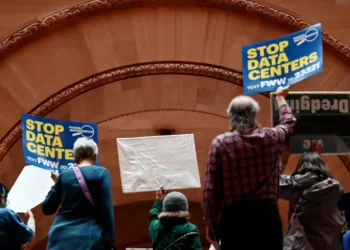
Legislators in Maine on Tuesday passed the nation’s first statewide ban on large data centers, part of a growing backlash to the energy-intensive facilities that fuel the rise of artificial intelligence.
The measure would block the creation of new data centers that draw more than 20 megawatts of power until the fall of 2027 and establish a mechanism to study their impact on the electrical grid.
Maine’s moratorium was approved in final votes Tuesday by both houses of the state legislature. The bill will now go to Gov. Janet Mills (D) for signature.
A spokesman for Mills did not immediately respond to a query about whether she plans to approve the legislation. Mills has said she wants an exception for a data center on the site of a defunct paper mill, but legislators earlier rejected such an amendment.
Battles over data centers have erupted across the country, from small towns to big cities, emerging as a rare source of bipartisan alarm. At least 12 other states led by both Democrats and Republicans are considering their own temporary bans.
Data centers house computer servers crucial to the internet, cloud computing and more recently AI. The average newly planned data center uses as much electricity as a city of 500,000, according to a Washington Post analysis, and some supersized facilities now under construction use far more.
A broad range of communities are voicing concern over how data centers consume electricity, water and farmland. Last year, local resistance stymied proposed data centers representing $152 billion in potential investment, according to Data Center Watch, a research project by an AI security firm.
Proponents, meanwhile, say the centers create jobs, fulfill consumer demand for online services and are critical to the next wave of technological progress.
Those advocating temporary bans say they’re not standing in the way of progress but taking the time to implement the proper regulatory framework for large projects with potentially wide-ranging impacts.
“This is not a Walmart,” state Rep. Melanie Sachs, a Democrat who sponsored the legislation, said in an interview. “Having a projected load of even two or three data centers can really impact the state as a whole.”
Sachs chairs a committee on energy and said the legislation is about “stepping back and saying, ‘If this is going to come, what can we do to really make it beneficial?’”
Patrick Woodcock, chief executive of the Maine State Chamber of Commerce, said his group sent a letter to Mills asking the governor to veto the bill. “It’s not as if we don’t have a review process for these projects to begin with,” Woodcock said. “There are real safeguards in place for ratepayers and the environment.”
Meanwhile, much of rural Maine “is desperately seeking investment,” Woodcock said, and data centers represent one of the few ways for such communities to grow their tax base in this economy.
Maine’s bill pausing new data centers was introduced in February. The state has some of the highest electricity prices in the country, and lawmakers say the moratorium is necessary to study how data centers fit into Maine’s larger energy picture.
Sachs’s father worked at the defunct paper mill in the town of Jay, where a data center is under consideration. As recently as last year, the then-owner had planned to turn it into a factory making a type of engineered wood used in construction, but tariffs from President Donald Trump’s administration threw that into question, local media outlets reported.
One impact of the data center legislation, Sachs said, has been to surface projects that the public wasn’t previously aware were underway, such as the Jay facility.
Local officials are also moving quickly to hit pause. On Monday, the Bangor City Council passed its own six-month ban on data centers, citing the need to adjust regulation in the face of “increased development pressure” around such facilities.
Existing ordinances do not “adequately address the unique infrastructure demands, environmental impacts … and operational characteristics of data centers,” the city council said in a memo summarizing the step.
The post Maine lawmakers pass nation’s first statewide ban on large data centers appeared first on Washington Post.