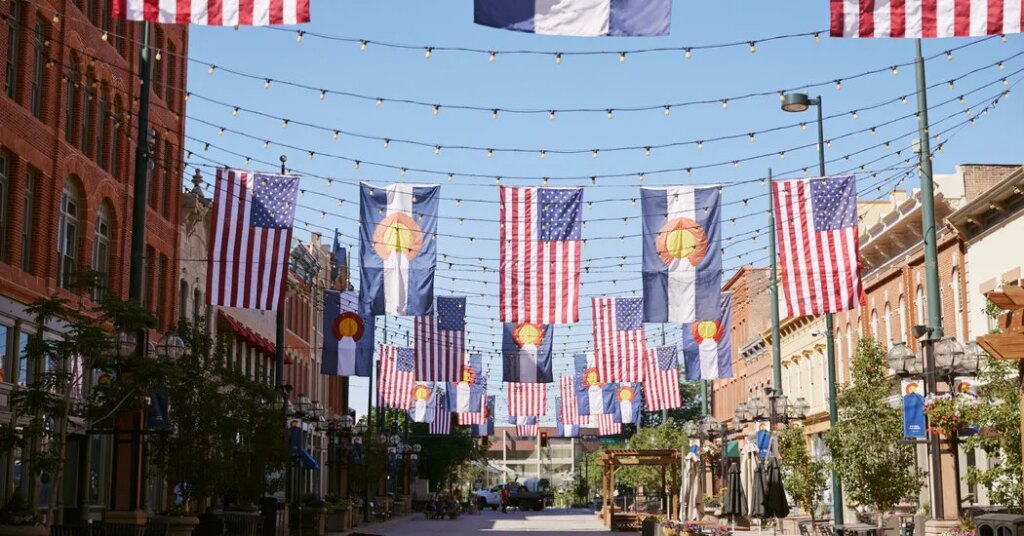
First, there was the baker from Lakewood, Colo., whose refusal to make a wedding cake for a same-sex couple landed him before the Supreme Court. Next, a graphic designer from nearby Littleton, who wanted to limit her wedding-related services to celebrations of heterosexual unions.
Last year, the court heard the case of a therapist from Colorado Springs who sought to counsel young L.G.B.T.Q. people to change their sexual orientation or gender identity.
And last week, the justices heard arguments about a Colorado Catholic preschool. It says it should not have to admit the children of gay or transgender parents to get public funding from the state.
The Supreme Court reviews thousands of petitions each term and agrees to schedule only about 60 for oral argument on its formal merits docket. But again and again, cases from the same Western state, with just over six million residents, have come before the court.
The reason, according to local lawyers, academics and former elected officials, says a lot about the shifting politics and demographics of Colorado and a little about how a local legal dispute can evolve into a precedent-setting case heard by the Supreme Court.
They also cited Colorado’s complicated history with gay rights and the ease with which citizens can propose ballot measures to amend the state’s Constitution.
Once a Republican stronghold, Colorado is now decidedly Democratic, but also the home base of well-funded, organized evangelical Christian think tanks and political groups with a long history in the state. A steady flood of ballot measures, including two that Colorado considered on Tuesday dealing with transgender issues, has also made the state a fertile testing ground for ideological battles.
And as Colorado has become increasingly liberal, the Supreme Court has moved in the opposite direction, with the addition of three justices nominated by President Trump, creating a powerful motivation for conservative groups to try to find test cases that challenge what they see as the state’s boundary-pushing policies.
“We are simultaneously a state where much of the population is at the forefront of ensuring equal rights and at the same time, we are home to a well-organized Christian-right structure, which generates strategies and plaintiffs to serve as the faces behind the battles against social equity,” said Mari Newman, a civil rights lawyer in Denver.
The Supreme Court’s new term opened in October with a groundbreaking lawsuit filed by the liberal college town of Boulder, Colo., targeting oil companies over their role in climate change. Two years ago, the justices also shut down an effort by Colorado voters to disqualify Mr. Trump from the state’s Republican primary.
Colorado is now so ubiquitous before the Supreme Court that it has become a laugh line for practitioners and even the justices themselves.
“You guys write, here in Colorado, a new constitutional amendment every three seconds,” Justice Neil M. Gorsuch, a Denver native, teased during a fireside chat with a fellow judge at a legal conference this fall at a resort in the foothills of the Rocky Mountains.
“They usually end up in my court,” Justice Gorsuch continued, to knowing laughter from the crowd. Justice Gorsuch served for more than a decade on the Colorado-based appeals court before his Supreme Court nomination.
Kristen Waggoner, the chief counsel of the influential Christian conservative legal organization Alliance Defending Freedom, owns a T-shirt sporting the state’s flag in the shape of a heart and the message “I love suing Colorado.” On the back is a list of more than a dozen lawsuits the organization has filed against the state and school district officials since 2014.
She insisted it is the Colorado legislature that is picking fights, by passing anti-discrimination laws that in her view impermissibly impose the government’s favored speech on its residents.
“We believe Colorado is at war with the First Amendment and that Denver is essentially trying to dictate what the right to speak freely means, and what the right to practice one’s faith means,” Ms. Waggoner said.
A former Colorado solicitor general, Eric Olson, rejected that assessment. He noted that in two of the cases the alliance brought in recent years, government officials took no action against the business owners who claimed they were discriminated against by state law. Instead, the businesses sued preemptively to block the chance they could be targeted — and potentially to win new precedents on religious speech issues from the court.
“It’s unfortunate that Colorado’s efforts to create a place where everyone can thrive is selectively attacked by those who wish to exclude members of our community from full participation,” Mr. Olson said.
Colorado’s unique history is part of what has brought it to this place.
Three decades ago, when the state’s population was smaller, whiter and more conservative, the group Focus on the Family established its headquarters in Colorado Springs and became a powerhouse of Christian conservative activism. The founder, James Dobson, helped start Alliance Defending Freedom as a counterweight to the American Civil Liberties Union.
In 1992, another Colorado Springs group, with support from Focus on the Family, got a measure on the state ballot that would have prohibited state and local lawmakers from passing anti-discrimination protections for gays and lesbians. It passed with 53 percent of the vote, giving Colorado a reputation among civil rights activists nationally as the “Hate State” and provoking a legal fight that set it on a path to the Supreme Court.
Ultimately, the justices struck down the measure, with Justice Anthony M. Kennedy writing for a six-member majority in 1996 that Colorado had impermissibly placed the state’s gay and lesbian citizens “in a solitary class,” making them unequal to everyone else. Justice Kennedy, a Republican nominee, would go on to write many of the court’s major decisions to protect gays and lesbians, including the 2015 decision legalizing same-sex marriage.
Pat Steadman, a former state senator, lawyer and longtime gay-rights advocate, recalled sleeping on the sidewalk outside the Supreme Court overnight to secure a seat for oral arguments in 1995. He was so moved by the court’s decision that he tattooed his right forearm with one of Justice Kennedy’s closing lines: “A state cannot so deem a class of persons a stranger to its laws.”
He said the fight mobilized Colorado’s civil rights community to pass new protections for the L.G.B.T.Q. community.
In the years since, an influx of left-leaning residents from other states has also turned Colorado solidly blue. The state has two Democratic senators and elected the nation’s first openly gay man as governor, Jared Polis, who is finishing his second term. The state has not elected a Republican governor in more than 20 years.
But the black ink on Mr. Steadman’s right arm has now faded and blurred. And his feelings about the court have changed, too.
In recent years, the state and L.G.B.T.Q. rights have been on a losing streak at the Supreme Court. In the cases of the Colorado baker, the graphic designer and the therapist, the conservative-dominated bench ruled against the state and in favor of the Christian business owners.
Mr. Steadman said he was preparing for the possibility that the state would lose once again in the case heard last week involving publicly funded preschools. He now sees the justices as political actors, particularly after the court’s 2022 decision to overturn Roe v. Wade.
“Back then, I thought we were making progress,” Mr. Steadman said of the 1990s case. But, he said, “we took a hard rightward step backward.”
In the case of the baker who turned away a gay couple, it was Justice Kennedy who ruled against Colorado and wrote for the majority.
Justice Kennedy found that members of a state board, the Colorado Civil Rights Commission, had treated the case with “clear and impermissible hostility” to the baker’s sincerely held religious beliefs. The justice cited the words of one of the commissioners, who had claimed that freedom of religion had “been used to justify all kinds of discrimination throughout history, whether it be slavery, whether it be the Holocaust.”
Melissa Hart, a former State Supreme Court justice, who died in October, said in an interview this fall that the opinion’s focus on the comments was unfair and made her worry that the conservative majority had concluded the state was hostile to religious interests, hurting its prospects at the U.S. Supreme Court.
“It put a target on the state that has had long-term consequences,” Ms. Hart said. “The reputation is ill deserved.”
At oral argument on Tuesday, those cases re-emerged in the latest litigation involving the Catholic preschool. Justices Amy Coney Barrett and Samuel A. Alito Jr. both recounted Colorado’s long list of disputes with religious entities and suggested the state should have anticipated a challenge to its anti-discrimination rules.
“It’s hard to imagine that Colorado couldn’t have seen this coming,” Justice Barrett said. “I mean, especially given the history.”
From Ms. Waggoner’s perspective, the state has “doubled down” even after its losses. Her organization is already back in court with new challenges to transgender protections that she said violate the First Amendment rights of business owners — cases that could put Colorado back before the Supreme Court.
Former Gov. Bill Ritter, a Democrat who served from 2007 to 2011, when the state was more purple than blue, said “the ideological center has moved left in Colorado as the ideological center of the court has moved right.”
He predicted, “We have not seen the end of the ways in which Colorado will find itself in these cross hairs.”
Noel Black contributed reporting.
The post Why Colorado Is at the Epicenter of So Many Supreme Court Clashes appeared first on New York Times.