DEPARTMENT OF FATE: The Promise, the Power, and the Collapse of America’s Most Consequential Institution, by Rachel Maddow
Of all the ways that Donald Trump has remade the federal government during his second term in office, his transformation of the Department of Justice might be the most significant. He has twice chosen one of his own former defense lawyers to serve as the country’s attorney general, and those A.G.s have overseen the exodus of thousands of career prosecutors. In their place, the department’s ranks have been filled with a slew of conservative activists, like the evolution skeptic Barry Arrington and the attorney Peter Feaman, a former Florida Republican Party committee member who describes the coronavirus vaccine as the “mark of the beast.”
And it’s not just personnel changes that have shaken things up. At the president’s urging, the D.O.J. has carried out investigations into a long list of Trump’s perceived enemies, including the former Federal Reserve chair Jerome Powell, the Federal Reserve Board member Lisa Cook, the former F.B.I. director James Comey and Trump’s own former national security adviser John Bolton, as well as a variety of lesser-known senators, governors, mayors and congressional representatives who have criticized the president. Electoral politics are not off limits either. In the days and hours before the midterms, the D.O.J. tried to force California to set aside 20,000 mail-in ballots, a move that one federal judge described as an attempt to “bend” the state “to the will of the executive branch.”
From her post on cable television, the MS NOW pundit Rachel Maddow has kept careful tabs on all these events. And recently she has something else to offer: “Department of Fate,” a head-spinning chronicle of the last century and a half of federal prosecution. It promises to be a long view on the nightly news.
Maddow has previously written (and recorded podcasts) about the prevalence of the far right in the United States in the 1930s and ’40s, so it makes sense that she would be interested in the history of the Justice Department — and her regular readers might expect her latest book to offer a declension narrative, in which a once-noble institution has been brought low by Trumpian machinations.
But “Department of Fate” does not tell a simple tale of downfall and corruption. Instead, she suggests that the department has been heavily politicized since it first opened its doors a century and a half ago. Throughout its existence, as she shows, there have been many periods when federal prosecutors have harassed people whom the executive branch deemed to be enemies of the state.
The office of the attorney general was established in 1789, but it initially had no staff to speak of and no authority over federal prosecutors. Congress only created the Justice Department in 1870, in the wake of the Civil War, as white Southerners organized terror movements under the banner of the Ku Klux Klan.
It was a time, she writes, when the federal government sought to refound the American Republic as “a democracy unrestricted by race, creed, color or prior enslavement.” As people like the Union Army soldier Jim Williams found out, this was easier said than done. A formerly enslaved man, Williams led a cadre of 90 armed Black men to protect South Carolinians who went to the polls in 1870. After the election, the Klan led a violent revolt, torturing and killing Black leaders, including Williams. They hung his body from a tree, Maddow writes, with a note pinned to his shirt: “Jim Williams gone to his last muster.”
Williams’s murder was just one of the many cases the new D.O.J. took up. Under the leadership of Amos T. Akerman, a former Confederate and slave owner turned loyal supporter of Reconstruction, the department arrested and prosecuted hundreds of suspected Klansmen.
As the Klan faded from view and Reconstruction crumbled in the late 19th century, the Justice Department became increasingly involved in another armed struggle: the labor wars. Laws meant to rein in increasingly large corporations were only halfheartedly enforced. Instead, Maddow notes, agents crushed Jacob Coxey’s 1894 march of the unemployed in Washington; coordinated with employers to break strikes; charged Eugene V. Debs’s American Railway Union as an illegal conspiracy in restraint of trade; and led the legal prosecution of Debs himself in the 1890s.
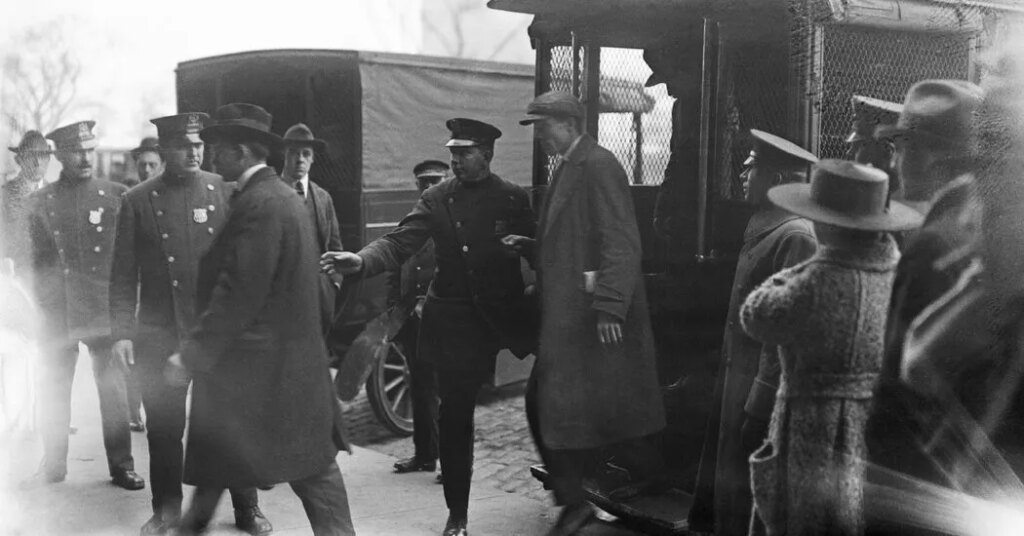
Maddow also gives especially vivid descriptions of the agency’s efforts to suppress left-wing politics after World War I, when the newly formed Radical Division led mass arrests of thousands of supposed anarchists and Communists, in some cases keeping them in what we would now see as torturous conditions. One barber suspected of subversive activities was arrested without a warrant in Bridgeport, Conn., and kept in a dark, windowless “hot box” cell for 53 hours.
Hundreds of American residents were eventually deported in the name of public order. But, as Maddow observes, the federal government adopted a selective method of keeping the peace: For all the zeal it showed chasing down alleged radicals at the time, it declined to carry out a formal investigation into the burning of Black businesses and homes in Tulsa, Okla., in 1921.
The reason for this lopsided approach, Maddow suggests, often had to do with protecting the interests of the president or his inner circle. In the early 1920s, federal prosecutors looked the other way when President Warren G. Harding’s secretary of the interior accepted bribes in exchange for contracts that gave oil companies the right to drill on federal land. In the 1980s, as evidence mounted that Oliver North, a National Security Council staff member, had orchestrated illegal arms transfers to Iran and diverted the proceeds to anti-Communist guerrillas in Nicaragua, the attorney general Ed Meese was painfully slow to investigate. “I think every member of the administration owes it to the president to stand shoulder to shoulder with him and support the policies that he has,” Meese told reporters after the deal came to light.
Like many critics of Trump, Maddow allows her tone to veer between melodrama and snide scorn. On the one hand, she argues that the Justice Department’s priorities — what kinds of people it chooses to pursue, and who gets a pass — “are more determinative of the course of the nation than anything else done by the U.S. government.” On the other hand, using classic cable news invective, she suggests that Trump’s attempts to investigate his apparent opponents are little more than “hot air,” rendering the agency “mostly a joke,” “irrelevant,” “dead, doornail, dunzo.”
But across its more than 400 pages, a different picture of the D.O.J. emerges. “Department of Fate” reveals a federal agency that has always responded to political imperatives that go beyond the White House. What begins as an indictment of Trump thus expands into a wide-ranging exploration of the depth of class and racial conflict in American history.
Despite her explicit theses, Maddow seems to know this. The solutions she puts forward are more systemic than sensationalist. She argues that Congress should strengthen the agency’s internal watchdog and bolster its resources. She also recommends that Congress reassert its primacy over the executive, starting by insisting on far more substantial vetting of nominees and on a two-thirds confirmation vote for all attorneys general. “We cannot afford” more “Ed Meeses or Bill Barrs,” she observes.
“When the United States is on the other side of this attempted revolution,” Maddow writes, the country will need to revisit and rethink its democratic institutions to safeguard them better for the future. As her chatty but surprisingly far-reaching book makes clear, a change of this kind would be tantamount to another refounding moment, a period of transformation not only for the Justice Department, but for the Republic itself.
DEPARTMENT OF FATE: The Promise, the Power, and the Collapse of America’s Most Consequential Institution | By Rachel Maddow | Crown | 475 pp. | $35
The post Has the Justice Department Always Done What the White House Wants? appeared first on New York Times.