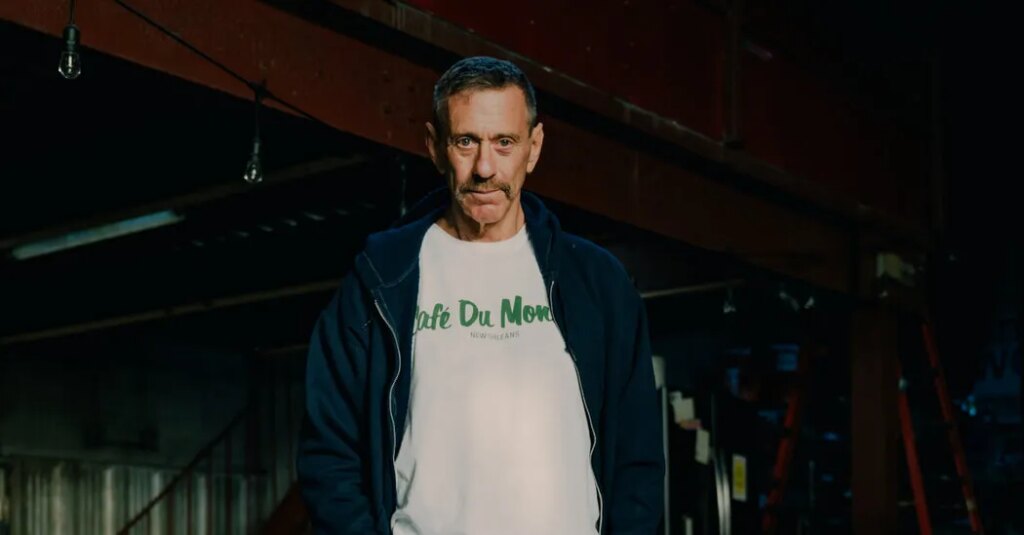
Neil Greenberg had to make a decision about whether to postpone the premiere of his new dance. After a month of rehearsals, beginning in July 2025, he knew — and he postponed. His husband, the artist Frank Mullaney, had just been diagnosed with lung cancer. Mullaney died in February. They had been together for 29 years.
Greenberg, 67, an active and enduring figure in the world of downtown dance in New York has been through a lot in his art-making life. His best-known work, “Not-About-AIDS-Dance,” which premiered in 1994 at the height of the AIDS crisis, was a response to the many losses he experienced, including the death of his brother. It deftly used subtitles to reveal information about the lives of Greenberg’s performers and himself, including the fact that he was H.I.V. positive.
The most chilling image accompanied text that read, “This is what my brother Jon looked like in his coma.” Greenberg, standing, moved a finger in the air as his eyes rolled back in his head. It knocked the breath out of you. It’s the only time, he said, that he has done “something truly kind of literal.”
He is firm that his new work, “Next Dance,” which opens at the Chocolate Factory Theater in Queens on Nov. 12, isn’t about his husband’s death. “This is not that, this is. …” he said, pausing. “I don’t even know how to finish that sentence. The dance is not about Frank dying. This is me following the movement and making my next dance in relationship to my previous dances.”
While there are sudden somber moments in “Next Dance,” as bodies roll and wind on the floor or drift in slow repose, there are also brighter bursts, eccentric and sensual, as dancers swivel their hips at such angles that their twisting torsos turn, somehow, into iridescent sculptures.
The score, a collaboration by James Lo and Zeena Parkins, fills the space with sounds, some percussive and seemingly underwater, and the ethereal notes of a harp. There is humor in the work, but with more frequency, a keen and poignant sense of the bittersweet.
One thing is clear: Nothing about “Next Dance” feels like just another dance. Featuring an all-star cast of Jennifer Lafferty, Owen Prum and Greenberg himself with costumes by Walter Dundervill, the piece, tautly stitched and emotionally vibrant, is one of Greenberg’s finest.
For Greenberg, a member of the Merce Cunningham company for seven years, movement invention matters. His choreography, meticulously extracted from improvisations, embraces the body’s propensity for amplitude and lush extravagance. Pliés are deep, arms stretch from the back, legs fling up and out and land with a robust plunk. His movement, lanky and large, is a study in off-kilter grandeur.
Brian Rogers, the Chocolate Factory’s artistic executive director, said that Greenberg — who is on the organization’s board — had a choreographic language, “that is rare among dancers who spend a lot of time in the companies of choreographers like Merce Cunningham, where, if you take his thing into your body, you can’t ever shake it. I think Neil shook it.”
The new dance strikes Rogers as being particularly powerful, partly because of the trio of dancers in it. “It felt correct,” he said. “It has to be these three.” But it’s also hard for Rogers to say that it is unrelated to Mullaney’s illness and death.
“I think that’s maybe a testament to what Neil’s work can do in the sense that he’s not prescribing for us the narrative of the dance,” Rogers said. “It’s not as if skillful use of abstraction is unique to Neil Greenberg, but he’s doing it very, very well.”
Greenberg, speaking in his Chelsea apartment where Mullaney’s photograph of the artist and performer Agosto Machado — part of his “Wallpaper Saints” series — looms large, sees “Next Dance” as a duet with three dancers. Instead of a conventional trio, there are solos and pairings — either Lafferty with Prum or Lafferty with Greenberg.
“Poor Jennifer,” Greenberg said. “She has to do the whole thing. I really love her in this dance.”
Lafferty, who can shift from pointed and direct to otherworldly and delicate, grasps the difference between gliding through steps and performing them from the inside out, while Prum is a force, tempering his commanding presence with lush lightness — almost in defiance of the power of his height.
Greenberg has filled “Next Dance” with props, including thick work gloves and tambourines. (Tambourines just happened to be in a studio where he was rehearsing.) “There are all sorts of things that are just kind of funny to me or odd and delightful to me,” he said. “But more and more the piece sometimes has some darkness, some sadness.”
He is adamant that the gloves aren’t a reference to Mullaney even though people have wondered about it. “Like why the gloves?” he said. “You have to wear gloves when you go in a hospital. It’s like, no. I had the gloves in my improvisation in March. I mean, I’m not psychic. I am psychotic.”
In “Next Dance,” he is exploring proximity and distance. The cast also experiments with its relationship to the audience. Sometimes there is a fourth wall; at other times, there is none. Sometimes the wall feels translucent. As Greenberg learned while dancing for Cunningham, there is no such thing as having a neutral relationship with the audience or, for that matter, a neutral anything.
“I think that that’s really one of the things I’ve been trying to be explicit about and really using choreographically,” he said of the relationships he is cultivating in his dance, which he sees as a tool or as choreographic material.
“It’s like ‘Project Runway,’” he said. “If you have a different material, then you make a different garment with it. It’s like actual fabrics, textiles. And then how the movement is performed is a part of what the textile is.”
Making the decision to go forward with the dance — resuming rehearsals just two days after an exhibition of Mullaney’s photographs at Catskill Art Space in upstate New York — was “so good for me,” Greenberg said. “It felt very strange for maybe a little while, but like hours only. Or one or two days. Then I got so engaged in what we were doing. “
And it reminded him of the time of “Not-About-AIDS Dance.” After his brother died, he didn’t know if he would continue — or even start — to make the dance he had planned on choreographing. “Or if I would start rehearsals and abort the process,” Greenberg said. “But it just felt so good to be in a room with dancers. And all of us working toward the same goal.”
This time, “Next Dance” had already been set in motion. The title came before Mullaney died — “way before,” Greenberg said.
“There’s something about next and the future and forward — it’s going to be something, and we’re going to make it,” he said. “There’s something for me that’s kind of positive. There’s going be a future.”
Or not. “Is your next dance your last dance?” he said. “But that was a concern having, not necessarily, to do with death.
“So that’s in there, too.”
The post For This Choreographer, After Tragedy, Comes a Dance appeared first on New York Times.