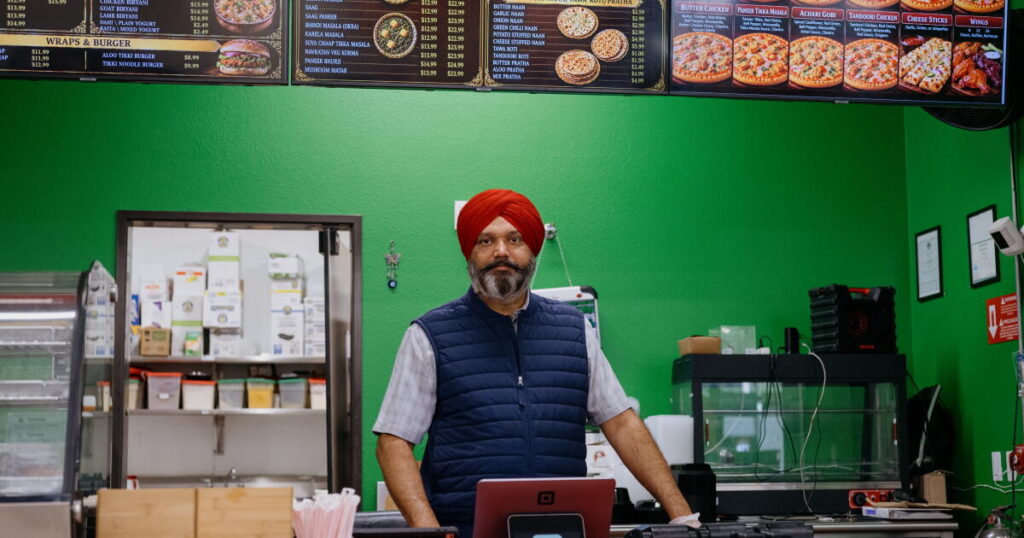
There’s been a surprise surge of Indian food spots along lonely stretches of California’s highways — an unlikely outcome of President Trump’s immigration policies.
More than 13,000 migrant drivers lost their licenses in the state this year as the White House ratcheted up restrictions on some immigrants. Many of those drivers were Indian and pivoted to set up food trucks.
After hauling produce for a decade, Karanveer Singh got an email in December, saying his license wouldn’t be valid after 60 days because of his immigration status. Three of his drivers got the same notice.
“The work I’d been doing for 10 years stopped dead,” he said. “It was very bad.”
He tapped his life savings to buy a used food truck, hire cooks and open Ghar Di Roti — which means homemade flatbread in Punjabi — at a gas station just off Highway 99 in Merced County. His truck now does brisk business selling Punjabi-style roti, dal and goat curry.
“A driver can get his diesel, take a shower, get his sleep, take his 30-minute break — and at the same time he gets hot food right there,” Singh said. “This is the very thing I wanted when I used to drive.”
Some highway restaurants have catered to Indian truck drivers for decades. However, recent increased scrutiny of international drivers — including legal immigrants and asylum seekers allowed to work but without updated paperwork needed to drive — has forced thousands to leave the business.
That helped trigger a truck-stop tandoori trend.
In 2023, some estimated that there were around 40 Indian roadside eateries on highways across the U.S. Today, there are more than 150, according to Dhabaroute, an online list of Indian roadside restaurants — called dhabas — for truckers. California has the most, more than 30, followed by Texas with more than 20, according to the crowdsourced website.
“People who went out of business because of licensing — a lot of people started food trucks,” said Raman Dhillon, who runs the North American Punjabi Trucking Assn., an organization of Indian truckers and trucking companies.
The trucking industry has become more diverse in recent years as immigrants have entered to meet rising demand and fill gaps left by retiring baby boomers. Foreign-born individuals now account for 16% of truckers nationally, according to the Department of Transportation.
The industry became a magnet for a specific subsection of the Indian migrant population: Punjabi Sikhs. Sikhs, followers of a monotheistic faith rooted in 15th century India, have worked American farms for a century, but they began arriving in large numbers in the ‘90s, fleeing religious persecution.
Around 750,000 Punjabi Sikhs live in the U.S., and about 150,000 work in trucking, with most based on the West Coast, according to Sikh Coalition, a civil rights group.
Many Sikhs started as farmers and expanded into trucking. Punjabi Americans built trucking fleets and expanded into trucking schools, truck stops, gas stations and eateries. Their success inspired songs and films that made American trucking a dream for some in India.
Punjabi truckers changed the culinary profile of American highways. Punjabi-owned dhabas emerged, serving the standard highway food-stall fare of India and Pakistan: piping hot rice, rotis, curry and sweet masala chai to fuel tired truckers. Community-created maps show the I-5 corridor has one of the largest clusters of Indian highway dhabas, with a substantial presence on I-80, I-10 and I-40.
Gurpal Singh Maan, 48, set up his shop before the latest wave of truck-stop food trucks. He sold his trucking business in 2023 and opened Royal Chaat at exit 434 on I-5. His food truck was so popular he now has a sit-down restaurant.
He says he’s seen a lot more competitors this year.
“People came into the food industry only when this problem hit,” referring to the federal crackdown on migrants.
The issue of immigrant truckers became a political flash point last year, when a Punjabi Sikh driver took an illegal U-turn at a turnpike that caused a crash in Florida that killed three people. The Trump administration found seven states, including California, Washington and Texas, that had issued truck driver licenses that stretched beyond the time the holders were allowed to stay in the U.S.
Transportation Secretary Sean Duffy said the administration has since “cleaned up American roads” by canceling more than 28,000 illegal foreign driver licenses. It also purged 9,500 truck training schools from its registry.
Punjabi drivers said they felt targeted. Many are Sikh, and devout Sikhs wear turbans and beards as symbols of their faith. As the White House called for a crackdown on drivers, Sikhs became easy-to-identify targets for racist attacks or authorities checking on papers.
Worried about their paperwork and scared of harassment, drivers left the business in droves. Some started delivery gig work, some switched to farming, some got jobs at restaurants. Maan, the owner of Royal Chaat, hired three former truckers. They went on to start their own food trucks.
Ex-trucker Rajvinder Singh, 43, spent a year studying and getting permits to open his food trailer, Desi Hut, in Manteca last year. Now he gets 10 calls a week from former truck drivers looking to follow in his footsteps.
Newcomers often underestimate the cost of starting a food truck, he said, and either give up before they start or quickly go out of business.
“I know at least 10 people who closed as fast as they opened,” he said.
The explosion of new Indian options comes as the trucking industry has been slammed by fluctuating tariffs and record diesel prices. There are fewer Indian drivers on the road, and now they have a lot more options.
“If there’s no traffic on the highway, nobody comes to your dhaba. There’s nobody out there,” said Gurnam Singh, owner of Antelope Truck Stop, along I-80 in Wyoming.
Established in 2008, it is one of the oldest truck stops with an Indian restaurant. Its sales are down 70% this year.
Meanwhile, many of the Indian drivers avoid Indian restaurants, worried that federal immigration officers sometimes lurk near locations likely to have migrant workers.
Merced food-truck owner Karanveer Singh said now he only hires U.S. passport holders to avoid trouble. Still, his success in the food business has convinced him to diversify into truck repair and wash businesses as well.
“I won’t go back” to driving, he said.
The post How federal crackdown on immigrant drivers ignited an Indian food frenzy — at California truck stops appeared first on Los Angeles Times.