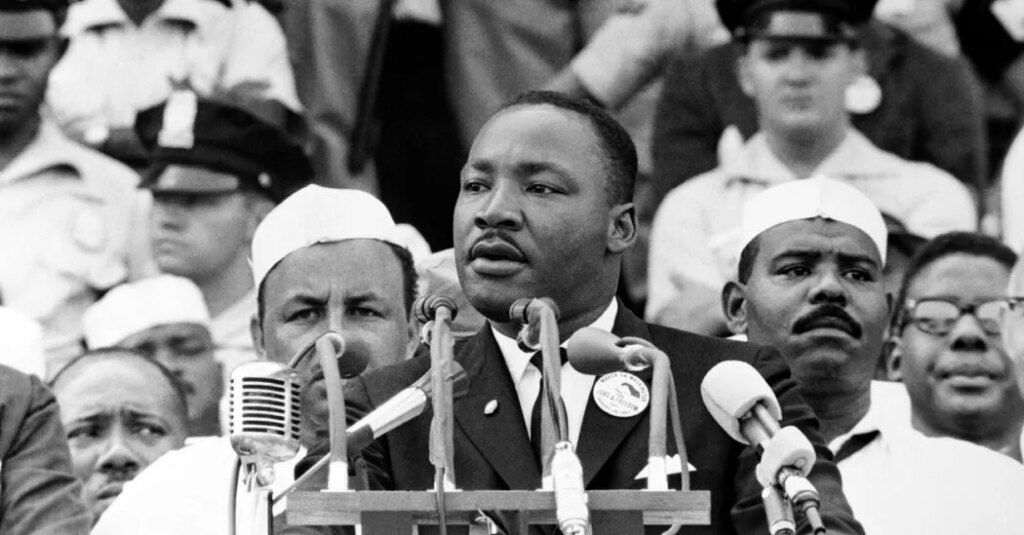
On Aug. 28, 1963, the Rev. Dr. Martin Luther King Jr. stood on the steps of the Lincoln Memorial and delivered a speech whose refrain — “I have a dream” — has soared into the canon of American oratory.
But the night before, he was a man alone in a Washington hotel room, wrestling with what exactly he would say.
For days, King had been brainstorming with aides, who had compiled various themes and motifs into preliminary drafts. Now, he wrote out his version by hand on a yellow pad, heavily crossing out words and whole paragraphs before sending it to be typed up.
King’s draft had long been assumed to have been discarded. But more than six decades later, it has surfaced from a desk drawer of a former aide, Edward T. Clayton, and will be auctioned at Christie’s in January.
The auction house said it expected the document — the only handwritten final draft of the speech known to survive — to fetch more than $10 million. The proceeds will benefit the King Center in Atlanta and other philanthropic causes chosen by the consignor, the aide’s widow, Xernona Clayton.
Spread across a table at Christie’s offices in Manhattan last month, the document looked unassuming — just seven pages filled with blue ink and the rusted ghost of a paper clip in the upper left corner. But the $10 million-plus price, if reached, would put it in a stratosphere associated with rare copies of the nation’s founding documents.
Peter Klarnet, Christie’s manuscript specialist, said that when he first saw it, his jaw hit the table.
“This is the most important manuscript I’ve ever had the honor to handle,” he said. “I can’t imagine anything better.” He paused, before adding: “That I wouldn’t have to steal out of the National Archives.”
The draft is very close to the typescript King carried to the lectern, roughly 20 copies of which are known to survive. Like the typed version, it does not include the words “I have a dream,” part of the ringing second half of the speech that King famously improvised.
It’s unclear whether the densely crossed-out passages, which fill half of some pages, will yield significant new insights into King’s ideas. But scholars who inspected a digital scan of the document provided by Christie’s said it was an extraordinary find.
“When they called me, I was almost in disbelief,” Lerone A. Martin, the director of the Martin Luther King, Jr. Research and Education Institute at Stanford and the senior editor of the Martin Luther King, Jr. Papers Project. “It’s almost like it gives us a chance to get between King’s ears, to get in his mind.”
Drew D. Hansen, the author of “The Dream,” a detailed study of the speech published in 2003, said the document gave him “actual chills.”
“I’ve read the speech a thousand times,” he said. “But seeing some of these refrains in his own hand is electrifying.”
Up until 4 a.m.
Today, “I Have a Dream” is American political scripture, on par with the Declaration of Independence and the Gettysburg Address, both of which King’s text invokes. But before the March on Washington, few Americans had heard King give a full speech.
He and his aides were keenly aware of the high stakes of the march, which was held barely two months after President John F. Kennedy sent the proposed Civil Rights Act to Congress. They were also mindful of the more mundane request that all speakers — including King, who spoke last — limit their remarks to five minutes.
The composition process, according to Hansen’s book, started five days before the march, as King sat with Clayton, Stanley Levison, Clarence Jones and other advisers in New York, Atlanta and Washington, trying out ideas and refrains, including some already in King’s repertoire.
Three typed preliminary drafts produced by aides, which King drew on in the final speech, are known to survive. But until now, Hansen said, there was nothing in King’s own hand beyond a few sentences written on the back of one of the aides’ drafts.
For King, drafting speeches was a collective effort, but the final poetry was all his.
“I don’t mind you criticizing my ideas,” King once said to the civil rights leader Bayard Rustin, who had made an unwelcome edit on another speech. “But I don’t like your criticizing my words, because I’m better at words than you are.”
Hansen, who is not involved with the auction, said the closeness of the manuscript to the final typescript supported that it was a final draft written between the late hours of Aug. 27, when King retreated to his suite at the Willard Hotel after a final meeting with aides in the lobby, and around 4 a.m., when he sent the speech to be typed.
So does the fact, Hansen said, that there are extensive heavily crossed-out passages, with some word choices crossed out multiple times.
“That’s unusual for King in general,” said Hansen, who for his book interviewed four people who helped with the speech’s composition. “But it’s consistent with what people who were there that night saw.”
Hansen noted King’s edits on the third page, where he warns of “the tranquilizing drug of gradualism.” First, he wrote “tokenism” and then crossed it out and wrote “waitism,” before landing on “gradualism.”
“You really see that care for individual words,” Hansen said.
The handwritten draft, like the typed version, includes no trace of King’s most famous edit — the impromptu insertion on the podium of the lengthy “I have a dream” section, which King and his aides had discussed using but ruled out because of time constraints. It does include the famous closing words, “Free at last.”
Hansen said the textual evidence was enough to convince him the document is King’s draft. And then there’s the document’s provenance from Clayton, the public relations director at King’s organization, the Southern Christian Leadership Conference, who is known to have helped with the speech.
“This is not coming from some random file drawer,” Hansen said.
An envelope labeled “speech”
Klarnet, of Christie’s, said he first viewed the document in Xernona Clayton’s office in Atlanta. In a video interview last month, Clayton, who recently turned 96, described how she had found it in her husband’s desk, which she had left largely untouched for decades after his death in 1966.
“He saved everything,” she said.
She first came across the manuscript in the late 1990s, she said, inside an envelope labeled “speech.” She recognized the words immediately but didn’t fully grasp the document’s significance as King’s own draft. She put it back in the desk, she said.
Clayton, who organized events for the S.C.L.C., was close with King and his wife, Coretta Scott King. Film footage shows her presenting a smiling Dr. King with a gift on his 39th birthday, in January 1968. Less than three months later, she helped Mrs. King buy a dress for his funeral, and has described touching up a spot on Dr. King’s cheek with makeup as friends and family approached the open casket.
Over the years, Clayton said, she was frequently asked whether she had King memorabilia to display or sell. But she said she didn’t want to be seen as disrespecting the memory of “a man I loved a lot.”
In recent years, she said, she changed her mind, and in 2024 showed the document to Eddie Bridgeman, her financial manager, who helped arrange the auction.
“Now that I’m older, I’m wiser, and it just seems like something that important ought to be shared,” she said.
The document is being offered by the Still Marching Irrevocable Charitable Unitrust, which Clayton has created to promote causes she champions. Bridgeman, its trustee, said that all proceeds from the sale would support philanthropic efforts, including a museum highlighting her legacy as an activist, broadcaster and community leader.
In the 1960s, Clayton contributed to the campaign to desegregate Atlanta’s hospitals, and in the 1970s, she became one of the first African Americans in the South to host a prime time talk show. She also helped create the International Civil Rights Walk of Fame in Atlanta and founded the Trumpet Awards, to honor African American achievements.
“You don’t have to be Martin Luther King,” Clayton said. “You can help those who are deprived just by being yourself. Just help where there’s a need for help. That’s been my life, and I’m still doing it.”
James L. Walker Jr., a lawyer advising Clayton, declined to comment on the division of proceeds with the King Center or on any discussions with King’s two surviving children, who are known for vigorously enforcing the copyrights on his words and have sometimes fought legal battles with family associates, and one another, over ownership of artifacts.
The King Center, through a spokesman, also declined to comment on financial arrangements. But King’s children are backing the Christie’s sale.
“It is poetic that the past will protect the future,” Martin Luther King III said in a statement included in a Christie’s news release.
“We are also grateful to join with Mrs. Clayton to ensure that the sale of this draft helps support the great work of the King Center and our mother, Mrs. Coretta Scott King, who would be 100 this upcoming year,” Bernice King, the chief executive of the King Center, said in the release.
On Nov. 16, the document will go on public view at the National Center for Civil and Human Rights in Atlanta, followed by displays in Chicago and New York. Clayton said she hoped the sale would drive new appreciation of King’s ideals.
“I think people need to hear Martin Luther King’s words fresh,” she said. “They are good words.”
The post King’s Lost Draft of ‘I Have a Dream’ Emerges From a Desk Drawer appeared first on New York Times.