The 12th in an occasional series of profiles on Southern California athletes who have flourished in their post-playing careers.
A debate has broken out above the empty plates and bowls covering Danny Everett’s dinner table. Is Everett, a former world and Olympic gold medalist, a better chef than he was a runner?
“Chef,” votes Everett’s niece, Anya.
Tiarzha Taylor, Everett’s wife, offers a more diplomatic answer.
“I can’t pick one. They’re both equal,” she says. “And it says something about his cooking that I wouldn’t put Olympian over chef.”
Everett, seated at the head of the table, isn’t sure if he’s being complimented or criticized. Five times he ran a race faster than any man in history before trading his spikes for a spatula 30 years ago. Still, those who have seen him do both say it would take a photo finish to separate his performances in the kitchen from the ones on the track.
Ask Everett and he’ll tell you he was better at running. Cooking, however, is just an extension of that.
“There was a time in the history of running I was the best person walking the earth in that event,” he said with a shrug and a smile.
“But when I left the track, I started to think about what I could do better.”
Few have made as much of both gifts as Everett. For more than a decade, he shared his running with the world, winning three NCAA titles and leading UCLA to two national championships while winning five Olympic and world championship medals.
Now he wants to share his cooking with a wider audience.
For a time, he ran a catering company, did parties and special events, even made a week’s worth of meals for busy families to heat up each night. It was cooking, sure, just like jogging to the bus stop is technically considered running. But making microwave dinners for working mothers is not haute cuisine.
At least not by Everett’s definition.
“Cooking,” he says, “is an art.”
So now the chef is coming home to his hilltop house outside Ojai, one which offers spectacular views of the Upper Ojai Valley and the “Pink Moment,” a brief 10- to 15-minute window when the setting sun casts a pink and purple glow across the Topatopa Mountains that make up his backyard. It would be a stunning backdrop for a supper club or for weddings, anniversaries and other intimate events.
Everett hopes to make hosting those kinds of celebrations the next chapter of his life.
“Everyone that comes, they always have such a great time,” Everett said. “So all that led me back to my own property.
“Once you get here, it feels worthwhile.”
But if the kitchen and what Everett does there have brought joy to others, it has also provided refuge and rehabilitation, nurture and nutrition for the chef. If there is one theme that runs through Everett’s life, it’s that of caregiver.
“My love language,” he said, “is cooking.”
Everett grew up in a home where he witnessed spousal abuse before he and his mother walked away from the abuser when Everett was in the sixth grade. But it was also a home in which meals often served as a ceasefire; the longer and better the meal, the longer and more lasting the ceasefire.
The power of food stayed with him, so Everett later took in two nephews when their mother couldn’t care for them and looked after his father in the final stages of terminal cancer by serving him his favorite meals.
Now he’s dealing with another family crisis. Last month his youngest daughter, who has struggled with mental health issues, pleaded not guilty to an arson charge stemming from a June fire at an Ojai boutique, according to the Ojai Valley News.
“She’s a phenomenal young lady,” said Everett, whose eldest daughter is a paralegal at a social-justice nonprofit and whose only son is a local entrepreneur. “She has so much potential, but she needs a lot of support.”
Everett, who turned 60 on Nov. 1, still has the tall, angular build of a quarter-miler despite having put on a few pounds since his last race nearly 30 years ago. His round, open face seems perpetually creased by either a grin or a furrow, as if he were deep in thought. That mirrors a personality that can quickly jump from silly to serious.
“Danny’s very loyal. He’s always looking out for everyone else,” said Steve Lewis, once a teammate and rival on the track and still a friend. “But at the same time he doesn’t hold his tongue, right? If somebody does anything wrong by him or anyone else, Danny’s going to let you know.”
“Danny is a very interesting human being,” added Bob Larsen, the Hall of Fame coach who recruited Everett to UCLA. “He has distinguished himself in many ways, but he doesn’t really toot his horn, he doesn’t brag. He just lays it out.”
Danny Everett became a world champion by mistake.
In his senior year at Fairfax High, Everett said he was bullied into signing up for the Army after graduation. But before the ink on his signature had dried, he realized he had to get out of the agreement.
“I shouldn’t have done it,” he said.
The only way the Army would let him go was if he was offered a track scholarship, which was about as likely as Everett finding the Loch Ness Monster. He had run just 52 seconds for the 400 meters, he said — good, but not nearly good enough to pay for college.
“I just ran fast enough to win,” Everett said. “I didn’t have to work that hard.”
That changed with a four-year hitch in the Army waiting for him. So Everett begged his way into the elite Arcadia Invitational and won the 400 in 46.79 seconds, shattering the meet record and dominating the best high school sprinters in the country. A few weeks later, he won L.A. City championships in the 200 and 400 meters and by the end of the summer he had run 45.76, dropping his personal best by nearly seven seconds and making him the third-fastest prep quarter-miler in U.S. history.
“Every school in the country was trying to pick him up,” said Johnny Ausbon, the Fairfax coach who pulled Everett out of a Shakespeare class and put him on a track. “I took him straight to UCLA, and we got him out of the Army.”
Everett chose UCLA, he said, because it was the only school where the recruiting pitch had nothing to do with track.
“They said nothing about training. They said nothing about running,” he remembered of the coaches. “Everything was about how I was going to be able to come out and have a degree and work in the real world.”
He left Westwood with more than a diploma though: In three years at UCLA, Everett broke school records in the 400 and 1,600-meter relay in addition to winning multiple team and individual titles. That’s also where he met Taylor, the track team’s student manager, who later became his wife of 30 years.
Taylor, an Alaska state sprint champion in junior high, was the first female student manager for the men’s track team at UCLA, so Larsen made up a rule on the spot: no dating.
“Because if you break up and start dating somebody else,” he said, “it’s chaos.”
That wasn’t a problem.
“Danny and I were just friends for a very long time,” Taylor said. “The thought of dating him never crossed my mind. It wasn’t until a couple of years later that I kind of looked at him in a different way.”
By then, Everett had run his way onto the U.S. team for the Seoul Olympics, finishing a half stride behind Butch Reynolds and nearly a half-second ahead of Lewis to finish second in the Olympic trials. In Korea, Everett finished behind both men, claiming bronze in a race won by Lewis. The trio joined Kevin Robinzine to set a world record in the 4×400-meter relay, giving Everett his only Olympic gold medal, which he now keeps in an upstairs closet.
Everett left UCLA three months later, giving up his senior season and his amateur status to join Lewis and Johnny Gray with the Santa Monica Track Club, where he could make a living from his running.
“I had to pass up a lot of money because you couldn’t run for the university and earn money in Europe,” Everett said. “I was passing up hundreds of thousands of dollars. It didn’t make sense.”
Joe Douglas, a tiny bulldog of a coach, had founded the club 17 years earlier for exactly that reason — to help former college stars extend their careers and make a lot of money while doing so.
“He totally changed my life,” Everett said. “Not only did he change my life as far as making me a better runner, he made us better people. He told us ‘don’t ever be nasty or mean. If there’s a fan, if there’s a meet promoter, never be nasty to them. Let me do that.’
“He taught us how to save our money and he taught us how to be very disciplined and how to look out for each other.”
He also taught them how to run and jump and win, which is why Douglas’ athletes claimed a combined 27 Olympic medals (19 of them gold), 18 World Championship titles, 33 world records and 66 American records before Douglas retired in 2020.
Douglas, who turns 90 on Tuesday, has seen his memory fade, but the athletes who breathed life into his story are still here. So led by Everett, Lewis, NBC sportscaster Lewis Johnson and filmmaker Jonathan Hock, an 11-time Emmy winner, they are trying to drum up support for a documentary about the club and how Douglas used it to change the face of track and field.
“It’s just so important for him to be able to celebrate it. To really get a documentation of the club and the impact on track and field that he made, telling him how he’s impacted our lives and all the things that we’ve done because of him,” said Everett, who would like to see the film finished before the 2028 Los Angeles Olympics.
Under Douglas, Everett went from being a very good sprinter to being the second-fastest man in the world at 200 (20.08) in 1991 and the second-fastest man in history in the 400 (43.81) heading into the Barcelona Games in 1992.
He never ran faster at either distance, nor did he win another world championship or Olympic medal.
Everett went to Spain as the favorite at 400, but injuries to his right Achilles tendon and right foot hobbled him in the semifinals, where he limped across the finish line last. He watched the U.S. break the world record in the 4×400 relay from his home in Calabasas.
After the Olympics, Everett had several surgeries on both Achilles and even tried a form of radical injection therapy that wound up doing more harm than good. So after finishing sixth in his heat of the 400 meters at the 1996 Olympic trials in Atlanta, Everett walked off the track for the last time.
It takes a map, a compass and a lot of luck to find the house Everett and Taylor share at the end of a steep, narrow road that ends just below the mountains southeast of Ojai.
“I’m working on becoming a hermit,” Everett says.
Well, not really. Because the house, which sits at the edge of a 10-acre ranchette, is a beehive of activity, home to five people, five dogs, two cats (that the couple know of) and various wildlife that stop by to visit.
Taylor, who has been with Everett from his first NCAA title at UCLA to that last race in Atlanta, has also been at his side in the latest transition. But she’s hardly been a silent partner.
A former executive director for several corporate foundations, Taylor is currently a board member of the Ojai Valley Hospital Foundation. She is past president of the Ojai Education Foundation, past co-chair of the Ojai Women’s Fund and past vice-president of the Ojai Roadrunners youth track club, among other things. Together she and Everett were honored for their “exceptional public service [and] volunteerism” by the Rotary Club of Ojai, which in 2021 named the couple “Living Treasures” of the community.
“We’re very community-minded,” Taylor said.
For Everett, that community work has included teaching cooking classes for elementary-school students, volunteering with the Ojai Roadrunners track club and coaching at Nordhoff High.
That’s a long way from his early childhood in northeast Texas, where he was primarily known for two things: regularly adopting the stray dogs he found on his way home from school — his collection eventually reached 13 — and helping his grandmother in the kitchen.
His grandmother, Hannah Porter, allowed a young Everett — and no one else — into her kitchen when she prepared family meals, so it was she who taught him most of what he knows about cooking. Everything was made by hand with ratios determined by hand, not a measuring cup, even when baking.
The results never disappointed. It was as if Everett had learned to write music by watching Beethoven or Bach or learned to paint by working with Monet or Cézanne.
“You don’t see people so relaxed and so satisfied as when they’re sitting in front of a delicious plate of food that’s been prepared by someone’s loving hands,” he said. “She was the slowest-moving woman in the kitchen. She took these little steps and I’m like ‘is she ever going to get these meals made?’
“People, they were happy, they were relaxed, there was this joy and I really do, at heart, love bringing that out of people.”
Porter eventually left Texas for Fresno so when Everett’s family moved west to South Central Los Angeles, the youngest Everett, still in grade school, took over cooking for everyone.
He’s never stopped.
“I always thought that there’s nothing in my life that anyone would learn from,” Everett said. “But now I have some insight on why I am the way I am. ‘Oh yeah, I cook, let’s have a meal.’
“But when you start really digging into these questions, it’s not only what are you doing, it’s now why are you doing it?”
At first it was just for family and friends, but before long Everett decided he wanted to share his cooking. At the Los Angeles Culinary Institute he trained in classic French cooking, then became a pastry chef at the Ritz-Carlton.
But he felt restrained by the routine, recipes and rules of a restaurant. He saw himself more as an avant-garde artist, not a house painter. So after running his last race, he started a catering company, SoulFête!, where he was limited only by his imagination.
“I call myself the reluctant caterer. It’s all word of mouth,” said Everett, who has staged pop-up events, hosted weddings and other celebrations on his property and recently organized an 85th birthday party for Larsen, his old UCLA coach.
His favorite dish to prepare is steak, partly because it can be made and seasoned so many ways. He also makes a signature layer cake he calls Belle Loreve, the name once attached to his property and one created by combining the last three letters from his wife’s surname and the first three letters of his family name.
“Cooking, it’s almost like a first memory,” he said.
“There’s very few times in my life that I can think of that I wasn’t also cooking.”
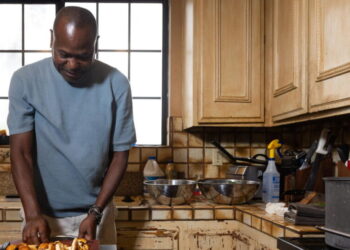
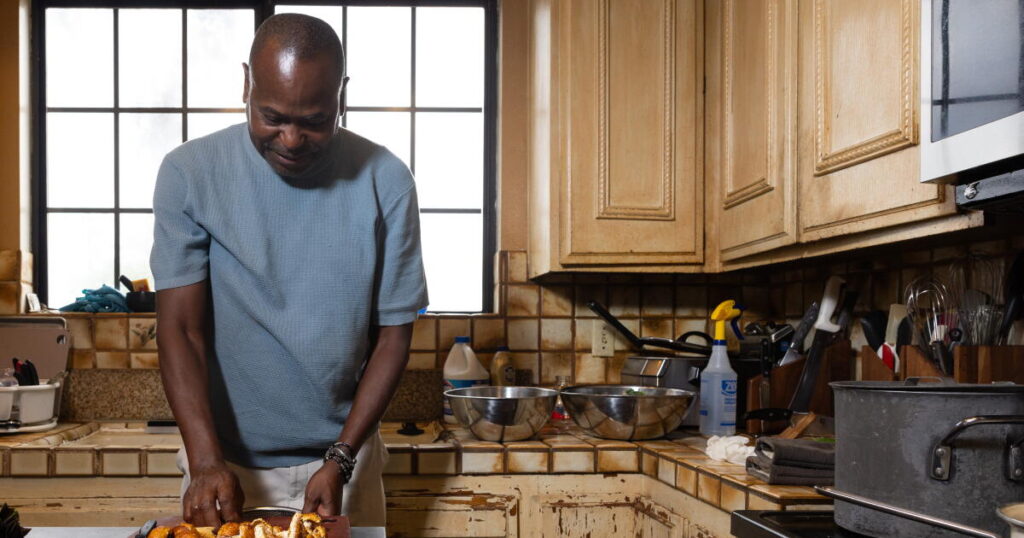
It was in preparation for another meal that Everett found himself dodging raindrops on a late-summer morning as he perused the produce at the Ojai Farmers Market. He was making a late lunch for a challenging group of guests — one omnivorous, one vegetarian and one vegan — so he had to get creative, settling on a main dish of risotto with chestnut mushrooms and vegetables.
An hour later, smoke is billowing out of a backyard barbecue while the tiny kitchen is a riot of brightly colored peppers, vegetables and spices. Everett approaches each meal the same way he did a race on the track, with an eye toward perfection.
“How can I make it 1% better?” he asks. “When I was competing, I enjoyed it in the moment. But when I left the track, I started to think about what I could do better.”
He’d like to return to hosting events at his hilltop home and has begun rehabilitating the landscaping, much of which was destroyed in 2017 when the massive Thomas fire charred everything but his house.
“As I’m going through this journey of getting my garden all pulled together, I want to share it with people,” he said. “And I want people to not only see how differently food tastes when you grow it yourself.
“Having someone curating that [who] loves to cook, and invite[s] you to my place, that is really a unique experience.”
In a way, Everett’s culinary career has come full circle, just as his best track races did. The 400 meters is unique among sprints in that it finishes where it started, and now the former quarter-miler wants to bring his skills as a chef back home to where they got their start too.
Much remains to be done to make that happen. There are gardens to plant, permits to acquire, tables and chairs to be bought and menus to plan. When everything’s ready, Everett could probably charge a couple of hundred dollars per plate for his meals. That’s a bargain, Taylor says, for food worthy of an Olympic medal.
“You never know who is going to drop by,” Everett said, standing by his stove. “You never know.”
The post ‘My love language is cooking.’ How Olympian Danny Everett found his culinary calling appeared first on Los Angeles Times.