Nearly 50 years after the Supreme Court said it was unconstitutional to require schools to post the Ten Commandments, Texas has become a 21st-century experiment in mandating Scripture in the classroom.
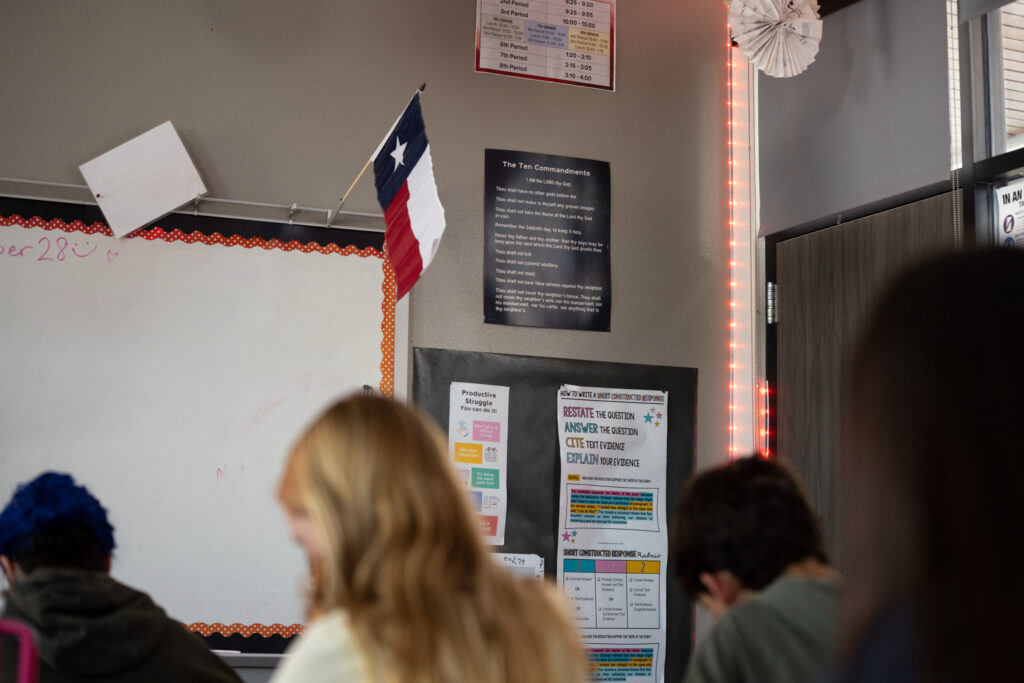
The state passed a law last year requiring a version of the King James Bible’s Ten Commandments to be posted “in a conspicuous place” in every public school classroom.
Advocates for the separation of church and state have asked the Supreme Court to overturn the law, which survived lower-court challenges earlier this year and was widely put into effect this fall.
The Supreme Court has yet to say whether it will take the case. In the meantime, posters displaying the commandments are going up in schools across the state.
A conservative Christian group has launched a digital “compliance tracker,” using tips from the public to monitor Texas’s 9,000 public schools. Websites are selling alternative posters for teachers to hang alongside the commandments; some display other “moral teachings,” such as the Five Precepts of Buddhism or the United Nations’ Declaration of Human Rights, while others proclaim of the mandated display: “This poster is illegal.”
Some Texans describe the Ten Commandments posters, which must be at least 16 inches wide and 20 inches tall, as the first step toward fixing what they call a broken American morality. Others are running for office on a platform that opposes the posters or suing to fight what they call religious supremacy.
Many schools and teachers are trying to remain neutral on the new displays. In some districts, teachers are being given official guidance that if students ask about the displays, they are to be told the posters are required by state law and to ask their parents for more detail.
“They just go on the wall in the classroom. They are not part of a lesson, instruction, they are not evangelizing. We’re complying with the law,” said Michael Novotny, the superintendent of the Salado Independent School District, a suburbanizing, 2,800-student system north of Austin. “I’ve not heard from a single parent or student for or against, and I expect it will be the same if the [Supreme Court] says they should come down.”
Mark Chancey, a religious studies professor at Southern Methodist University who focuses on religion in public education — especially in Texas — said the widespread implementation of the law is “extraordinary.” No such sweeping effort to post Scripture, and no similar enforcement, have happened in the history of U.S. public schools, he said.
Texas is one of four states that passed laws in recent months requiring the Ten Commandments be hung in public classrooms. An Arkansas judge partially halted that state’s law earlier this year. Alabama’s requirement goes into effect Jan. 1. Louisiana was the first of the states to pass such a law, in 2024, but courts held off full implementation until earlier this year.
Tennessee this year passed a law allowing schools to post the commandments, a measure similar to existing laws that have passed since the early 2000s, in North and South Dakota and Oklahoma. All those states tried in the past year to make the posters mandatory but failed.
Texas has been a major testing ground for infusing religion into public education, recently passing laws allowing public schools to replace guidance counselors with chaplains, mandating that students read Bible verses and giving money to districts that adopt a Christian curriculum for their elementary school students.
State Attorney General Ken Paxton (R), who is running for U.S. Senate, last year urged students to recite the Lord’s Prayer in school and said schools should post the Ten Commandments. His Democratic Senate opponent, state Rep. James Talarico, opposes the commandments law, telling Joe Rogan last year that the posters “will create a whole new generation of atheists.”
The law does not order school districts to purchase the posters. Instead, it says schools must put them up if they are donated to the school. Advocacy groups have been fundraising and organizing for a year and a half to get posters into schools.
The Texas statute includes the same funding mechanism as a Kentucky statute overturned by the U.S. Supreme Court in 1980, which also required the posting of the Ten Commandments in public school classrooms.
In ruling the Kentucky law unconstitutional, the high court used a standard in place for a half-century that said government actions need to have a secular purpose. Today’s conservative Supreme Court majority tossed that standard in 2022 and said the role of religion in government should be guided by “history and tradition.”
The high court in recent years has allowed an expansion of the free exercise clause of the First Amendment, which is meant to protect the existence of religion in the public square. One recent ruling says a football coach could pray with athletes on the field, and another that businesspeople could deny services to some customers if serving them would violate the businesspeople’s religious beliefs.
The justices have not decided whether to hear the challenge to the Texas Ten Commandments law.
More than a dozen Texas families of multiple faiths have asked the court to block the law, saying it violates the First Amendment ban on the government establishing religion.
Barbara Roberts, a longtime Republican activist who supports the posters, said she sees them as “a step towards encouraging school systems to start thinking seriously about why there is so much trouble, violence, mass shootings, kids fighting and lack of discipline in public schools. Just waking people up.”
“We’re in a battle for the soul of our country,” she said.
Some of the lawmakers who sponsored the legislation have called it a step toward weaving religion more fully into public life.
“There is no such thing as ‘separation of church and state’ in our Constitution,” state Sen. Mayes Middleton told a Christian magazine last year. This year, he is the Republican nominee to succeed Paxton as attorney general, the state’s highest-ranking legal authority.
Middleton did not return requests for comment last week.
Roberts said she spent $60 to buy a box of 30 posters this fall for the walls of Barbara Bush Elementary School in Houston. When she learned they had not been put up, she went to the school and approached a staff person outside who was wearing a cross.
“I thought: ‘Okay, if you’re wearing a cross, you might be a Christian,’” Roberts recalled in an interview. She then got legal help to write a letter to the superintendent of the school district, noting the law is in effect. The posters soon went up at Barbara Bush, she said.
Pew Research earlier this year found that Americans are split almost evenly over whether the Ten Commandments should be displayed in public school classrooms, with 50 percent approving and 48 percent opposing.
Americans were similarly split on whether teachers should be allowed to lead students in prayer — 53 percent oppose, 47 percent approve. A far lower number, just 8 percent, approved of mandated teacher-led prayer. Pew’s survey didn’t ask about laws requiring the posting of the commandments.
Americans’ views on the role of Christianity in public life vary widely depending on the wording of poll questions. Pew finds 17 percent of adults say Christianity should be declared the official national religion — up four points from two years ago. In 2022, 45 percent said America ”should be a Christian nation.”
Amy Taylor, a middle school language arts teacher in Denton, north of Dallas, said she is running for the state Board of Education because of the commandments mandate and other issues, such the ballooning list of books banned for public school use.
“I’m watching all these pressures to control what happens in classrooms in Texas that seem to be more about controlling people’s individual lives rather than helping students reach their potential,” she said.
The posters went up in her district this fall. School officials emailed teachers guidance emphasizing that the posters were not a district choice, “are not instructional material” and are not part of any lesson plan.
“We put this thing in the room and said: ‘We’re not going to talk about it,’” Taylor said. “Students are like, ‘They have to put that on the wall.’ They know the legal requirements.”
She said she strongly opposes what she sees as the state pushing and elevating one religious group over others in a diverse society.
“Though no one has said anything, I know there is a kid who in their heart thinks ‘I’m not normal here,’ because they’re Catholic or Hindu or Muslim,” Taylor said.
Ted Lowe chokes back tears when he talks about his two young daughters going to class in their Austin-area public schools with the posters on the wall. Lowe, who is Jewish, and his wife, Rebekah, who is Christian, are among the families suing the state over the law. A federal court initially granted them an injunction, halting the posters from going up. But in April a federal appeals court upheld the Texas law.
“It hit me at the time that I failed as a dad,” Lowe said, his words halting. “We want to protect our kids.”
On Back to School Night in September, he took a photo of the poster on his child’s classroom wall, its white letters against a black background. “I AM THE LORD thy God,” began the list. Next to it was a similar-size poster with classroom rules.
“We respect each other.”
“We are a team.”
The Lowes declined to make their daughters available for interviews. The elder of the two, in particular, is “angry,” said Rebekah Lowe, who works at a Christian publishing firm that creates curriculum for churches.
“She thought: ‘Oh good, my rights are upheld,’” when the law was temporarily paused, Lowe said. “Now she has a visible reminder that they aren’t.”
The post Ten Commandments posters make Texas a test site for religion in schools appeared first on Washington Post.