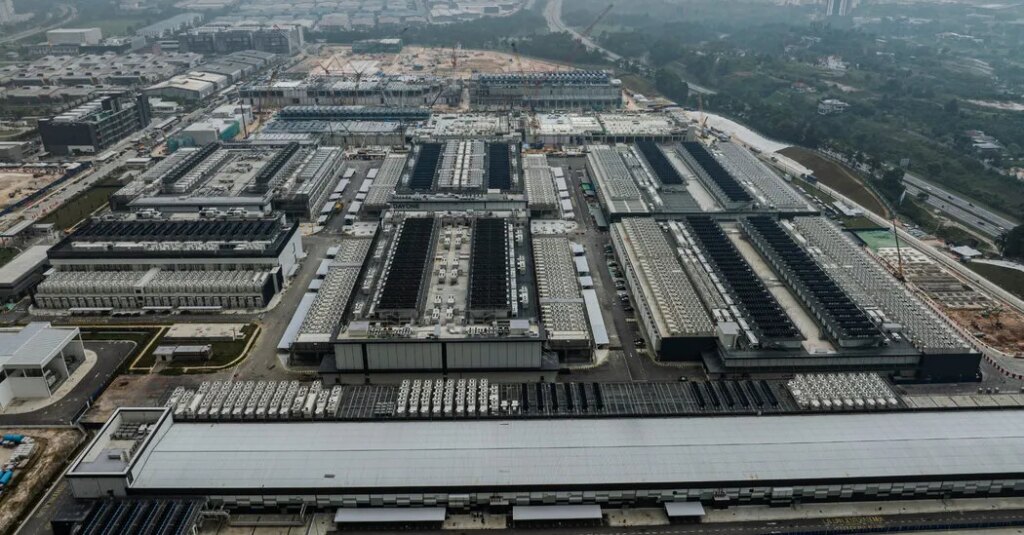
Across a stretch of southern Malaysia once carpeted with palm-oil and pineapple plantations, signs of China’s global technology ambitions are taking shape.
More than 15 cranes tower over 100 acres of excavated earth, where DayOne, a company with corporate roots in one of China’s biggest data center operators, is building a sprawling complex. A short drive away, at the edge of dense tropical forest, hundreds of workers are completing another facility expected to serve Chinese tech companies.
Inside these data centers will be some of the world’s most advanced artificial intelligence chips. The semiconductors, made by Nvidia, are largely banned from shipment to China under American export controls. Yet those restrictions generally do not prevent Chinese companies like ByteDance — DayOne’s biggest customer — from gaining access to the same chips in data centers outside China.
That distinction has helped turn Malaysia, a country of 35 million people, into an unlikely frontier of the A.I. boom. Drawn by cheap land and electricity, and proximity to undersea cables that carry internet traffic to China and the rest of the world, technology companies are pouring billions of dollars into the country.
Malaysia has carved out an uncommon position in an A.I. industry increasingly divided along geopolitical lines between China and the United States. Rather than choosing sides, it has welcomed both.
The frenzy has reshaped Malaysia’s economy and landscape, raised fears about strains on electricity and water supplies, and drawn scrutiny from American officials concerned about Chinese access to advanced A.I. chips.
Nowhere is that transformation more striking than in Johor, the southern state at the center of the building boom. Across the state, 65 data center projects are operational, under construction or in various stages of planning and approval.
The facilities already consume more than two gigawatts of electricity, enough to power more than one-third of Malaysian homes. If all planned projects are completed, demand could exceed 10 gigawatts, according to Invest Johor, a state agency, making it one of the world’s largest concentrations of computing power. Chinese and Western tech companies are expected to account for roughly equal shares of that capacity.
“This is really mind-boggling and beyond imagination,” said Steven Tan, chief executive of Pro3c, a Taiwanese company that makes optical parts for Nvidia chips. “Everyone is coming here.”
American technology giants, including Microsoft, Google and Oracle, are investing heavily in Malaysia to be closer to Asian customers. At the same time, the country has become an offshore computing hub for Chinese companies like ByteDance, Tencent and Alibaba. In some of Johor’s industrial parks, infrastructure serving American and Chinese companies is being built almost side by side.
“This is the only place in the world at the moment where we are seeing this,” said Lee Ting Han, a Johor government official involved in data center approvals. “What makes Malaysia so special for this A.I. wave at the moment is our nonaligned neutral status.”
The China Boom
Malaysia’s boom began around 2021. After neighboring Singapore banned new data center construction because of electricity constraints, companies soon began moving across the border.
Gary Goh, who runs a Malaysian data center consulting firm, recalled searching Johor for land near transmission lines to get access to the electricity they needed. “There’s ‘K-pop Demon Hunters’ — I’m the transmission line hunter,” he said.
Chinese companies arrived first, including what would become DayOne. Originally an international subsidiary of GDS Holdings, one of China’s largest data center developers, it announced its first Johor facility in 2021 to help Chinese customers expand overseas.
Renamed DayOne in 2025, it has become one of Malaysia’s largest data center developers. At one Johor site, DayOne bought an 18-hole golf course for a new facility.
Its expansion coincided with growing tensions between Washington and Beijing. In 2022, the U.S. government imposed export controls that prevented Nvidia from selling its most advanced chips directly to China, seeking to slow its A.I. development.
DayOne, which has headquarters in Singapore, illustrates how Chinese firms have maintained a foothold in the A.I. data center boom despite American restrictions. It has raised billions from international investors, including the American investment firm Coatue Management and Japan’s SoftBank, and recently announced plans for an initial public offering.
Yet DayOne maintains strong ties to China’s tech industry. GDS remains a major investor, alongside Hillhouse Investment, a Singapore-based firm founded by the Chinese billionaire Zhang Lei. Jamie Khoo, GDS’s former chief operating officer, now leads DayOne, and William Huang, GDS’s chairman, sits on its board.
ByteDance, TikTok’s parent company in China, is DayOne’s biggest customer, according to analysts. In a recent securities filing, DayOne said an unnamed customer operating a “leading short-form video” service accounted for nearly 70 percent of its revenue in the first half of 2026.
ByteDance did not respond to a request for comment.
DayOne said it supplied land, buildings and electricity and rented the space to customers, which supply their own chips and equipment.
Louis Hung, a DayOne spokesman, said the company “does not purchase, sell, export or engage in any commerce involving computing chips, nor does it install chips or servers into its facilities.” He added that its shareholders, customers, suppliers and board were diverse and international.
In April, DayOne joined Nvidia’s data center partner network, which helps develop facilities for handling the most advanced A.I. computing gear.
Nvidia said remote access to computing capacity hosted abroad is consistent with American export controls because the chips remain outside restricted countries. The business “promotes U.S. national security and brings tens of billions of dollars and high-paying jobs home,” the company said in a statement.
The American Bans
American officials have taken notice of Southeast Asia’s role as a hub for offshore data centers.
A report circulated within U.S. government agencies identified direct or indirect Chinese ownership in 38 of 128 data center projects across Southeast Asia. It estimated that the computing power available to Chinese companies through Malaysia, Thailand, Vietnam, Indonesia and Singapore was nearly as substantial as that from all of mainland China, where U.S. export restrictions have held back development. The report was shared with The New York Times.
In July, Michael Kratsios, a White House adviser involved in A.I. policy, accused the Chinese company Moonshot of using high-end chips in Thai data centers to train its models.
Jimmy Goodrich, a former semiconductor industry executive and now a researcher at the University of California, San Diego, said U.S. export controls failed to adequately address Chinese companies’ use of chips through overseas data centers. Enforcement has instead focused on chip smuggling through Southeast Asia.
“None of this is illegal,” he said. “It’s a gaping hole in export controls that nobody has fixed. These loopholes give China access to massive computing power and room to catch up in the A.I. race.”
This week, The Times reported that an executive for Megaspeed, a Singapore-based data center company operating in Malaysia, was under investigation for steering advanced Nvidia A.I. chips to China, and could be a Chinese intelligence asset.
DayOne warned investors this month that new U.S. restrictions on remote access to A.I. computing power through countries like Malaysia could undercut demand and hurt its “financial condition.”
The Fallout
Across Johor, transmission gear, cooling systems and backup generators fill building sites as giant gray concrete and steel structures rise.
Growth has been so rapid that local communities are fed up.
Malarispary Gunasegara, who lives across the street from a construction site for the Chinese data center company ZDATA, said dust pollution was so bad she could no longer leave her windows open.
Visalini Kuppusamy, a teacher at a nearby preschool, said children could not play outside during heavy construction.
After residents complained, ZDATA offered free car washes.
Worker safety issues have also emerged. On New Year’s Day 2024, a worker for a Chinese state-owned construction firm died at a DayOne site after falling 23 feet from a temporary structure, according to a report by the Johor Department of Occupational Safety and Health.
DayOne said in its IPO filing that “several incidents at our construction sites” involved worker fatalities without specifying where.
At another DayOne site, 60 workers alleged they were owed roughly $125,000 for three months of work, according to a police report reviewed by The Times.
Malaysian officials have begun questioning the pace of growth, with the government recently imposing what some officials described as a de facto moratorium on new data centers. Under the policy, only facilities with their own off-grid power sources and independent water supplies for cooling will be approved — a difficult threshold to meet.
For now, dozens of approved projects are moving ahead.
Eric Yong, a real estate agent who shifted his focus to data center development in 2023 and regularly travels to China to meet clients, was asked whether geopolitical tensions complicated business.
Quite the opposite, he said. U.S.-Chinese tensions are driving business.
“Only when it’s complicated do we have things to do,” he said.
Zunaira Saieed contributed reporting from Malaysia.
The post How One Country Became the Unlikely Crossroads of the Global A.I. Boom appeared first on New York Times.