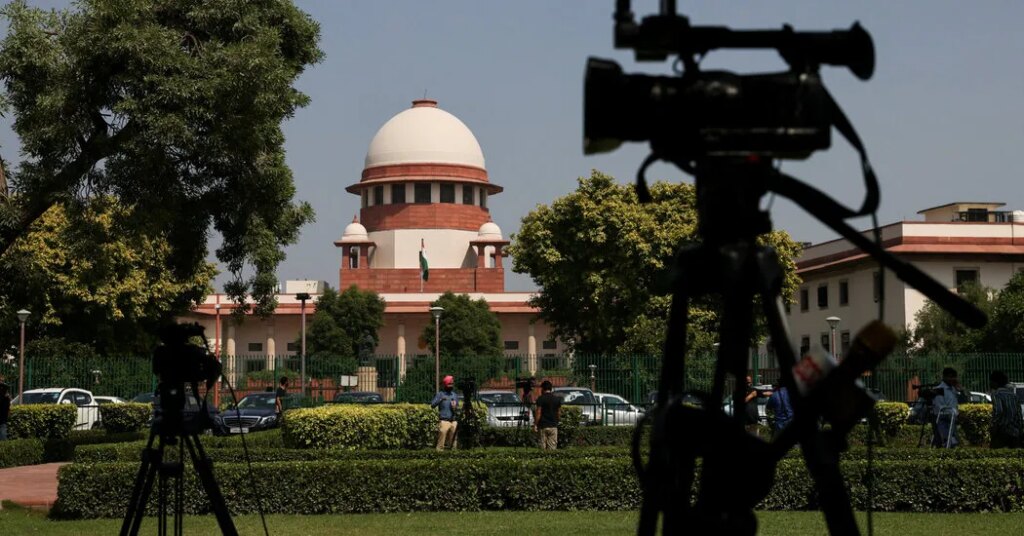
An association representing 21 of India’s established news organizations has asked the country’s Supreme Court to strike down provisions of a new privacy law, warning that it would cripple investigative journalism and force newsrooms to close.
The challenge brings some of India’s most powerful media organizations into a legal battle that had until now been led largely by free-speech activists and smaller independent news outlets.
The media coalition includes Network18 and NDTV, owned by the billionaires Mukesh Ambani and Gautam Adani, respectively. Critics have derided both as “Godi media,” a pejorative term for news outlets perceived as overly deferential to Prime Minister Narendra Modi.
Their involvement adds a new dimension to the dispute. A challenge once driven by journalists who have often found themselves at odds with the government now has the backing of media companies controlled by two of India’s most powerful businessmen, whose perceived proximity to Mr. Modi has long raised questions about the independence of their news outlets.
At a hearing on Tuesday, lawyers for the Digital News Publishers Association said the law would make it nearly impossible for journalists to do their jobs, and called it a “complete regime of pre-censorship.”
The publishers argue that the privacy law, set to take effect in May 2027, treats news organizations like ordinary commercial businesses, requiring journalists to obtain explicit permission from people before reporting on them.
That could mean asking politicians, business executives and other powerful figures for permission to investigate their activities. Even after a story is published, those involved could withdraw their consent and demand its removal, the publishers said.
“What is the point if I have to ask for permission and for consent?” Madhavi Divan, a lawyer representing the association, told the court. The law “is changing the whole concept of what is news.”
Since Mr. Modi came to power in 2014, concerns about press freedom in India have intensified, fueled by legal and regulatory pressure on journalists, physical attacks, online harassment and growing restrictions on independent reporting.
First drafted in 2018, the privacy legislation was meant to fill a major gap in India’s personal data protections. Previous safeguards, scattered across outdated information technology rules, were limited and “super dated,” said Thomas Vallianeth, a prominent privacy lawyer.
The new law established a comprehensive framework governing how organizations collect, store and use personal data, imposing stricter requirements on companies like social media giants Meta and Google as well as e-commerce sites like Amazon. The government has not disclosed which companies the new law would affect.
But legal experts say broad, vaguely worded exemptions give the government and its agencies considerable leeway to operate outside the law’s protections.
Versions through 2022 explicitly exempted news-gathering activities. But the final law did not include those protections.
“This act was not meant for journalism at all,” Ms. Divan said. “If we have to ask for permission, newsrooms will shut down.”
Chief Justice Surya Kant, one of the three judges hearing the case, questioned how the court could protect such exemptions from misuse.
“How will you ensure there is no misuse?” he asked, saying the court must balance the rights of “innocent citizens” against those of the news media.
Ms. Divan responded that journalists already face legal and regulatory limits. “We face the consequences if there is something wrong or incorrect or inaccurate,” she said.
The challenge has also been brought by Yukta Mudgal, an independent journalist based in New Delhi who said she relies on public records and information obtained through India’s right-to-information system. In her petition, she warned that the law “poses a real and imminent threat to her ability to report.”
The media group’s 724-page submission, reviewed by The New York Times, raises concerns beyond the consent requirement.
It argues that the law gives the government power to demand raw data from newsrooms, potentially exposing confidential sources and whistleblowers. It also said changes to public records rules could let government agencies withhold information on privacy grounds, undermining a crucial tool for exposing corruption and wrongdoing.
India ranks 157 out of 180 countries in Reporters Without Borders’ World Press Freedom Index.
Journalistic content has also been removed from social media more often this year, and a recent rule change gives online platforms just three hours to comply with certain takedown orders.
At the same time, media ownership concentrated in the hands of business tycoons with close ties to the government has fueled concerns about editorial independence. One prominent example was Mr. Adani’s 2022 takeover of NDTV, a television network long known for scrutinizing the Modi administration.
On Monday, an Indian court ordered the removal of “The Friendship Files,” a 36-minute film posted by Sabeer Bhatia, a co-founder of Hotmail, that accused Mr. Modi of favoring Mr. Adani. The order followed a defamation lawsuit by Adani Enterprises. The court also directed YouTube, X and Instagram to remove several posts about the film.
The post India’s Media Giants Join Fight Against Modi’s Privacy Law appeared first on New York Times.