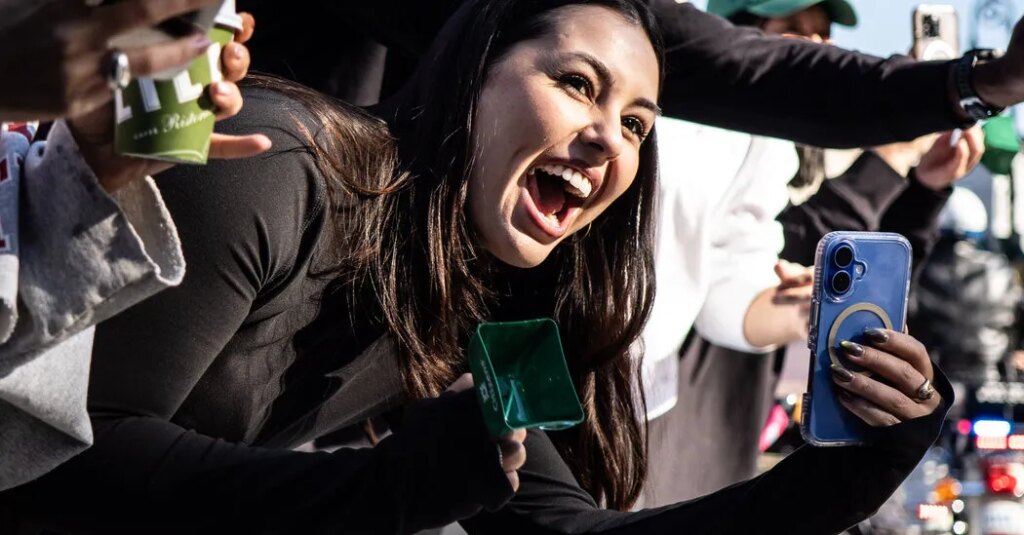
As runners take to the streets on Sunday for the New York City Marathon, the methodical thudding of feet on pavement will be punctuated by the distinct ringing of an unlikely talisman: the cowbell.
“The sound of a marathon, if you close your eyes, is probably lots of people cheering against the backdrop of a cowbell,” said Jack Fleming, the chief executive of the Boston Athletic Association, which puts on the Boston Marathon.
How, exactly, did the lowly cowbell ascend to the sidelines of such an iconic race? How did such a pedestrian instrument become the signature sound of major marathons around the world?
The answer is that nobody seems to know.
Nick Synan, the founder of the Upper East Side Run Club, theorized that perhaps the cowbells used at marathons descended from farmers, who employed them to guide their herds home to the barn.
“Not to say that you’re comparing runners to cattle, but sometimes you’re trying to just guide them along the course,” he offered.
The cowbell’s evolution into an accessory of sports spectatorship began in Europe, specifically Switzerland, Austria and Germany, when ski racing first became popular about a century ago, according to Elisabeth Halvorson, founder of the online retailer cowbells.com, who described herself as “the global expert on cowbells used at sporting events.”
“During the winter, the cowbells are hanging in the barn because they only use the cowbells during the spring and summer for locating the cows,” she said. “Mittens don’t clap. So to cheer on the racers, the families would go into the barns and get the cowbells.”
But how did the bell get from the ski slope to the marathon course? Even Ms. Halvorson could not say. But both she and Cici Bevin, the president of Bevin Bells, which has been making bells since 1832, surmised that from winter sports, the cowbell made its way to cycling — a popular summer sport in the Alps — and from there to road racing.
“There’s plenty of cattle that still wear cowbells, and we sell a reasonable number of bells for livestock,” Ms. Bevin said. “But by and large, the vast majority of our cowbells right now is for cheering at events.”
Regardless of how the cowbell came to play such a large role in marathon spectating, it has become fully ingrained in the sport. Mr. Synan, who ran his first New York City Marathon in 2013, said that any celebratory sound was helpful in breaking up the monotony of placing one foot in front of the other for hundreds of blocks. But he said he was especially fond of a clinking cowbell.
“I feel like sound kind of motivates you during the race, and so I’m definitely attuned to hearing cowbells,” Mr. Synan said. “It’s kind of like a drum beat of some sort.”
Carey Pinkowski, the executive director of the Bank of America Chicago Marathon, said he first remembered seeing cowbells on the course in the late 1990s — and the marathon quickly embraced them.
The bells are popular souvenirs, he said, because they are relatively cheap to buy in large quantities, can be personalized with logos and last a long time. They are also given away in bulk to fans in cheering sections and to the runners themselves, he said.
But Mr. Pinkowski also offered a word of caution, after enthusiastically employing a cowbell along the sideline of a 20-mile race in September.
“I got two really significant blisters on both of my index fingers,” he said. “If I’m in that same position, I need to put a Band-Aid around my index finger.”
Mr. Fleming, the Boston Athletic Association executive, said that 15 years ago, the cowbell overtook thunder sticks and plastic pompoms because it was reusable. Plus, it made cheering a little easier, since it only required one hand to operate.
“It gives you a break, I think that is a big part of it — you can continue to cheer and celebrate someone while also taking a sip of water or maybe looking at your phone at the same time,” he said, before worrying that he was discussing cowbells too seriously.
Mr. Fleming noted that his colleague kept a cowbell collection on her desk. Each bell came from a different race around the world — and each produced a slightly different sound.
“This one is high quality,” Mr. Fleming said after grabbing a commemorative cowbell for a 5K race hosted by the New York Road Runners, the nonprofit that organizes the city’s marathon. The cowbell’s ring sounded purer than the metallic clanging of the other bells.
Mr. Pinkowski, the Chicago Marathon executive, said that almost everyone at the office seemed to have a cowbell. But after the marathon runs its course each year, there is nary a hint of chiming in the halls.
“I think for a week after the marathon, in our office, nobody rings the cowbell,” he said. “I think there’s a little bit of a moratorium on cowbell.”
The post The Only Prescription for Marathon Watchers? More Cowbell. appeared first on New York Times.