THE CREATIVITY CON: How Innovation Became America’s Biggest Racket, by Thomas Frank
Between 2017 and 2024, a North Carolina man named Michael Smith signed up thousands of bot accounts to music platforms like Spotify. He then had those bots stream hundreds of thousands of songs he had made using artificial intelligence. As one group of indefatigable bots listened to tracks by another group of indefatigable bots, Smith collected the royalty payments — more than $8 million for A.I.-generated songs that were streamed billions of times. He was recently sentenced to 18 months in prison for fraud.
Thomas Frank cites Smith’s scheme toward the end of “The Creativity Con: How Innovation Became America’s Biggest Racket” as the perfect encapsulation of our possible A.I. future — a postindustrial world whose voracious energy demands will destroy the planet while robots sing for one another and keep humans out of the loop.
Lucrative sounds for robots are a far cry from the nonremunerative post-punk music that Frank listened to in the late 1980s and 1990s, when he helped found The Baffler, a magazine dedicated to excoriating what he calls the era’s “shallow, packaged nonconformity.” He fondly remembers the magazine’s old office on Chicago’s South Side, housed in a refurbished parking garage and filled with found furniture: “We ordered our fried chicken at a shop with bulletproof glass.”
Ah, yes — the gritty Gen X-er keeping it real by rejecting the siren songs of consumerism and gentrification. Frank, I should say, is a terrific writer. He is scathing, witty and entertainingly ruthless. I remember when his acid critiques served as satisfying antidotes to the cheerful boosterism for “innovations” like globalization and the dot-coms.
The thing is, American culture is no longer dominated by the bloated optimism that Frank is so skilled at skewering. The bland “win-win” clichés of the ’90s have been eclipsed by MAGA grievances and right-wing nihilism.
Frank concedes that something has decisively changed. In the second half of “The Creativity Con,” he says that The Baffler’s ’90s-era “creative industry” targets — academia, the music business and the mainstream media — are now “in shambles.” Yet much of this book is dedicated to railing against pundits who made names for themselves a couple of decades ago, like the “creative class” theorist Richard Florida and the British “New Labour” consultant Charles Leadbeater.
Frank takes evident pleasure in ridiculing Leadbeater’s blithe pronouncements about “innovation and creativity” as “the wellsprings of economic growth and productivity.” Leadbeater’s comments sound woefully out of touch in the age of Brexit and Trumpism, and no wonder: He wrote them in 1999.
This is where the book’s two objectives sit uneasily together. On the one hand, Frank wants to trace the history of how paeans to creativity and innovation provided ideological cover for educated elites. Fields like advertising and management theory were cheerleaders for novelty. By promoting their vision of the economic future, the mandarins of the professional-managerial class could privilege white-collar “knowledge workers” like themselves while pooh-poohing blue-collar interests. They could speak the language of democracy — creativity is possible for everyone! — while embracing neoliberal economics despite its attendant widening inequality.
Sure, these elites may have insisted that they were simply recognizing an inevitable transformation. But Frank argues that they propagated “a hostility to manufacturing” and “a gross bias against working people” whose consequences “we are still enduring today.”
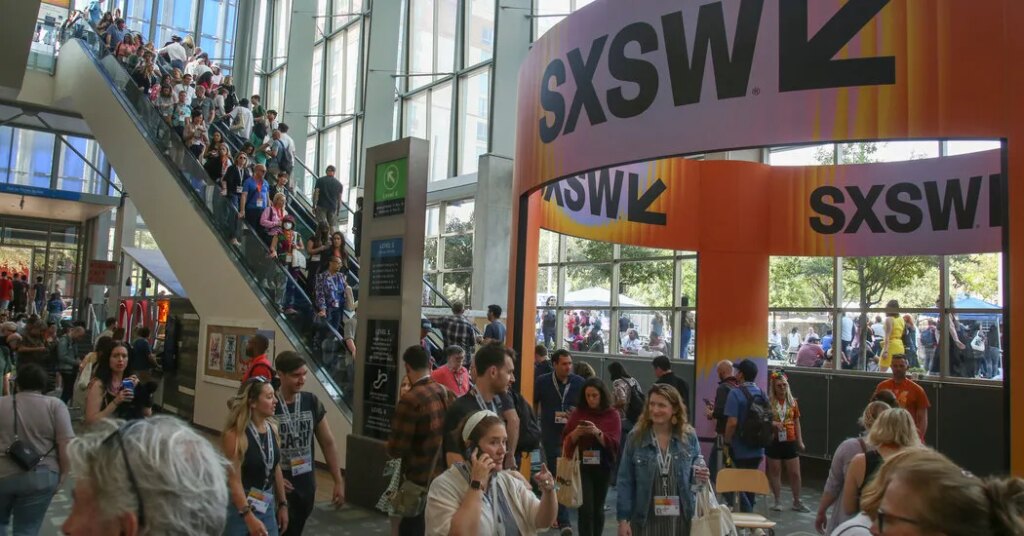
Which leads us to the other thread of Frank’s book: the polemic. Not only does he want to show how buzzwords about innovation were silly and dangerous before the Trump era; he also maintains that they’re silly and dangerous now. “The Creativity Con” begins and ends with the 10 days he spent in 2023 at the technology and culture festival South by Southwest in Austin, Texas, where, perpetually irritated, he derides everything from the selfie-takers in front of an orange-and-pink mural — “leaping in the air, as if buoyed by joy” — to the “carnival” of luxury brand sponsorships. Yes, it all sounds pretty annoying! But also: Who cares?
Frank rightfully points out how all the pablum about the importance of creativity never translated into properly valuing “genuine human creativity.” He cites Apple’s “Think Different” campaign from 1997 as the ultimate expression of this discrepancy. When the innovations of the internet and social media started devouring the economic foundations of actual industries like music and journalism, distress signals were met with “blank indifference,” Frank writes — proof that a lot of the “creativity con” was just that: cynical and vapid corporate-speak, designed to make Americans feel exceptional and superior to laggards in other countries.
But Frank’s book isn’t mainly about the cratering of the old creative industries or the rise of an extremely online influencer class. “The Creativity Con” extends a point he made in his 2016 book, “Listen, Liberal: Or, What Ever Happened to the Party of the People?,” which decried the modern Democratic Party for turning “creativity” into its “defining virtue.” A decade later, he’s still shaking his head at former President Barack Obama, whom he labels — along with the disgraced entrepreneur Elizabeth Holmes — “an innovation idealist.”
Frank holds the so-called innovation Democrats wholly responsible for the backlash that came next. Their preening liberal condescension, he suggests, pushed forlorn blue-collar voters to throw in their lot with Donald Trump, whose administration has brought back coal, tariffs and measles. But Frank, an avowed lefty, is so disgusted with the president that he needs to tether him to “the creativity con,” too. So he quotes Trump praising Elon Musk as a “supergenius.” Frank adds, “‘Genius’ is one of Trump’s favorite words, just as ‘innovation’ was one of Obama’s.”
Musk and his fellow tech tycoons might be cuckoo for innovation, sending young DOGElings to seize the computer systems of the federal government. But one of the curious (and innovative?) things about Trumpism in its current iteration is how it has managed to bring together Silicon Valley billionaires, who are pursuing profits on the bleeding edge of technology like A.I., and old-school revanchists, who are rescuing industrial polluters and reviving archaic hatreds and bigotries. Frank is very attuned to the first, high-tech part of this coalition; he has weirdly little to say about the second.
“I do not pine for the return of smokestack industries in their old form,” he writes. “But I confess I am nostalgic for the America that went along with those smokestacks: the America in which working people were middle-class people and in which the power of the mighty was restricted in all sorts of ways.” It also happened to be an America in which the power of the non-mighty — whether nonwhite, non-male or gay — was restricted in all sorts of ways.
Frank is no doubt as tolerant of social freedoms as the liberals he scorns; he clearly doesn’t want whatever it is that the far right is trying to resurrect. But “The Creativity Con” offers no route out of the MAGA nostalgia that has overtaken American politics, not even a scrap of hope.
There’s something depleting about seeing one of our most brilliant critics throw up his hands at our current reality and respond with a variation on the jeremiads he was writing 30 years ago. You don’t have to be a creativity charlatan to imagine something better than “a world that is no more.”
THE CREATIVITY CON: How Innovation Became America’s Biggest Racket | By Thomas Frank | Penguin Press | 343 pp. | $30
The post Our Culture Worships Creativity and Innovation. Is It All a Con? appeared first on New York Times.