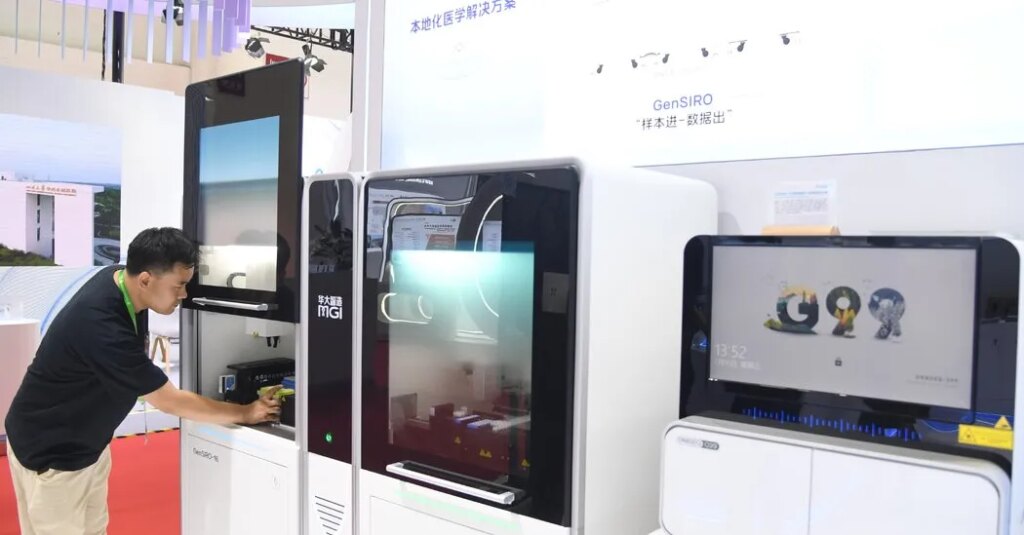
The Trump administration on Wednesday added BGI, a major Chinese genomics company that U.S. officials have long eyed with suspicion, to a trade blacklist aimed at barring products made with forced labor in China.
BGI will be prohibited from shipping goods to the United States under criteria a 2021 law established.
In recent years, both Democrats and Republicans have called out and sanctioned BGI, saying its close ties to Beijing and its access to sprawling genetic data pose a threat to U.S. national security. U.S. officials have also linked BGI subsidiaries to abuses in the Xinjiang region of China, including conducting genetic analyses of Uyghurs and other predominantly Muslim minorities.
BGI did not immediately return a request for comment Wednesday morning. The company has previously said that it performs work “for civilian and scientific purposes only,” denying that it poses a risk to U.S. national security or collects Americans’ genetic information.
BGI sells DNA sequencing machines and operates laboratories that crunch genetic data on behalf of academic researchers and drug companies around the world. The company, which has a laboratory in San Jose and offices in Massachusetts, does not directly market its sequencers and the chemicals involved in that process in the United States, though experts say the company has found backdoor avenues to ship them. Over the years, it has announced partnerships with several American companies and universities.
The move is likely to be considered an affront by the Chinese government, which has traded tit-for-tat actions with the United States in recent months despite a broader trade truce. President Trump and the Chinese leader, Xi Jinping, are expected to meet in China next month and possibly the month after in Miami.
Beyond BGI, the Trump administration has been escalating its scrutiny of China’s surging biotechnology sector, with proposed rules issued last week that would more strictly regulate certain investments.
The Department of Defense deems BGI and several of its subsidiaries as “Chinese military companies operating in the United States.” In response, BGI said in a statement that it was not controlled by the Chinese government or military.
In a notice posted to the federal registry on Wednesday, the Trump administration said the new restriction would also apply to BGI Genomics, a BGI subsidiary, and MGI, a Chinese company spun off from BGI.
Dozens of Chinese companies have been added to the list related to forced labor. This past summer, the Trump administration added 43 to the list in industries like aluminum, apparel, copper and cotton.
China denies the presence of forced labor in Xinjiang. But the U.S. government has said the Chinese government uses forced labor, mass detentions and other coercive practices to subdue the region’s predominantly Muslim ethnic groups, particularly the Uyghurs.
For years, several of BGI’s subsidiaries have also been on a separate Commerce Department list restricting their access to U.S. technologies.
Under a law Mr. Trump signed late last year, U.S. government agencies are barred from contracting with certain foreign biotech service providers in adversarial countries like China. The law did not name BGI, but it is affected because of its inclusion on the Pentagon’s list of firms deemed Chinese military companies.
Last week, the Treasury Department proposed regulations prohibiting U.S. companies and investors from taking investment stakes in Chinese biotechnology. Those rules could chill certain types of agreements between U.S. and Chinese firms, though they crucially exempt the booming area of deal making that the world’s biggest pharmaceutical companies prize most, in which they have been filling their pipelines with experimental drugs from China.
The post U.S. Restricts Trade With Chinese Genomics Company appeared first on New York Times.