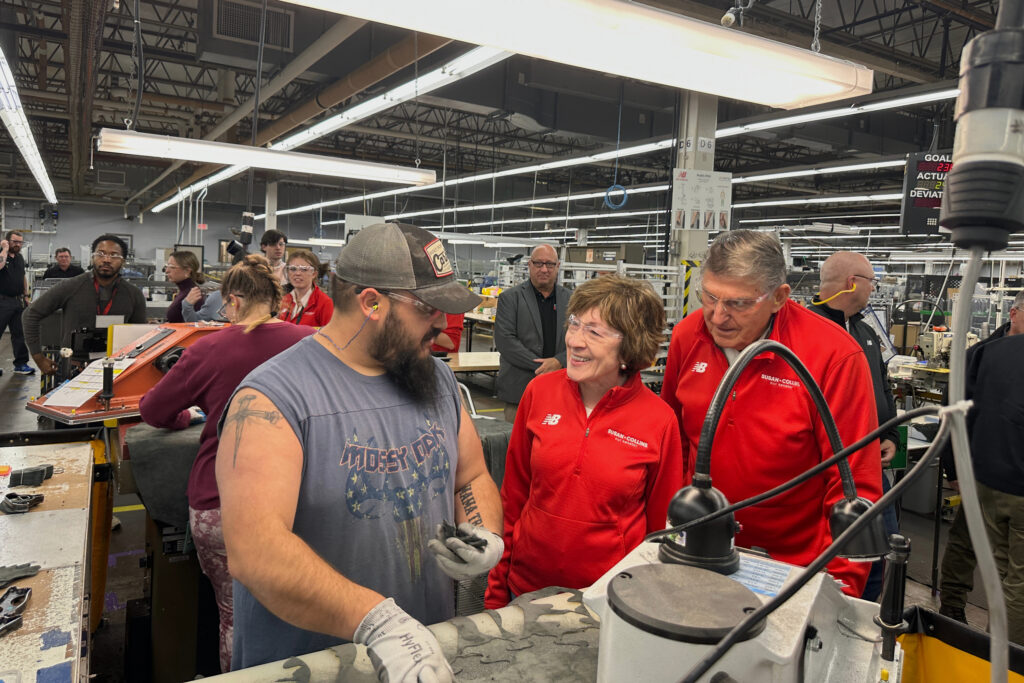
New England’s only Republican senator persuaded the Trump administration last week to ease tariffs on nine categories of Canadian products vital to Maine’s economy. The preelection exemptions underscore both the power of Senate Appropriations Committee Chair Susan Collins (R-Maine) and the fundamental folly of protectionism.
Against the backdrop of President Donald Trump’s unpopular trade war with Maine’s northern neighbor, Collins announced on Friday that tariff exemptions will extend to products such as corrugated paper, plastic boxes and cases, plastic packing bags and sacks, agricultural cleaning and grading machinery, and edible seaweed products. The adjustments are meant to help Maine’s agriculture industry.
Wild blueberry growers, for example, rely on specialized Canadian harvesting boxes designed to work with their existing processing equipment. An American supplier of some cardboard agricultural totes recently stopped making them, leaving growers with no domestic alternative, according to Collins.
Protectionists see tariffs as a shield around American producers. Maine shows the silliness of that analogy. Producers are also importers. Farmers need machinery. Manufacturers need components. Builders need cement. Municipalities need road salt. Paper mills need pulp. Impose an import tax on those inputs, and everything they go into costs more.
There is no economic principle under which a Maine blueberry grower deserves help while a manufacturer in a state without a toss-up Senate race deserves to pay a punitive tax on an equally indispensable Canadian input. What distinguishes them is politics. This leads to arbitrary decisions. For example, in the same announcement that gave relief to Maine, Trump imposed new 50 percent tariffs on a hodgepodge of other Canadian products, including shampoos, carpets, cocoa powder, vinyl flooring, wall-installed air conditioners, yacht parts and canoes.
Research demonstrates clearly that tariffs are passed along in the form of higher prices for shoppers. The Budget Lab at Yale estimated this summer that the tariffs then in place would raise consumer prices by about 0.7 percent, costing the average household around $1,100 a year.
People have noticed. A September CNN poll found that 70 percent of likely Maine voters think placing tariffs on Canadian goods is mostly a bad thing for the state. Only 12 percent of respondents said tariffs are a good thing. An AP-NORC survey last month found 64 percent of Americans think Trump has “gone too far” with imposing tariffs on other countries.
This isn’t the first time Collins has persuaded the White House to ease tariffs that acutely hurt Maine. Last month, she claimed credit for winning carve-outs for road salt, cement and pulp used in Maine’s paper mills. Her Democratic challenger, Troy Jackson, said this didn’t go far enough, quipping that Mainers “can’t eat road salt.”
The political consequences are stark in other states that trade heavily with Canada. In neighboring New Hampshire, Republican Senate candidate John Sununu has said the trade war with Canada “doesn’t make any sense.” In Michigan, Republican Senate candidate Mike Rogers broke with the president when he released an ad this month saying that “Canada is not our enemy” and calling to “end this tariff war now.” Tariffs have also created political problems for the president in agricultural states such as Iowa and Kansas.
Capital markets thrive on predictable rules, not presidential discretion. A business cannot confidently make long-term investments when taxes on its inputs depend on how urgently its senator needs an exemption and whether the White House owes him or her a favor.
More perniciously, protectionism invites cronyism. Markets allocate goods according to price and demand. Protectionism replaces those decisions with political calculations. Business success can depend less on finding a better supplier than on finding a better lobbyist.
Collins did her job by helping Maine’s industries, but Americans shouldn’t need the intervention of a powerful senator facing a tight election just to buy a cardboard box at the market price.
The post Buying a cardboard box should not require a senator’s help appeared first on Washington Post.