This article is part of the Fine Arts & Exhibits special section on how the world of art and museums is pushing boundaries.
A new show at the Honolulu Museum of Art, “Vital Connections: Art & the Brain,” welcomes viewers with a pair of simulated brain scans made of colorful beads. One bears signs of PTSD, the other of Alzheimer’s disease.
An odd choice, perhaps: What do afflicted brains have to do with a museum visitor?
Quite a bit, it turns out. Ruth Cuthand, the Canadian artist who threaded the scans, told museum officials that she was inspired by illnesses affecting members of her family. Right away I thought of a friend with early dementia and how sad that made me feel. That, apparently, was the point.
The exhibition is a collaboration with the Brain Health Applied Research Institute, a local organization known as B+HARI. It uses a gallery of 24 works of modern and contemporary art to challenge viewers to dispense with the usual routine of contemplating art and the motives of the artist and instead focus on elements of each work that might provoke a memory or emotion.
As part of the experience, three groups of people — random visitors; members of the public who participated in a B+HARI program of physical movements and verbal expressions; and people who participate regularly in its weekly programs — are later asked to explore how pieces affected them in a personal way.
The exhibition, which runs through Jan. 10, builds on long-established research that shows how experiencing art of any kind — painting, theater, music — can lead to better health outcomes. Here, museum curators plus doctors, architects and neuroscientists at the research institute have chosen specific artworks that they say might influence thinking, perspective and mood, even if just temporarily.
“Science has established that art is good for the brain. What it hasn’t figured out is how to prescribe it, how to dose it, and how to make sure it actually reaches the person in front of the painting,” said Dr. Kazuma Nakagawa, a Harvard-trained neurologist who founded B+HARI with Ma Ry Kim, a specialist in the emerging field of neuro-architecture who designed the gallery.
“Looking at art is a workout for the brain,” Nakagawa said, “but only when a viewer truly makes a real connection with it.”
But why diseased brain scans? “They offer an immediate and thought-provoking visual connection between art and neuroscience,” said Catherine Whitney, the museum’s director of curatorial affairs. “Layered with sensory and emotional meaning, they encourage audiences to consider the complexities of the human brain and cognitive health, which are often obscured from our everyday perceptions.”
The Honolulu museum’s exhibit is part of a larger trend. Traditional art museums are steadily adding science-related exhibitions in their continuing efforts to exceed pre-pandemic audience levels.
The shows are also part of an effort to demystify science, as issues such as climate change, technology, medical advances and artificial intelligence are mired in controversy and misinformation.
Pioneer Works cultural arts center in Brooklyn has an exhibit through Nov. 22, “Siphon,” that focuses entirely on aspects of an octopus — its intelligence, nervous system, sleep cycles and movement capabilities.
The Los Angeles County Museum of Art has an ongoing presentation, “Deep Time Cinematography,” a conceptual film by Jonathon Keats that tracks changes in the Hollywood Hills landscape over the next 10,000 years.
And a show at the Denver Art Museum, “Space Is the Place: Art & Design in the Atomic Age,” examines the optimism and anxieties of the coming space age during the Cold War. It is open through Feb. 21.
Past exhibitions dealt with other issues. The Museum of Food and Drink in Brooklyn explored the physics of taste in “Flavor: The World to Your Brain.” The Cooper Hewitt, Smithsonian Design Museum in New York and the San Francisco Museum of Modern Art displayed versions of “Art of Noise,” using music to understand how we hear sound. The Brooklyn Museum took aim at the plastics industry for materials found in New York waterways in “Death to the Living, Long Live Trash.”
“The motivation for museum science shows it is part of a larger effort to meet people where they are,” said Kate D. Levin, who oversees global arts programs for Bloomberg Philanthropies. “Science is now appealing in the context of visual art in ways it wasn’t before.”
The Honolulu museum, celebrating its centennial next year, has been better known for the Asian art in its 55,000-piece collection. Several years ago, Kim from B+HARI met Whitney from the museum to consider ideas for a show that examined how art could enhance thinking and maybe help slow cognitive decline.
They designed a pilot exhibit with the British artist Rebecca Louise Law, hanging thousands of dried flowers to demonstrate the fragility of nature and human connection to it. Volunteer viewers shared their thoughts and responded so positively, Whitney said, that she began planning another art-brain exhibition. That became the current show, which opened in September.
The exhibition is divided into three sections, all preceded by grooved wooden touch-plates designed to set the mood through slow breathing and clearing of the mind.
In the first section, “Art & Science — Perception and Memory,” David Hockney’s 1983 photo collage of the novelist Christopher Isherwood talking with the poet Bob Holman challenges a viewer’s brain to reassemble the images to make sense of them. A rustic pointillist scene by the 19th-century French artist Henri-Edmond Cross, “Landscape,” poses a similar challenge through the thousands of tiny dabs of paint that appear disconnected close up, but cohesive from afar.
In an Emmy-nominated film, “See Memory,” the New York artist Viviane Silvera deconstructs the complexities of memory through 30,000 of her paintings and interviews with neuroscientists.
The next section, “Connection to the Planet,” is all about nature, reminding viewers that they are part of something larger than themselves. Some of the images were chosen to provoke such feelings as wonder, awe and connection to universal concepts, Whitney said. Richard Misrach’s 60-by-80 inch untitled photograph of serene ocean water interrupted only by his wife floating on her back evokes a sense of calm or maybe wonder, or perhaps something else entirely. But it also stirs a connection to nature.
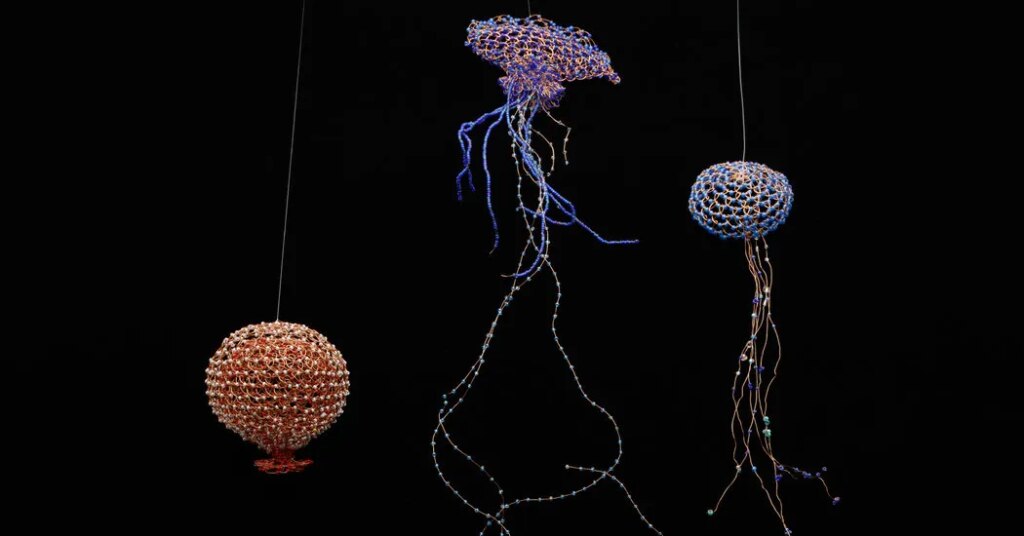
Delicate glass beads shaped as jellyfish by the Native Hawaiian artist Bernice Akamine might suggest a world under threat from climate change.
The final section, “Flow: Multisensory Connections,” is intended to move viewers into an immersive state of concentration, as they might experience in pursuit of a creative, athletic or intellectual goal. The sports equivalent of, as the exhibit text puts it, being “in the zone.”
The curators have chosen several works that suggest movement, including a swirling dot painting by the Japanese artist Yayoi Kusama, who died in August; a brass and wire hanging sculpture by the American modernist Ruth Asawa; and a large interactive video projection by the Chinese American artist Ming Ren that changes with the movements of anyone in front of it.
Before the opening of “Vital Connections,” several B+HARI regulars who participated in weekly sessions found resonance with art in other rooms. Jill Axelson, 48, a former designer, wrote of seeing herself and family members in Fairfield Porter’s 1969 oil, “Amherst Parking Lot No. 1,” a quiet scene of bright light upon brilliantly colored autumn leaves. That and other works, she wrote, evoked strong feelings of love and family but also loneliness and grief. At one point, she imagined feeling alone in Porter’s painting as another family gathered in a large house behind trees. She said she “smelled a meal being prepared.”
Allen Abaya, 80, an Air Force veteran and contractor for General Electric, had studied the same painting, and wrote that he began “crying because it brought back memories of a friend who was with me in the painting, a friend who passed a few years ago.”
The value of art to stimulate thought and improve well-being has long been studied, including in a landmark effort by the World Health Organization in 2019 based on more than 3,000 scientific studies across Europe. Several books are devoted to the subject, like “Art Cure” by Daisy Fancourt and “Your Brain on Art” by Susan Magsamen and Ivy Ross.
The connection has been established to such a degree that a concept of “arts on prescription” is gaining favor in a growing number of places, including Canada, England, Germany, Switzerland and France. The idea is for doctors to prescribe — and for insurance to cover — a museum visit as part of lifestyle imperatives along with medication, exercise and diet.
It remains a nascent movement in the United States, with only a handful of programs operating — in Massachusetts, New Jersey and North Carolina, among other places. Nakagawa said he was working toward creating a pilot effort at the Queen’s Medical Center in Honolulu, where he is chief of its Neuroscience Institute.
“We are essentially exploring what it would look like for a neurologist to ‘prescribe’ a museum visit to patients at high risk for cognitive decline as part of their overall brain health strategy,” he said. “It may seem unconventional today, but I hope that someday this type of approach will become a normal part of health care.”
The post This Is Your Brain on Art appeared first on New York Times.