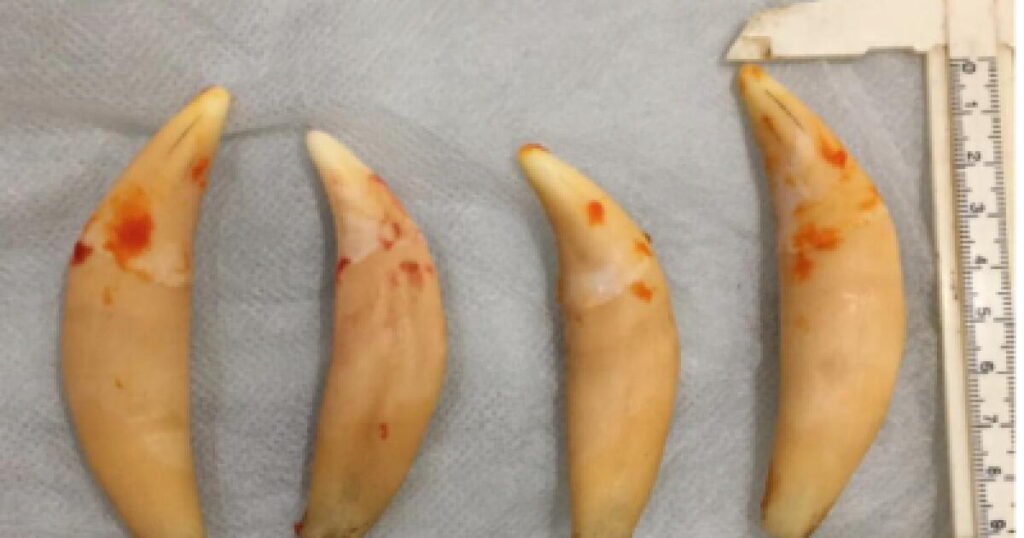
A federal judge sentenced a married couple from Anaheim to three years probation after they pleaded guilty to helping traffic wildlife parts such as black bear gallbladders, lion teeth and rhinoceros horns between Oregon and Vietnam.
Linh Luu and her husband, Kevin Le, pleaded guilty Friday in federal court in Eugene, Ore., to violating the Lacey Act, which prohibits the buying or selling of wildlife — including wildlife parts — that are illegally imported or exported. Each also received a $10,000 fine as part of their punishment that will be paid to the Cooperative Endangered Species Conservation Fund.
According to court documents, Luu and Le processed $51,000 in payments between Sept. 2019 and May 2021 to help a friend living in Vietnam buy and sell wildlife parts in and out of the U.S.
One exchange detailed by federal prosecutors involved undercover agents meeting the couple at a parking lot of a Target to deliver $12,000 in cash as a down payment for pieces of rhinoceros horn. They discussed ways to avoid U.S. banking regulations and that the cash was from illegal wildlife trafficking.
The couplewas involved in transactions that saw American black bear gallbladders and cougar bones being smuggled into Vietnam, as well as black and white rhinoceros horns, lion teeth and a tiger pelt being illegally imported to Oregon.
Federal prosecutors noted that black bears and cougars are coveted by some for their use in traditional medicine.
The wildlife parts were exchanged in violation of the Endangered Species Act, which makes it illegal to trade animals and plants covered by the Convention on International Trade in Endangered Species of Wild Fauna and Flora (CITES). The treaty, signed by the governments including the U.S. and Vietnam, regulates the trade of species that are or might become extinct.
Lions and white rhinos are listed as threatened, while black rhinos and tigers are endangered species.
The post Anaheim couple trafficked endangered wildlife parts, including bear gallbladders and lion teeth, feds say appeared first on Los Angeles Times.