Gazela Pudar Drasko is a political sociologist at the University of Belgrade and visiting fellow at the Institute for Human Sciences.
In May 2023, a boy walked into his elementary school in Belgrade and shot dead nine fellow students and a security guard. It was the first school shooting in Serbia’s history. The very next day, another gunman killed eight people in villages on the outskirts of Belgrade. I was among the tens of thousands of citizens marching against violence, carrying candles and flowers, asking how our society had come to this.
The government responded with shocking condescension. The prime minister at the time posted a mocking photomontage of herself, President Aleksandar Vucic and another minister ridiculing the size of the crowds. I remember the sheer disbelief, and then the anger. As the mother of a schoolchild, I understood for the first time that the people at the top of the state were a callous group, utterly detached from the lives of ordinary people in Serbia.
Three years later, Serbian society has been transformed. Elections this Sunday could well topple Vucic, who has dominated Serbian politics for more than a decade.
I am a political sociologist who studies why people engage (and disengage) in democratic politics. The pattern is well established: Outrage rises, crowds fill the streets — and then everything goes back to normal. Vucic had a template for staying in office: He repeatedly called early elections, and with both a pliant media and vast state resources in his pocket, defeated a fragmented opposition. People got tired — and grew resigned.
Then, on Nov. 1, 2024, the concrete canopy of a newly renovated train station in Novi Sad, Serbia’s second-largest city, collapsed onto the people below. Sixteen people died, some of them children, some students. Vucic’s government had trumpeted the renovation as a major public works achievement. Almost two years later, despite credible evidence unearthed by an independent commission of corruption and lack of transparency, no one has been convicted.
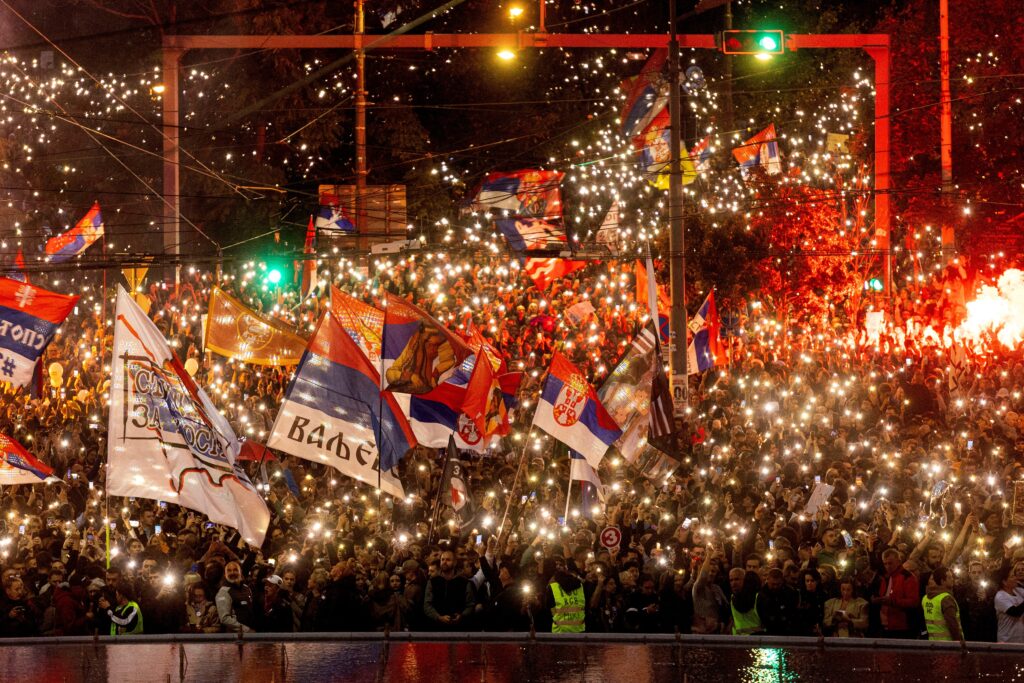
But unlike in every previous scandal where the public shrugged, the students stood up. After a peaceful vigil commemorating the Novi Sad victims was violently dispersed by pro-government activists, broader demonstrations erupted. Within weeks, more than 90 schools and other higher-education institutions held open assemblies to deliberate and decide what to do next. Out of this dynamic sprang a surprising new political force: a movement with no leader and no spokesperson who can speak without a popular mandate.
The students then left the campuses. They marched hundreds of miles, slept in school gyms and talked with farmers, teachers and pensioners. They wanted to directly reach people across Serbia — their parents and grandparents — by breaking through the government’s media blackout.
What strikes me most, looking back, is their persistence and discipline. For almost two years, a leaderless movement has faced a ruling party that controls much of the country’s institutional machinery. It has endured attacks, arrests and intimidation, and it has remained nonviolent. Scholars like me will be studying that for years.
In May 2025, the students concluded that protest alone could not deliver accountability and demanded early parliamentary elections. Vucic resisted for 16 months and then, apparently convinced that he had figured out how to survive, called snap elections for this Sunday.
A survey conducted in June by the Center for Research, Transparency and Accountability, an independent election-monitoring group, and Stanford University’s Democracy Action Lab found that 6 in 10 Serbians thought democracy is the best political system, with the same share saying it does not actually work in Serbia. A third trusted the government. Seventy-one percent trusted state universities, and 60 percent still supported the student protests after a year and a half.
Serbians have not given up on democracy. They have given up on institutions that claim its name. Many Americans will recognize that gap. The students have shown that democracy can be practiced outside mainstream political institutions: in classrooms, in village squares, in conversations between people who once had little reason to cooperate.
I worry that the government may try dirty tricks this weekend, including relying on violent hooliganism on election day. But I am also hopeful for the future. It’s not just the hope that one government might replace another. It’s that citizens can recover their belief in political change, and eventually in institutions themselves. For years, Serbians have learned to depend on powerful individuals rather than on rules that apply equally to everyone. The students are asking us to trust something else: a process of collective decision-making, even when it is slow, complicated and frustrating.
Unlike Hungary’s opposition, which rallied around the charismatic Peter Magyar and his Tisza party, the students have resisted pressure to produce a single leader, putting forward instead a team of ordinary, competent people with integrity. Serbia is not Hungary, but a similar outcome — where an entrenched authoritarian elite is democratically shown the door — is now a real, and increasingly likely, possibility.
Even if the opposition wins on Sunday, the hardest work still lies ahead. Transforming institutions is an enormous undertaking. But after nearly two years of determined, nonviolent resistance, watching a new generation take responsibility for its country’s future gives me every reason to believe in Serbia’s democratic future.
And perhaps something larger is taking shape here: A new democratic hope is emerging from the Balkans that political change need not be born of violence, but can be built through solidarity, courage and collective action.
The post How a leaderless student movement could topple Serbia’s autocrat appeared first on Washington Post.