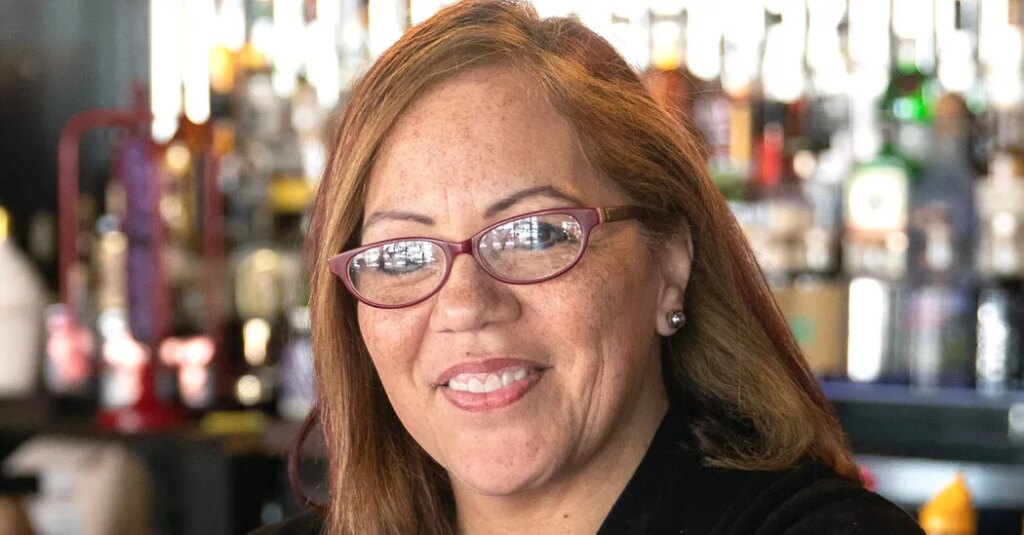
The mayor of Kissimmee, Fla., was arrested on Wednesday on charges of theft and fraud in connection with $50,000 in Covid-19 grant funds that she and her family received from a city program she helped create, officials said.
The mayor, Jackie Espinosa, 58, was charged with grand theft and organized scheme to defraud.
“Florida taxpayers funded that money to help small businesses recover, not to enrich the mayor who controlled it,” James Uthmeier, the state attorney general, said in a statement.
Ms. Espinosa has been the mayor of Kissimmee, a city in Central Florida with a population of more than 84,000, since November 2024. She was arrested outside her home on Wednesday morning and was being held without bond.
She was booked into the Osceola County jail on a charge of theft of property valued at between $20,000 and $100,000, a second-degree felony, records show. The arrest record also cites a felony charge of organized fraud to obtain property worth $50,000 or more.
Migdalia Perez, a lawyer for Ms. Espinosa, said in a statement that her client maintained her innocence.
“There is a fundamental difference between an alleged ethics violation and a criminal offense,” Ms. Perez said in a statement. “The state cannot transform one into the other without proving every element of a crime beyond a reasonable doubt.”
In his statement, Mr. Uthmeier said the investigation showed that after Ms. Espinosa became mayor, she created a city program called Business Boost 2.0, which was funded under the economic stimulus package signed into law by President Joseph R. Biden Jr. It was intended to provide assistance to small businesses during the Covid-19 pandemic.
The statement said Ms. Espinosa and her family members applied for $50,000 in funds for three businesses they owned. The funds were deposited into accounts linked to the Espinosa family on Nov. 7, 2025, the attorney general’s statement said.
On Dec. 5, the city attorney notified the mayor that accepting the funds “created a prohibited conflict of interest,” the statement said.
Ms. Espinosa “was advised to return the money, but she declined to do so, stated she would fight any complaint, and took no corrective action,” according to the statement.
In March, a Kissimmee resident filed an ethics complaint accusing Ms. Espinosa of violating the city’s code of ethics by creating and funding grant programs that she and her family members benefited from, among other allegations.
Mayanne Downs, a court-appointed special prosecutor, investigated the allegations and found “clear probable cause” to file articles of impeachment against Ms. Espinosa, according to a report Ms. Downs filed in July.
In August, the Kissimmee city commissioners deadlocked 2-2 on a vote to move forward with impeachment proceedings against Ms. Espinosa. In September, the Florida State Ethics Commission said it had found probable cause that Ms. Espinosa had a conflict of interest in accepting grant money for her business that was administered by her agency.
Blaise Ingoglia, the state’s chief financial officer, said at a news conference on Wednesday afternoon that the state Department of Financial Services began looking into Ms. Espinosa after investigators noticed “irregularities” while auditing local governments with respect to the Covid-19 programs. Ms. Espinosa faces up to 30 years in prison if she is found guilty, he said.
In addition to the $50,000 that Ms. Espinosa and her family received, he said that an additional $40,000 went to “tenants Espinosa’s businesses,” including a dance studio, restaurant and real estate agency.Ms. Espinosa submitted the grant applications on the day the program began accepting them, Mr. Ingoglia said.
“She was one of the first ones in line” to apply, he said, adding that she was also “part of the control mechanism that approved the applications.”
Mr. Uthmeier said at the news conference that “there is zero tolerance when it comes to public corruption.”
The case will be prosecuted in the 13th Judicial Circuit.
The post Florida Mayor Is Accused of Taking Covid Grant Funds She Helped Approve appeared first on New York Times.