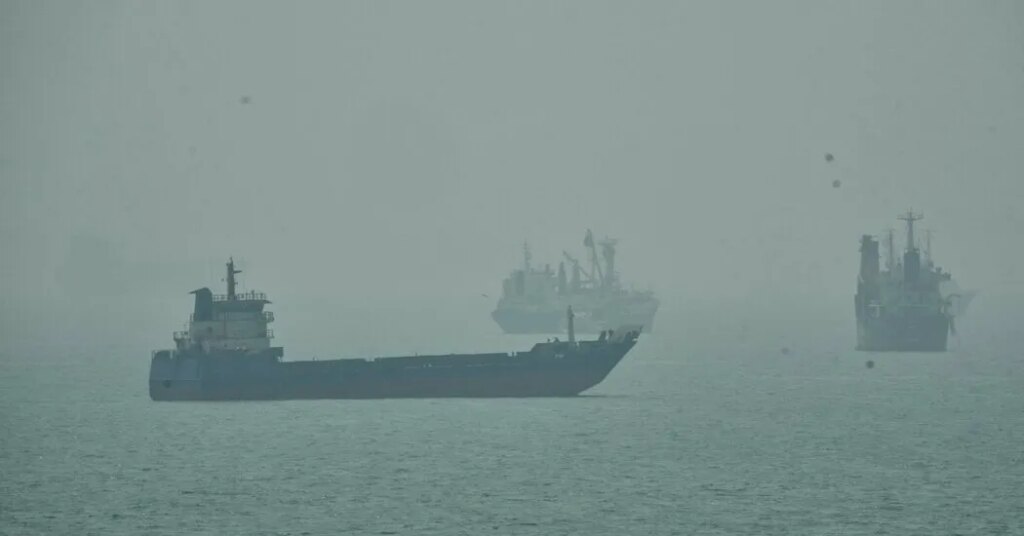
Iran is hitting a lot more tankers in the Strait of Hormuz, but ship operators are still going through the waterway, transporting oil in significant volumes.
So far this month, 26 vessels have been struck, according to data from organizations that track maritime incidents, making it the most dangerous period for shipping during the war with Iran. On Wednesday, a 730-foot container ship sank after a projectile hit it.
Under U.S. military protection, tankers had been returning to the strait in greater numbers. That helped oil exports from the Middle East to get close to their prewar levels last month.
But while Iran’s escalated attacks on tankers appear aimed at reversing the surge, data from firms that track oil shipments suggest that the recent recovery in exports through the strait has held up.
TankerTrackers.com said over 12 million barrels of crude a day had gone through the waterway on average this month, slightly higher than September’s average. “Exports continue to strengthen,” said Samir Madani, a co-founder of TankerTrackers.
Kpler, another maritime analysis firm, said nearly 10 million barrels of oil a day had gone through the strait this month, down from around 11 million in September.
Tankers typically turn off their transponders to go through the strait, so the ship trackers piece together vessel movements by waiting for transponders to go back on, and by using satellite images and other information. Their totals can differ, and they often revise their most recent counts higher as they obtain more information.
Both trackers’ totals for the strait are still well below the 17 million barrels a day that went through it just before the war, which began at the end of February.
Some analysts said there were signs that Iran’s upsurge in attacks had begun to cause some shipping operators to think twice about going through the strait.
Dimitris Maniatis, the founder of Marisks, a maritime risk management firm, said some ship operators headed for the waterway had apparently decided not to go through in the wake of the latest attacks. “They don’t want to take the risk of being hit,” he said.
The strait is not the only way to export oil out of the Middle East. Persian Gulf countries have significantly increased the amount of oil they export through pipelines that bypass the waterway. So far in October, they have exported around five million barrels a day through those routes, according to TankerTrackers.
If the flows through the pipelines and strait are combined, around 17 million barrels of crude a day have left the Middle East this month. Before the war, the region was exporting over 19 million barrels a day through all routes.
But the pipelines are also vulnerable to attack. Last month, Saudi Arabia had to shut down its East-West pipeline for a while after an Iranian-backed militia struck it.
Since the war began, Iran has tried to use its power over shipping in the strait as a strategic lever against the United States and Israel. Iran’s attacks essentially closed the waterway during the early months of the war, but after the U.S. military’s tanker protection effort began in May, tankers returned in greater numbers. At the same time, a U.S. naval blockade is preventing Iran from exporting oil through the strait.
While flows from the Middle East have picked up, oil is a lot more expensive than it was before the war. Gasoline and diesel prices remain high and weigh on the finances of consumers and many businesses. The cost of shipping oil around the world has soared, adding to the costs shouldered by importers. Before the war, it cost around $3 to ship a barrel of oil from the Persian Gulf to East Asia; now the cost is over $30. On Wednesday, Brent crude, an international oil benchmark, traded at nearly $106 a barrel.
Oil prices will decline to prewar levels only if there is a lasting peace deal between the United States and Iran. And some analysts said Iran could even step up its attacks on tankers.
“Are they going to escalate further? I would expect that,” said Noam Raydan, a senior fellow at the Washington Institute for Near East Policy.
The higher number of strikes on tankers this month raises questions about the effectiveness of the U.S. military’s protection operation. Iran uses drones and missiles to target ships. The United States guides tankers through the strait and tries to intercept the Iranian weapons.
Asked whether the attacks showed the United States was unable to protect some tankers, Capt. Tim Hawkins, a spokesman for Central Command, the arm of the military running the tanker protection operation, said, “Centcom remains vigilant and present, and continues to work with regional partners and the shipping industry to protect commercial vessels.”
Captain Hawkins said that 1.25 billion barrels of oil had been shipped through the strait in the last few months with the support of the U.S. military, and that 19 million barrels went through on Monday.
“Transits through the Strait of Hormuz continue despite Iran’s unwarranted aggression,” he said.
In recent days, the conflict between Saudi Arabia and the Houthis, an Iranian-backed militia in Yemen, has intensified. On Tuesday, the Houthis hit a building owned by the state-owned energy giant Saudi Aramco. Over the weekend, they struck King Khalid International Airport in Riyadh, killing at least 13 people and wounding more than 300.
The Houthis hold parts of Yemen that they can use to threaten tankers in the Red Sea that pick up oil from the East-West pipeline on the western coast of Saudi Arabia.
But despite those disruptions, Saudi Arabia has been exporting a significant amount of oil. It has exported 7.7 million barrels of oil a day so far this month, nearly three million of which was loaded on the western coast, according to TankerTrackers.
Jenny Gross contributed reporting from London.
The post Gulf Oil Is Still Flowing Despite a Surge in Attacks on Ships appeared first on New York Times.