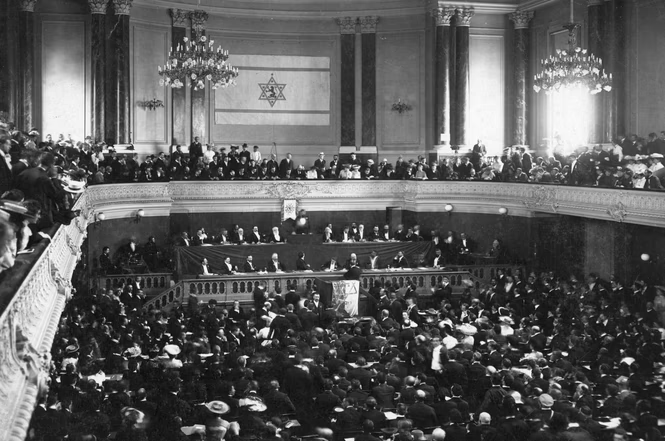
On October 7, 2023, Hamas fighters launched a surprise attack on Israel from the Gaza Strip, killing more than 1,200 people and taking 251 hostages. The attack was the worst disaster in the history of the Jewish state. Three years later, it’s clear that it was an even greater disaster for Palestinians. Determined to punish Hamas and prevent future attacks, Israel responded with a devastating invasion of Gaza that killed more than 70,000 people; it estimates at least 22,000 were combatants. Today, 2 million Palestinians, 80 percent of the population of Gaza, have been displaced from their homes.
But if Hamas was defeated militarily, it largely succeeded in its goal of swinging Western public opinion against Israel. The spectacle of Israeli powerlessness followed by the violent display of Israeli power profoundly changed the way the Jewish state is seen and discussed. Perhaps the best way to gauge that change is to look at the transformation of the word Zionist.
Zionism was coined in the 1890s to name the organized political movement to create a Jewish state. After that goal was achieved with the establishment of the State of Israel, in 1948, the label continued to be claimed by people who took pride in its existence and wanted it to survive and thrive. This included most American Jews, but not only them. Two weeks after the Hamas attack, President Joe Biden visited Tel Aviv and declared, “I don’t believe you have to be a Jew to be a Zionist, and I am a Zionist.”
It’s unlikely that those words will be heard again from an American president, of either party. To understand why, all you have to do is type the word Zionist into the search bar of any social-media platform, and review the rancid results.
The border between the internet and real life has become alarmingly porous. In May, Maureen Galindo, a candidate in the Democratic primary for a House seat in Texas, posted that if elected, she would turn an ICE detention center into “a prison for American Zionists,” where “most of them” would be castrated for being pedophiles. The notion that Zionism is a perversion or sickness is shared by extremists of many stripes. The far-left pundit Hasan Piker has called it “a mental illness,” and the far-right pundit Tucker Carlson has said that Christian supporters of Zionism are victims of a “brain virus.” The same ecumenism can be seen in the career of the term Zio: Originally popularized as an anti-Semitic slur by far-right white supremacists such as David Duke, it is now casually used by anti-Zionist Jews such as the actor Odessa A’Zion, whose now-problematic name compelled her to clarify on social media that she is “not a zio!”
[Adam Louis-Klein: The left-wing case against anti-Zionism]
The belief that Israel should continue to exist, which is what most people who call themselves Zionists mean by that word, does not seem to entail Nazism, insanity, or a taste for political conspiracy or sexual perversion. But the goal of this rhetoric, and the more genteel equivalents used in parts of academia and the culture industry, is not to provide an accurate definition; it is to make the word Zionist so toxic that people will be afraid to claim it.
And Jews have gotten the message. Last year, the Jewish Federations of North America conducted a public-opinion survey on “Jewish Life Since October 7th.” It found that 88 percent of American and Canadian Jews “believe Israel has the right to exist as a Jewish, democratic state,” but that only 37 percent were willing to call themselves Zionists. Yet it’s clear that most Jews are not opponents of Zionism—only 7 percent of respondents called themselves anti-Zionists. Their problem is not with the idea of Zionism, but with the term itself.
Ironically, nothing would have suited the founders of Zionism better than for the world to stop talking about it. Their aim was to create not an ism, but a country; once that was achieved, the ism could be discarded, like scaffolding from a completed building. Anshel Pfeffer, a prominent left-wing Israeli journalist, has written that “Zionism ended on May 14, 1948,” the day the State of Israel was created. Today, Israel is not an idea but a real place, complete with shopping malls and sports teams and commuter trains, where 10 million people, three-quarters of them Jewish, live mostly ordinary lives. In this sense, hating Zionism in 2026 is a category error—like railing against the idea of American independence a century after the Revolution.
When people say they hate Zionism, Pfeffer argues, what they really mean is that they hate the conduct of the state Zionism created: “‘I no longer believe in Zionism’ seems to have become just another way of saying ‘I’m thoroughly pissed-off by the policies of successive Israeli governments.’” And there is no doubt that the collapsing reputation of Zionism has been driven by outrage at the Netanyahu government’s conduct of the war in Gaza. The most illuminating part of the Federations survey asked respondents how they define Zionism. A popular answer among those who call themselves non- and anti-Zionist was “supporting whatever actions Israel takes.”
If that definition were accurate, even the president of Israel couldn’t be considered a Zionist. In a speech in May, Isaac Herzog fiercely denounced Israelis who commit violence against Palestinians in the West Bank, saying that ultrareligious settlers “defile our home and depart from every basic norm—moral, legal or Jewish.” But then, the language of American anti-Zionism can’t be understood simply as criticism of Israeli actions. There is something deeper at stake when a politician calls for Zionists to be castrated, or when the group Jewish Voice for Peace associates its opposition to Zionism with the struggle against “white supremacy, homophobia, transphobia, patriarchy, colonialism, militarism, and capitalism.”
No nation is without enmities and rivalries, yet somehow no Ukrainian has ever bombed a Russian Orthodox Church in the U.S., the way a Lebanese émigré drove a truck full of gasoline and explosives into a synagogue in Michigan in March. No sympathizer with Tibet or Taiwan has ever murdered people at a China-sponsored event in the U.S., the way an American killed two Israeli-embassy workers at a diplomatic reception at the Capital Jewish Museum in 2025.
To inspire this kind of hatred, the policies of a foreign government are insufficient. It requires an idea—an evil principle that must be eliminated for the good of humanity. The word anti-Semitism is now used to condemn prejudice against Jews, but it was invented in Germany, in the late 19th century, as the name of a proud political movement. Members of anti-Semitic parties wanted to distinguish themselves from old-fashioned Jew-haters; their target wasn’t religion but “Semitism,” which sounds like the name of an idea. If defeating “Semitism” meant exiling or killing the millions of Jews who lived in Europe, so be it; the disease was so bad that any cure was justified. Today, anti-Zionism follows a similar logic. Opposition to an ism cloaks a desire to exile or kill the millions of Jews living in Israel, and to punish Jews in other countries who object to this prospect.
So there is a dreadful inevitability about the way anti-Zionism has rediscovered the ancient themes of Jew-hatred. One example can stand for many: In January, an X account called “illuminatibot,” which has 2.4 million followers, posted that “Zionist tunnels were discovered under synagogues in NYC. Stained mattresses and baby high chairs were found inside.” The word Zionist here has no connection to Israel or to political ideology. It is simply a placeholder for evil, and the suggestion that Jews are doing unspeakable things to children in synagogues would have been perfectly familiar in 14th-century Europe.
In this sense, the persistence of the term Zionism in 2026 is the clearest sign of the failure of Zionism itself. For Zionism believed that creating a Jewish state would demythologize and detoxify Jewishness, making the Jews a “normal” people. Theodor Herzl, the founder of the Zionist movement, wrote that “the Jews, once settled in their own State, would probably have no more enemies.” To understand why that prediction turned out to be so wrong—to judge what Zionism accomplished and what it failed to accomplish—you have to go back to the beginning of the story.
Before Zion was an ism, it was a place—a hilltop fort conquered by King David in his campaign against the Jebusites, a Canaanite tribe. According to the second book of Samuel, it was on the site of this stronghold that David founded his new capital, Jerusalem, importing carpenters and stonemasons from Lebanon to build himself a royal palace. The king changed the name of the hill to City of David, but the original name wasn’t forgotten—there’s a Mount Zion in Jerusalem today, though it’s probably not the same one the Bible talks about. More broadly, Zion became a synecdoche for Jerusalem and, by extension, for the whole kingdom ruled by David and his successors.
Even in biblical times, Zion was more often ruled by foreign empires than by the Israelites. The land of Israel was conquered by Babylonians, Persians, Greeks, and Romans, with interludes of Jewish self-rule. Still, it remained the home of most of the world’s Jews until 66 C.E., when a radical faction in Jerusalem rebelled against the Roman empire and launched a war for national independence; it minted coins with the inscription “For the Freedom of Zion.” After several years, the Romans crushed the rebellion, and in the course of the fighting, the Temple in Jerusalem—the center of Jewish worship—was burned to the ground.
Until the Holocaust, this was the worst catastrophe in Jewish history. The historian Josephus, who fought in the rebellion as a general in the Jewish army, wrote that more than a million Jews were killed, many by starvation, during the Roman siege of Jerusalem. After a second failed uprising in the 130s C.E., the Romans set out to destroy what remained of Jewish society. To signal this policy, the emperor Hadrian changed the name of the province from Judea to Syria Palaestina, after the people known in the Bible as the Philistines. This is the origin of the name Palestine, which the land bore for the next 1,800 years under the rule of successive empires—Byzantine, Arab, Turkish, British.
By the Middle Ages, most Jews lived in Europe, the Middle East, and North Africa, and only a small number remained in the biblical land of Israel. Yet Zion continued to play a central role in the Jewish imagination. Over the centuries, Judaism developed a complex theology and mysticism of exile, seeing the loss of the Jewish homeland as a punishment inflicted by God. It followed that only God could decide when the exile would end. Mainstream Jewish tradition specifically prohibited settling in large numbers in the land of Israel, though individuals could live there—and through the centuries, despite the obstacles, a determined few returned.
Jews instead imagined the return to Zion as a sudden, supernatural event, which would take place when God sent the Messiah to redeem the world. Like the Second Coming for Christians, Jews believed this was certain to happen eventually, but it was impossible to know when, much less to bring it about through human action. All they could do was pray, and the Jewish prayer service is threaded with petitions for an end to exile. Three times a day for almost 2,000 years, Jews have asked God, “May our eyes behold your merciful return to Zion.”
Today Jerusalem is once again the capital of a Jewish country, and some 600,000 Jews live in the city, alongside nearly 400,000 Muslims (and 15,000 Christians). Yet observant Jews around the world still recite the prayers asking for an end to exile. This paradox points to the most important fact about Zionism: It fulfilled the ancient hope of return, but not in the way Jews had always dreamed of, by a miraculous redemption. Instead, it used politics and diplomacy to create a secular state.
The word Zionism encodes this mismatch—a biblical name joined to a modern ideological suffix. It was a product of 19th-century Europe, the birthplace of so many isms—liberalism, nationalism, socialism, communism. In fact, most of the early theorists of Zionism came to it after being disillusioned with one of these other ideologies, which kept failing to solve the problem that concerned them most personally: the persistence of Jew-hatred.
The first thinker to follow this trajectory was Moses Hess, a German philosopher who started his career as a collaborator of Karl Marx’s and spent decades agitating for a socialist revolution. Then, in 1862, he changed course and wrote a book called Rome and Jerusalem, which anticipated Zionism by considering Jews not as followers of a religion, but as members of a nation. “The Jewish religion,” he wrote, “is, above all, Jewish patriotism.”
This way of thinking broke with traditional Judaism, which defined the Jewish people by its relationship with God. But it was also a sharp rebuke of modern Jews who hoped to assimilate into European society. After the French Revolution, many countries in Western and Central Europe “emancipated” the Jews, removing old legal barriers that made them second-class citizens. But Hess observed that legal equality had not led to true belonging: “In spite of the degree of education to which the Occidental Jews have attained, there still exists a barrier between them and the surrounding nations, almost as formidable as in the days of religious fanaticism.” Rather than trying in vain to become German or French, Hess argued, Jews should recognize that they constituted a nation of their own, and work for “national regeneration.”
Rome and Jerusalem didn’t reach a large audience at first, but other thinkers kept finding their way to similar conclusions. Leon Pinsker, a doctor from Poland, grew up in the mid-19th century trusting that Jews would one day be accepted in Russian society; he learned to speak Russian, was one of the first Jews to attend a Russian university, and edited a Russian-language Jewish magazine. But late in life he could see that his hopes had been disappointed, and in 1882 he published a pamphlet titled Auto-Emancipation, arguing that it was time for Jews to take charge of their own fate.
Why was it, Pinsker asked, that hostility toward Jews was so enduring and took so many different forms? “To the living the Jew is a corpse, to the native a foreigner, to the homesteader a vagrant, to the property owner a beggar, to the poor an exploiter and a millionaire, to the patriot a man without a country, for all a hated rival.” The reason, he argued, was that the Jews had lost their nationhood. Exiled from their ancient homeland, they were doomed to wander the Earth like ghosts without a body. The only way the Jews could rescue themselves, physically and spiritually, was by leaving Europe to settle in “a land of our own.”
Initially, Pinsker didn’t believe that this land had to be the biblical land of Israel. But around this time, a number of groups calling themselves “Lovers of Zion” started to organize for emigration from Eastern Europe to Palestine, which was then part of the Ottoman empire, and in 1884 Pinsker led a conference to unite them into a movement. These groups were tiny: One of the first was made up of 14 university students from Kharkiv, who helped establish an agricultural settlement called Rishon LeZion, Hebrew for “First to Zion.” Today it is one of the largest cities in Israel, with a population of about 250,000.
The most consequential Zionist awakening took place in 1895 in Paris, where Theodor Herzl was working as a foreign correspondent for the Neue Freie Presse, Vienna’s leading newspaper. Herzl was a shining example of what Jewish emancipation was supposed to achieve. He was a successful journalist and playwright who spoke German rather than Yiddish, the language of the Eastern European Jewish masses. In fact, Herzl knew almost nothing about Judaism. Yet for his whole adult life, he wrote in his diary, “the Jewish Question grieved me bitterly.” If full assimilation couldn’t stop Jews from being excluded, hated, and attacked, what could?
Herzl came up with a staggeringly ambitious new answer. In his pamphlet The Jewish State, he called for the mass emigration of European Jews to Palestine—and, unlike earlier writers, he set out a plan for how it could be done. Jews would sell their property in Europe and use the proceeds to buy land in Palestine, working collectively through a new political body, the Society of Jews, and a new economic organization, the Jewish Company. The task was immense, but Herzl insisted that it was not impossible. He estimated that transferring the bulk of European Jewry, millions of people, would require an initial investment of $200 million (the equivalent of almost $8 billion today) and take about 20 years.
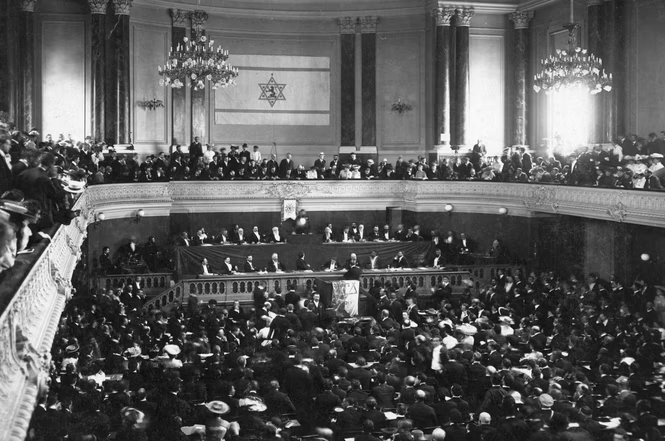
Herzl wasn’t the first person to entertain such a vision. The reason he’s remembered as the founder of Zionism is that he created institutions to make it a reality. In August 1897, he convened the first Zionist Congress, in Basel, Switzerland, where more than 200 delegates from 17 countries founded the Zionist Organization, a real-world version of Herzl’s Society of Jews. Zionism was now not just an idea but a movement, with leaders, a program, and the stature to negotiate with governments.
A skeptic would not have found the congress very impressive—just a collection of self-appointed activists who met for three days to make speeches. But after it was over, Herzl wrote in his diary: “Were I to sum up the Basel Congress in a word—which I shall guard against pronouncing publicly—it would be this: At Basel I founded the Jewish State. If I said this out loud today I would be greeted by universal laughter. In five years perhaps, and certainly in fifty years, everyone will perceive it.”
Fifty years and eight months later, on May 14, 1948, the State of Israel declared independence. Herzl didn’t live to see his prophecy vindicated: He died of heart disease in 1904, at the age of 44, and was buried in Vienna. In 1949, his remains were taken to Jerusalem, where they were interred in the new country’s national cemetery, on Mount Herzl.
Herzl may have been right about the timing, but the process of creating a Jewish state turned out to be completely different than he imagined. Radical movements generally underestimate the obstacles they face; it’s hard to be a realist and a revolutionary at the same time. As soon as Zionism evolved from an idea to a practical enterprise, most of the early theorists’ assumptions proved to be wrong.
The first mistake was to underestimate the difficulty of nation building. Zionism quickly became popular among Eastern European Jews, by offering a vision of dignity and renewal to an oppressed people. But attending Zionist meetings in Poland or Ukraine was far more appealing than actually packing up and moving to Palestine, a poor and remote place that few European Jews knew anything about. From 1881 to 1914, when the First World War cut off emigration, roughly 2 million Jews moved from Eastern Europe to America; only about 70,000 went to Palestine, and many of them left after discovering how difficult life was there.
The ones who stayed tended to be young and ideologically committed, and professed a combination of Zionist and socialist beliefs. This cohort included many of the future founders of Israel, such as David Ben-Gurion, the first prime minister, who emigrated from Poland to Palestine in 1906, at the age of 19. These Jews didn’t want to continue the European way of life at a different address, the way Herzl imagined. They wanted to create a new civilization, with its own language—a revived and modernized Hebrew—and an economy based on labor unions and collective farms.
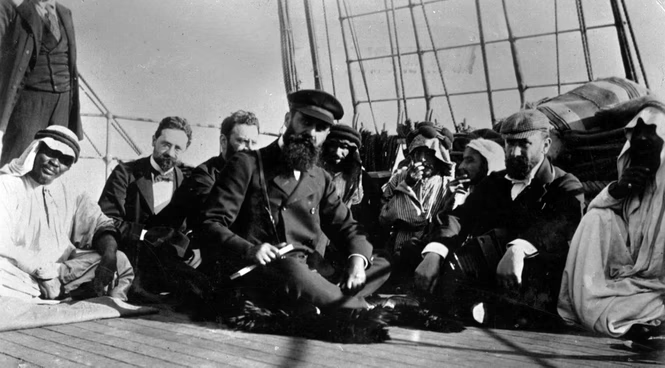
This agenda brought them into direct conflict with Jewish religious authorities. Most traditional rabbis vehemently opposed Zionism, seeing it as a secular movement that led Jews away from God. They considered the very idea of settling the land of Israel before the coming of the Messiah to be heretical. For their part, many Zionists blamed religion for Jewish weakness and passivity. Others simply saw it as a relic, irrelevant in a modern society. When Herzl designed a flag for the prospective Jewish state, it included no Jewish symbols—just seven gold stars on a white background, representing the new country’s progressive seven-hour workday.
But with religion too, Zionism underestimated the complexity of the task it had set for itself. It reconceived Jewishness as a political identity, rather than a religious one, but how could a Jewish state avoid having a profound connection with Judaism? The depth of the connection became clear at the Zionist Congress in 1905, when the delegates considered the British government’s offer to designate a territory in Africa for Jewish settlement.
The “Uganda plan” made concrete a question that Hess, Pinsker, and others had asked. Did a Jewish state have to be in Palestine? If the goal was securing a place where the Jews could control their own destiny, couldn’t it be located anywhere? But after a bitter debate, the congress voted to reject the Uganda plan. Zionism couldn’t deny the implications of its name: The biblical land of Israel was the only homeland the Jews could accept.
[From the April 2024 issue: The golden age of American Jews is ending]
Zionism’s most consequential mistake was its failure to anticipate that Palestine’s Arab population of roughly 450,000 would resist the Jewish claim at every step. In his seminal 1979 book, The Question of Palestine, Edward Said wrote that “the struggle between Palestinians and Zionism” was “a struggle between a presence and an interpretation”—that is, between the Arabs already living in Palestine in the late 19th century and the Zionists’ understanding of the country as the past and future Jewish homeland.
At first, Zionist theorists minimized that conflict. Herzl predicted that the Arabs of Palestine would welcome Jewish settlement, because it would raise the standard of living for everyone. Ottoman Palestine was poor and sparsely populated, but the assumption that its inhabitants would simply be grateful for the blessings of European civilization was self-serving. As early as 1891, Arabs in Jerusalem petitioned the Ottoman government to forbid the sale of land to Jews. After making a tour of Jewish settlements in 1912, Ahad Ha’am, a leading Zionist figure, warned that “many natives of Palestine” were beginning to “look askance, quite naturally, at the selling of land to ‘strangers,’ and do their best to put a stop to this evil.”

What was clear on the ground, however, seemed less important to Zionist leaders in Europe, who were focused on the bigger geopolitical picture. The movement was divided between “practical Zionism,” which pursued incremental growth of Jewish settlements in Palestine, and “political Zionism,” which aimed to win control of the country via a diplomatic coup. Once that was achieved, the political Zionists imagined, mass immigration would quickly create an overwhelming Jewish majority.
And for political purposes, public opinion in Palestine was irrelevant. At the time, there were no independent Arab countries in the Middle East; the whole region was ruled by the autocratic Ottoman empire, and the only vote that counted was the sultan’s. Herzl tried to convince the Turkish ruler to grant a charter for Jewish settlement. When that failed, Zionists lobbied European governments to bring pressure to bear. One of these unofficial diplomats was Chaim Weizmann, a chemist at the University of Manchester, in the United Kingdom, who would become the first president of Israel.
These efforts paid off during the First World War, which found the British and the Turks on opposite sides. In the last months of 1917, a British army marched north from Egypt and drove Turkish forces out of Palestine in a swift campaign, reaching Jerusalem in six weeks. Britain and its ally France now had the power to redraw the map of the Middle East, carving Ottoman territory into Arab states that still exist today—Iraq, Syria, Lebanon, and Jordan.
As for Palestine, Britain’s foreign secretary, Arthur Balfour, announced in a public letter on November 2, 1917, that “His Majesty’s Government view with favour the establishment in Palestine of a national home for the Jewish people, and will use their best endeavours to facilitate the achievement of this object.” The Balfour Declaration didn’t explicitly promise a Jewish state, but it looked like the fulfillment of Zionist hopes. The British Jewish philosopher Isaiah Berlin later called the Balfour Declaration “the greatest event in Jewish history since the destruction of Judea.”
The Palestinian American historian Rashid Khalidi, by contrast, calls it “a declaration of war by the British Empire on the indigenous population,” the start of a campaign to “force them to relinquish their homeland to another people against their will.” Khalidi’s book is titled The Hundred Years’ War on Palestine, and in a real sense, the war in Gaza is the latest and most terrible episode in an armed conflict that has been going on since the end of World War I, when Arab resistance to Jewish settlement turned violent. In 1920, Arab and Jewish militias clashed in the village of Tel Hai. It was a minor skirmish that left 13 dead, but it looms large in Zionist history, for two reasons: It was the first battle involving a Jewish military unit in 1,800 years, and it signaled that the future of Palestine would not be decided by diplomacy alone.
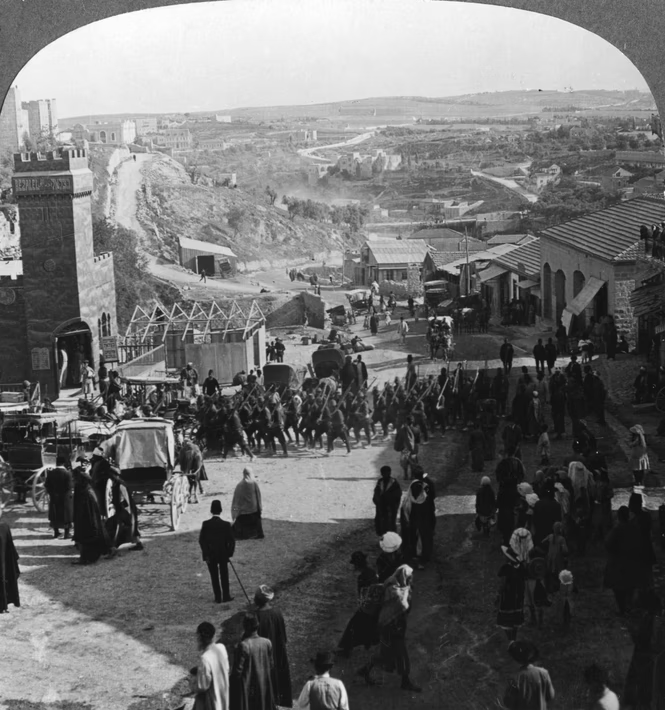
In the 1920s, the question of how to respond to Arab opposition led to the most important split in the history of the Zionist movement, one that has shaped Israeli politics ever since. Should Jews in Palestine adopt a defensive position, relying on British protection while continuing to buy land and recruit new immigrants? Or should they recognize that Arab hostility was permanent and British support unreliable, and stake out an aggressive position in the conflict that was sure to come? The majority of Zionists, including Weizmann, the official leader of the movement, took the first course. Vladimir Jabotinsky demanded the second.
Next to Herzl, Jabotinsky is the most important figure in the history of Zionism, but he was and still is deeply divisive. A man of letters like Herzl—he wrote novels and translated Edgar Allan Poe into Hebrew—he was radicalized by the persecution of Jews in the Russian empire, and even changed his first name to the Hebrew Ze’ev, meaning “wolf.” During World War I, he organized a Jewish unit to fight in the British army, but no sooner had he settled in Palestine than the British put him in jail, for collecting weapons to arm a Jewish militia.
Jabotinsky demanded that the Zionist movement revise its strategy, and his followers became known as Revisionists. In an influential 1923 essay, “The Iron Wall,” he argued that mainstream Zionists were deluding themselves about the situation in Palestine. The conflict between Jews and Arabs was not a “misunderstanding” that could be solved “if we can only make it clear to them how moderate our intentions really are,” he wrote. It was a genuine clash of national interests, which became inevitable the moment Zionism set its sights on a Jewish state.
“There is no likelihood of any voluntary agreement being reached,” Jabotinsky wrote. “So that all those who regard such an agreement as a condition sine qua non for Zionism may as well say ‘non’ and withdraw from Zionism.” If Jews wanted to build a state, they would need the protection of an “iron wall”—that is, an armed force. Jabotinsky believed that Arabs and Jews would eventually live together in peace: “I am prepared to take an oath binding ourselves and our descendants that we shall never do anything contrary to the principle of equal rights, and that we shall never try to eject anyone,” he wrote. But peace would come only once Jews had proved that they could not be ejected, either.
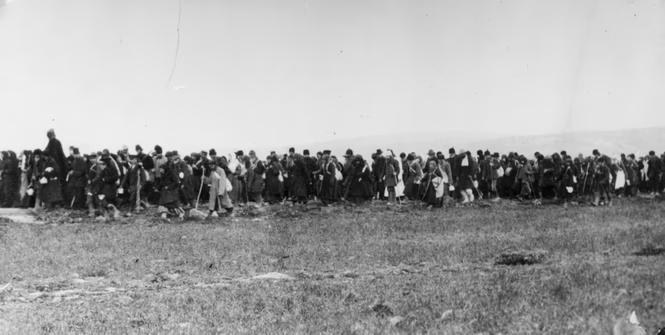
The Jewish population of Palestine grew from about 84,000 in the 1922 census to 175,000 in the 1931 census, and then to an estimated 450,000 in 1939. This Jewish society—known as the Yishuv, from the Hebrew term for “settlement”—was the foundation of the State of Israel, and it could not have come into being without British sponsorship. But Jews never came close to being a majority in Palestine before World War II. The mass immigration that Herzl imagined did not take place, for several reasons. The country lacked the economic capacity to quickly absorb millions of people, and European Jews were reluctant to leave the places where they had lived for centuries, unless it was absolutely necessary. After Hitler came to power, in 1933, for instance, more than 50,000 German Jews left for Palestine.
But in the 1930s, the British began to limit immigration as their commitment to a Jewish “national home” waned. In 1936, the Arabs of Palestine began a revolt against Jewish immigration and British rule that continued until the start of World War II, three years later. Britain had crucial economic interests in Arab countries, and British India had the largest Muslim population in the world. Britain’s leaders began to wonder whether it was worth antagonizing so many for the benefit of so few. In 1937, a commission proposed partitioning Palestine into Jewish and Arab states; some Zionist leaders wanted to accept, but Arab leaders refused. In 1939, the British announced a new policy: Jewish immigration to Palestine would be capped at 75,000 total over the next five years, then effectively prohibited.
By revoking the Balfour Declaration on the eve of the Holocaust, the British ironically confirmed the most powerful argument for Zionism, from its beginnings to the present day: The Jewish people need a state of their own in order to survive. “We are facing an elemental calamity,” Jabotinsky testified to the committee considering partition in 1937. “We have got to save millions, many millions. I do not know whether it is a question of rehousing one third of the Jewish race, half of the Jewish race, or a quarter of the Jewish race; I do not know, but it is a question of millions.” By closing the door to Palestine, the British ensured that those millions had nowhere to go when the Holocaust began. By 1945, the Jewish population that Zionism was created to rescue, and that it imagined would populate the Jewish state, had been annihilated by the Nazis.
It’s widely believed that Israel was created as reparations for the Holocaust. That’s one reason the country’s opponents have found it politically effective, since long before the war in Gaza, to characterize it as a genocidal state: If a country that exists as compensation for genocide is actually an agent of genocide, the rationale for its existence is negated. This is often paired with the charge that Israel is a product of colonialism—just another example of white Europeans stealing land from an Indigenous people.
A closer look at the events leading up to Israel’s declaration of independence shows that neither of these interpretations fits the facts. The revelation of the Nazi death camps did not lead Britain to hand over Palestine, or any part of it, to the Jews. Hundreds of thousands of Holocaust survivors remained in displaced-persons camps in Europe for years after the end of World War II because the British continued to restrict immigration to Palestine, and no other country—including the United States—was willing to let them in. In a notorious episode in July 1947, a ship carrying 4,500 Holocaust survivors to Palestine was intercepted by the Royal Navy, and the passengers were sent back to an internment camp in Germany.
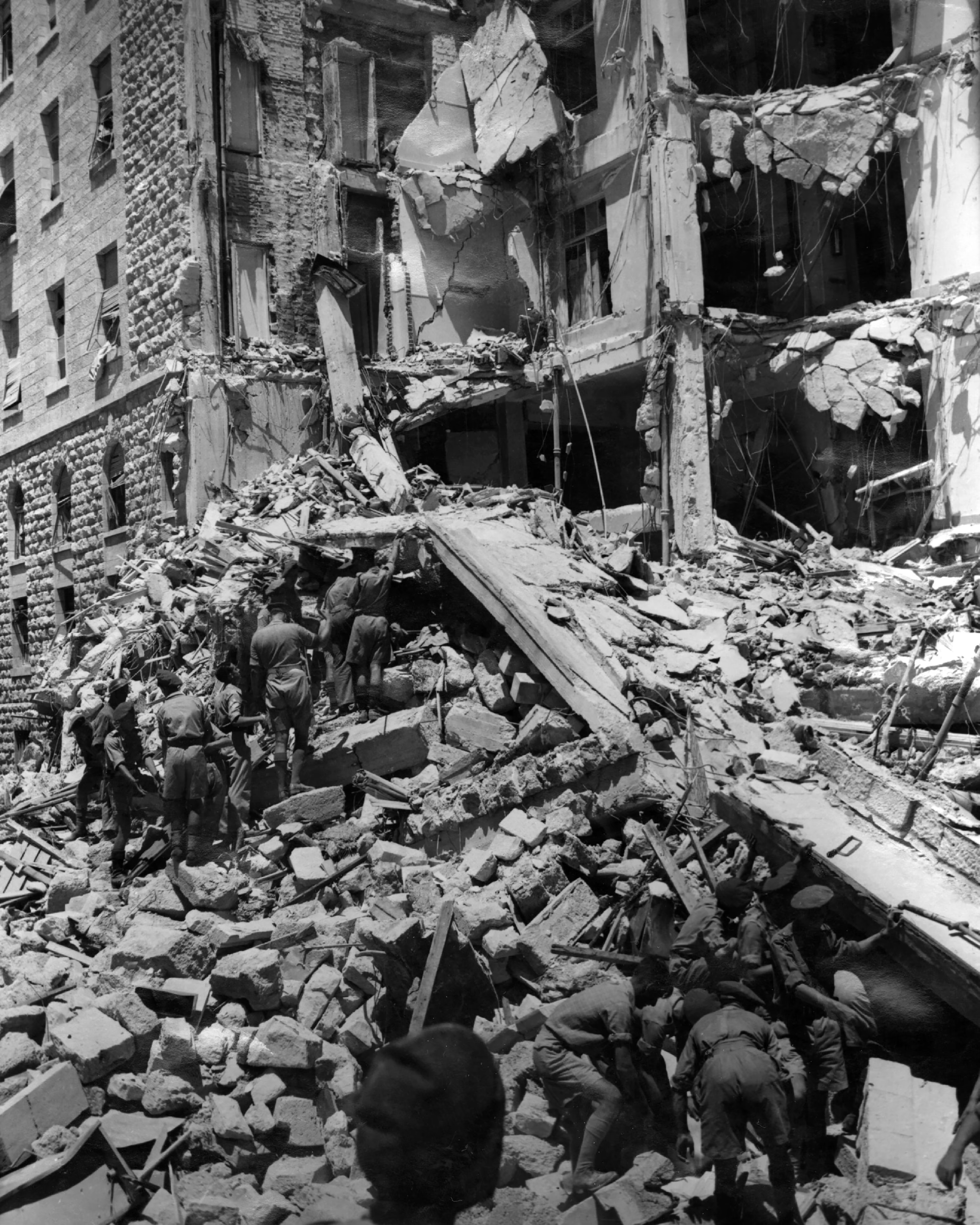
What finally convinced Britain to withdraw from Palestine was a Jewish national-liberation movement employing the same tactics that drove European empires out of Asia and Africa—including terrorism. After World War II, the Revisionists’ military wing, known as the Irgun, embraced terrorism to pressure the British into withdrawal. In 1946, the Irgun bombed the King David Hotel in Jerusalem, where the British had their administrative headquarters, killing 91 people. The head of the Irgun, Menachem Begin, became prime minister of Israel in 1977; the political party he founded, Likud, is now headed by Benjamin Netanyahu.

Similar stories could be told about Algeria, Vietnam, South Africa, and other former colonies where erstwhile terrorists became national leaders. If progressives who admire those nations’ liberation movements abhor Israel, it is because Zionism cuts across the usual political categories.
Zionism was born as a reaction against European bigotry and violence, but unlike other peoples victimized by Europeans, the Jews mostly lived in Europe, so their self-emancipation required leaving to create a new country somewhere else. The place they fixed on was their indigenous homeland, from which the Jews had been largely expelled centuries earlier by a genocidal empire. But the land of Israel was now Palestine, and the Jews could make a home there only against the will of its Arab inhabitants. Zionism was able to take root with the support of the British, but that support lasted barely 20 years, and then the Jews had to fight both the British and the Arabs.
By 1947, the British empire was in retreat everywhere, exhausted politically and economically by World War II. In August, British rule in India ended after 200 years, and the territory was hastily partitioned between Hindus and Muslims. The result was massive chaos and violence that killed up to 2 million people and left India and Pakistan mortal enemies to this day.
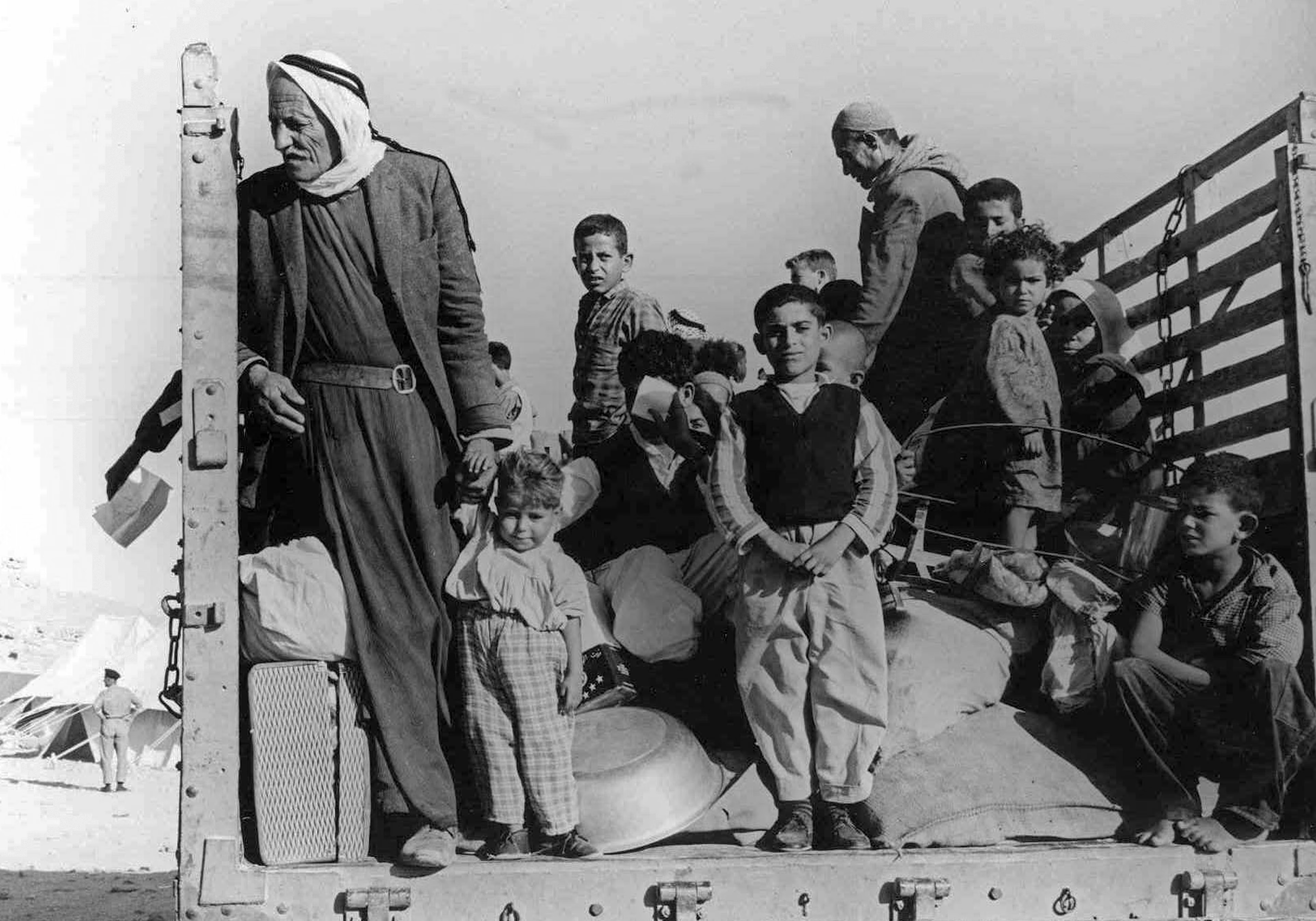
In November of the same year, the United Nations voted to partition the much smaller territory of Palestine between Arabs and Jews, with similar results. The Arabs of Palestine had never accepted the legitimacy of the Jewish presence there, and when Israel declared independence, they took up arms, supported by armies from five states. In the war that followed, Israel conquered part of the territory designated by the UN for a Palestinian state, and 700,000 Arabs were driven out or fled—an event remembered by Palestinians as the Nakba, or “the catastrophe.” Some 6,000 Jews, 1 percent of the Jewish population, were killed in the fighting.
The history of Zionism involves so many paradoxes that some basis can be found for almost any characterization of the movement. It was European and anti-European, religious and anti-religious. It can also be considered both a success and a failure.
In the summer of 1895, Theodor Herzl read an early draft of The Jewish State to a friend, Emil Schiff. When he was finished, he saw that Schiff had tears in his eyes—not because he was moved, but because he thought Herzl was in the grip of mental illness. “My dear friend, there is something wrong with your nerves. This book is a product of sickness. You must see a doctor,” Schiff recalled saying.
It wasn’t an unreasonable reaction. The notion that the Jews, who for 2,000 years had been synonymous with homelessness and powerlessness, could build a country of their own—not when the Messiah came, but within a human lifetime—sounded delusional. Yet in the epigraph to a later book, Herzl declared, “If you will it, it is no dream,” which became a Zionist slogan. The creation of Israel demonstrates that the most important force in human affairs isn’t wealth or numbers, but the power of an idea.
Zionism may have succeeded in creating a Jewish state, but it failed to solve the problem that the Jewish state was supposed to solve. The “sole purpose” of the movement, wrote Max Nordau, one of its early leaders, was “to normalize a people which is living and suffering under abnormal conditions.” Jabotinsky said the same thing: “Every nation on Earth, every normal nation, they all have states of their own,” he testified to the British commission. “That is the normal condition for a people.”
Part of the normal condition of a state is to have enemies. In predicting that the Jews would have no enemies once they had their own country, Herzl was thinking of the hatred they would escape by ceasing to be powerless; he did not think about the hatred they would attract by exercising power. The key contribution of Revisionism to the Zionist project was to understand this fact and take it seriously. Jabotinsky was viewed by the Jewish liberals and intellectuals of his time as little better than a fascist, because he insisted that Zionism’s goals could not be achieved without force.
The history of Israel, from 1948 to the present, shows that he was right. If not for its military power, the Jewish state would long since have been destroyed—by invasion in 1948, 1967, or 1973; by terrorist assaults like the one perpetrated on October 7; or by Syria, Iraq, or Iran, whose attempts to develop nuclear weapons have been thwartedby Israeli attacks. Today, however, the most serious dangers facing Israel—terrorism, international isolation, the radicalism of far-right politicians and religious settlers—can’t be overcome by force. In different ways, they are all products of the Israeli-Palestinian conflict, and a century of violence has shown that, despite the fantasies of extremists on both sides, this conflict cannot end in military victory. If it is to end at all, it can only be by achieving something even more difficult: peaceful coexistence.
When Israel’s war of independence concluded with an armistice, in 1949, the new state, intent on preserving a Jewish majority, refused to allow the Arabs expelled during the fighting to return. About 150,000 Arabs remained in Israel, constituting 20 percent of the population. But no country of Palestine came into existence in the part of the territory designated by the UN for an Arab state, because it was annexed by neighboring Arab countries—the Gaza Strip by Egypt and the West Bank by Jordan.
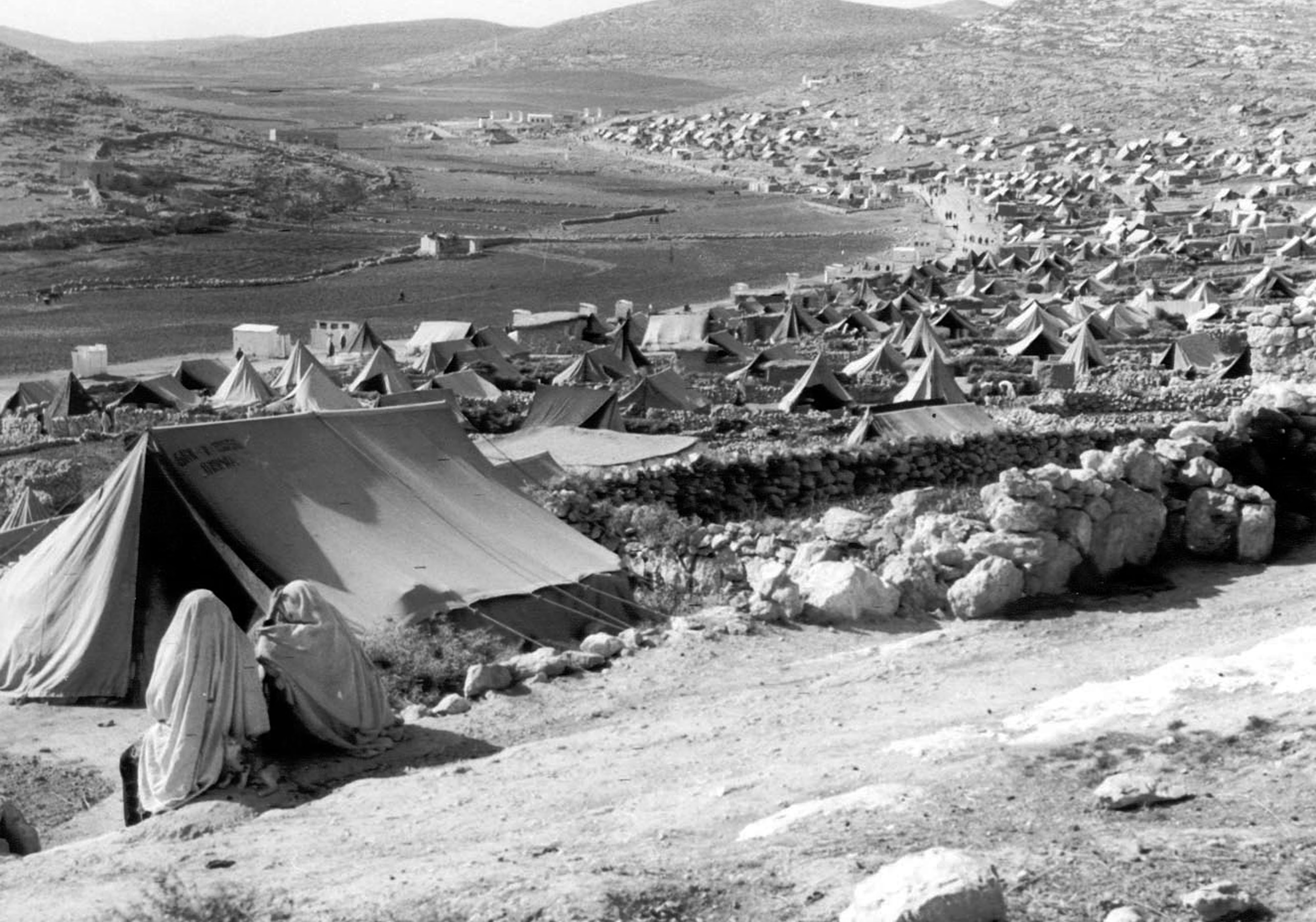
Then, in 1967, Israel conquered those areas in the Six-Day War, gaining control over most of historic Palestine. This was the goal of Revisionist Zionism, but the Revisionists had assumed that it would happen because of mass Jewish immigration. “There will always be two nations in Palestine—which is good enough for me, provided the Jews become the majority,” Jabotinsky wrote in “The Iron Wall.” Today, however, the Jewish and Arab populations “between the river and sea” are roughly equal, about 7.5 million each. This means that the Jewish state’s control over all of historic Palestine cannot be maintained democratically. Roughly 2 million Arabs are citizens of Israel and participate in the country’s elections. More than 3 million Palestinians in the West Bank live under Israeli military occupation, and 2 million in Gaza are ruled by Hamas.
Neither Jews nor Arabs believe this situation is desirable or sustainable, but no one has found a way out of it. From the 1930s to the 1990s, repeated proposals were made to settle the conflict by partition—creating two states, one for Jews and one for Arabs. But for two countries to live in peace in a territory the size of New Jersey would require a degree of mutual acceptance and trust that seems even less attainable today than it did in the past. In 2012, 66 percent of Palestinians in East Jerusalem and the West Bank and 61 percent of Israelis supported a two-state solution; in 2025, those figures were down to 33 percent and 27 percent.
[Graeme Wood: Israel can’t postpone its reckoning forever]
Another way for the conflict to end would be for one side to expel the other once and for all. When expelling Palestinians is proposed by far-right Israeli politicians, the world condemns the idea, and rightly so. But when the converse is proposed—dismantling the State of Israel and expelling the Jews—it is applauded by much of Western enlightened opinion, under the name of anti-Zionism. An illustrative example came in the summer of 2025, when Zohran Mamdani was running for mayor of New York City and a protester berated him for saying that Israel has the right to exist. Mamdani, who is as anti-Zionist as they come, meant that the country can continue in some form, but not as a Jewish state. That wasn’t good enough for the protester, who accused the future mayor of hypocrisy for saying Israel can exist at all while also embracing the slogan “Free Palestine.”
The protester was insisting on a fact that the politician preferred to obscure: Anti-Zionism is the only contemporary political movement whose goal is to destroy a country. Rather than describing this as a struggle against Zionism, a malign abstraction, anyone who calls for the destruction of Israel should be obligated to explain in concrete terms what would happen to the approximately 7.5 million Jews living there. Would half of the world’s Jewish population be “driven into the sea,” as Arab propagandists long threatened—that is, murdered, as on October 7? Would they “go back to Europe,” as protesters on American college campuses sometimes demand—where 6 million Jews were murdered, and despite the fact that today, half of Israeli Jews trace their ancestry to the Middle East and North Africa? Many anti-Zionists openly endorse these ideas. In March, the prominent Palestinian American writer Susan Abulhawa responded to a video of Israel’s defense minister on X with this comment: “these parasites will be sent back to Eastern Europe, if not the gallows.”
Other anti-Zionists, including Jewish ones, are more likely to say that Jews and Arabs will live together peacefully in a multiconfessional country. This was the vision that Mahmoud Khalil, a pro-Palestinian activist currently fighting deportation from the U.S., shared in an April interview with the Forward, a Jewish publication. He acknowledged that “it might sound like a very ideal utopia.” But the idea of Israeli Jews living under a government that would include Hamas or Hezbollah isn’t utopian. It’s a recipe for the kind of sectarian civil war that has devastated Lebanon, Syria, and Iraq for decades. No wonder the idea of a single state is overwhelmingly opposed by both Palestinians and Israelis.
It can seem that the only alternative left is despair. In September 2025, a Gallup poll found that only 21 percent of Israelis and 23 percent of Palestinians in the West Bank and East Jerusalem “think that a permanent peace between Israel and Palestine will ever be achieved.” But perhaps the idea with the greatest potential to shape a better future in Israel is the same one that has shaped the country since the beginning: Zionism.
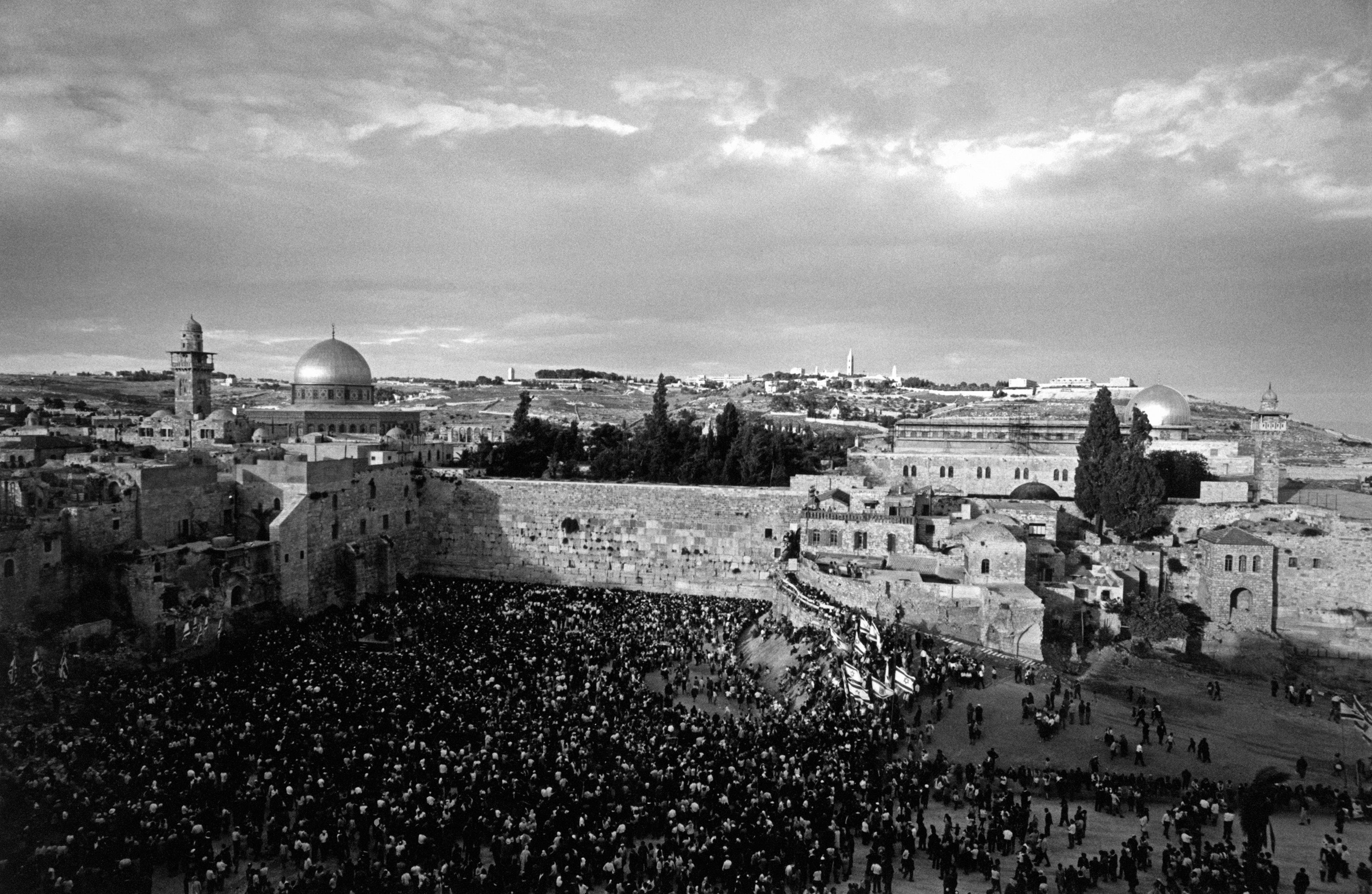
For those who have turned the word into an obscenity, it may seem bizarre to suggest that Zionism can be a constructive force. They believe that it must be vanquished, along with the state it brought into being, for the good of humanity. This is a role that Jews and Judaism have played in the Western imagination for thousands of years. For adherents of medieval Christianity, of the Enlightenment, of biological racism, it was obvious that Jewish collective existence was the chief obstacle to human progress. Today, Zionism is seen the same way. If, as the radical Swedish thinker Andreas Malm put it in the title of a recent book, “the destruction of Palestine is the destruction of the Earth,” then the survival of humanity depends on the elimination of the Jewish state.
But though this logic is emotionally compelling to anti-Zionists, its actual tendency is to make the Israeli-Palestinian conflict unsolvable. By insisting that Jewish statehood is an illegitimate aspiration that appeals only to evil people, anti-Zionists confirm Zionism’s central argument: that without a Jewish country, the Jewish people are defenseless in a hostile world. In the face of such hostility, Israelis consider it suicidal to give up military power or territorial control.
The effective target of anti-Zionism is not Israel but Jews in the United States and Europe. Since October 7, they have had their first taste of a kind of pressure that earlier Jewish generations knew well: to win individual approval by repudiating collective identity. On social media, on college campuses, in professional organizations, Jews know that they can be called upon at any time to reject Zionism and Israel, in whatever terms the caller demands. But as with other kinds of bullying, this demand cannot be satisfied, because it doesn’t want to be satisfied. Giving in is always interpreted as a sign of weakness that encourages further demands.
History, and the experience of some of today’s leading Jewish critics of Israel, shows that individual Jews can’t dissociate themselves from the status and fate of the Jews as a whole, even if they try. Earlier this year, the New York City politician Brad Lander defeated an incumbent in a Democratic House primary, partly on the strength of his outspoken criticism of Israel. But in August, when Lander joined a demonstration against a Hindu-nationalist speaker at Madison Square Garden, he was attacked by his fellow protesters for not being anti-Israel enough. “We don’t want no Zionists here. Get the fuck out!” one shouted.
Instead of seeing the persistence of Zionism as a historical or moral error, it’s more accurate—and more useful—to understand that persistence as a political opportunity. The reason Zionism didn’t disappear in 1948 is that its mission went beyond creating a Jewish state. The state is necessary for the Jewish people to survive; that belief has been abundantly and tragically vindicated. But the history of Zionism shows that it is compatible with many different conceptions of the Jewish state: territorially expansive or limited, religious or secular, socialist or capitalist. This openness made for bitter divisions in the Zionist movement before 1948, as it does in Israeli politics today. What’s certain is that, by any standard, the national life that Zionism envisioned—a “normal” existence, not one based on domination and fear—has yet to be achieved. The work of Zionism will remain incomplete until Jews and Arabs live in peace in the land that both have the right to call home.
The post What is Zionism? appeared first on The Atlantic.