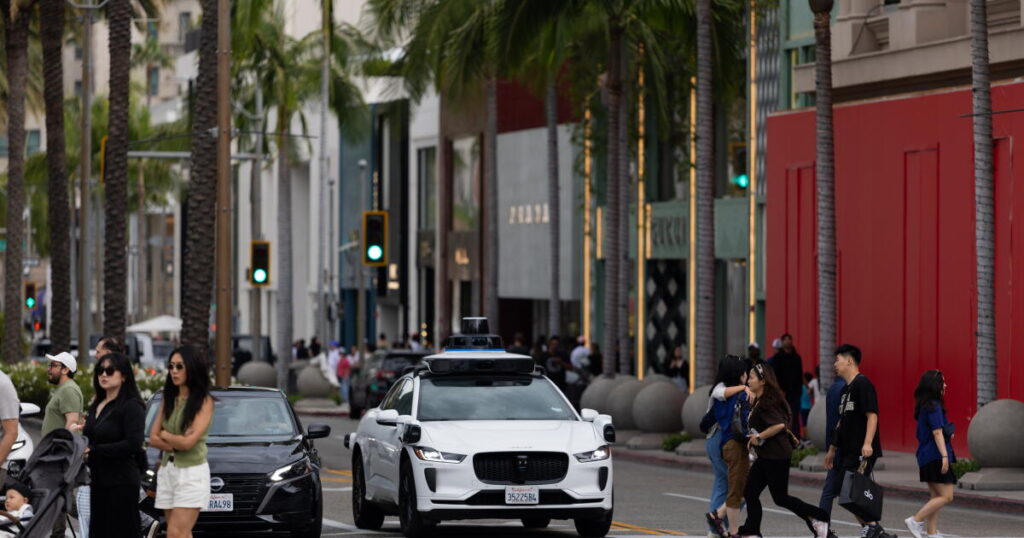
As more driverless cars hit Los Angeles streets, accidents involving them have surged.
Accidents tied to Mountain View, Calif.-based Waymo tripled last year in L.A. County as it put more robotaxis on the road. The vehicles still had relatively few incidents, and most were fender benders, according to a Times review of autonomous vehicle crash data filed with the National Highway Traffic Safety Administration.
Amazon’s Zoox is already testing its driverless vehicles in L.A., and Tesla’s Cybercab and others are expected to follow suit.
Waymo, Zoox and Cybercab operate in many cities, but California still serves as a test site for robotaxi technology, said Matthew Raifman, who studies autonomous vehicles at UC Berkeley’s Safe Transportation Research and Education Center and compiled a dashboard of robotaxi accidents using government data.
“As a testing bed place in California, we are taking on a lot of that trial and error,” he said. “I wish it wasn’t a robotaxi race, even though it is. I hope it’s a slow stroll towards safe mobility.”
California isn’t the only testing ground. Tesla announced over the weekend that it is expanding robotaxi operating hours in Austin to 11 p.m. from 10 p.m. When asked why it couldn’t go later, Elon Musk said the company was working on protecting pets.
“The main thing we’re trying to solve is making sure that we don’t run over pets when they’re hard to see at night,” Musk said in a post on X. “Literally trying to avoid grey kittens on grey tarmac in the dark.”
The worst Waymo incidents recorded have grabbed headlines.
At an intersection in San Francisco in January, a collision involving at least five vehicles and an empty Waymo left one person and a domestic animal dead. The crash was the first time an autonomous vehicle with no safety driver was involved in a fatal incident, triggering news reports and safety concerns, even though the Waymo wasn’t responsible.
In August in Dallas, a Waymo was one of the vehicles involved in an accident that killed a pedestrian. Last year in Arizona, a motorcyclist was fatally injured after hitting a Waymo and being flung into the road. In each of these fatal accidents, Waymo didn’t appear to be at fault.
The Times reviewed Waymo crash data in Los Angeles County. Incidents ranged from Santa Monica to Franklin Hills, but most caused no apparent injuries. Many occurred while the Waymo was standing still.
Waymo has reported 186 crashes in Los Angeles County this year, 219 in 2025 and 69 in 2024, according to data compiled by the California Autonomous Vehicle Crash Dashboard built by Raifman and his colleagues.
This year, 149 Waymo accidents in Los Angeles have involved a passenger vehicle, 11 involved a heavy truck, and two involved a first-responder vehicle.
Eighty-two of the crashes occurred when the Waymo was stopped and 65 when it was driving straight.
Government filings give a general description of the accidents in L.A.
In one accident, a Waymo moved over to let an emergency vehicle pass but was hit by the vehicle. There were no injuries, but the Waymo had to be towed away.
In another incident, a Waymo waiting for a light was hit from behind by a truck. Waymo reported that the customer alleged minor injuries. The government reports redacted the locations and further details about the accidents.
Just more than 80% of the crashes reported in the county this year resulted in no apparent injuries, 15% caused possible injuries, and fewer than 1% caused a suspected serious injury.
The vast majority of driverless car accidents that show up in official government figures are minor and probably wouldn’t have been reported to authorities by human drivers.
But as driverless vehicles become more widespread in cities across the country, residents and policymakers have voiced concerns. They want to know whether the artificial-intelligence-powered robots are really safer than human drivers, and what could happen when they interfere with emergency response or construction sites.
“We can’t have vehicles that are posing hazards on our streets,” San Diego City Councilmember Marni Von Wilpert said in an interview. Von Wilpert also chairs the city’s public safety committee that oversees emergency response. “We didn’t even know when the robotaxis were coming.”
The City Council voted last month to ask the state for authority over when and how robotaxis are deployed in the city. Currently, the California Public Utilities Commission, not individual communities, governs the expansion of robotaxis into new cities.
Culver City voted last month to set rules around robotaxi fleet services that dictate where and when the vehicles can be charged, stored and cleaned. Earlier this year, Santa Monica engaged in a legal battle with Waymo over the company’s noisy, disruptive charging depots.
More than 590 accidents involving Google-owned Waymo robotaxis were recorded in California in 2025. The number of collisions in 2025 nearly doubled from the 304 recorded in 2024, according to data from the National Highway Traffic Safety Administration and the California Autonomous Vehicle Crash Dashboard.
Experts say the sharp increase in crashes shouldn’t immediately raise alarm — with more robotaxis on the road, they are bound to be involved in more incidents.
Although the number of incidents has risen, the accidents per mile driven have improved over the years. In 2023, Waymo reported about 57 crashes per million miles driven. This year, that rate has fallen to fewer than six crashes per million miles.
Waymo said its autonomous driver has traveled the equivalent of 300 human lifetimes, or the distance of driving Route 66 more than 110,000 times. In that distance, Waymo has avoided injuries that would have affected 841 people, the company estimates.
“We look at every crash, every close call, and try to improve the driver to avoid those things,” said Kris Kusano, who oversees safety data research at Waymo. “The data we have is quite conclusive that, yes, they are safer than average drivers in the cities we operate in.”
Zoox is testing in Los Angeles and San Francisco and has been involved in 18 crashes in the state this year, according to NHTSA data.
Last month Waymo released its latest safety data. Across 67 million miles driven in Los Angeles, Waymo reported zero crashes resulting in serious or fatal injuries, compared with 11 expected serious injury crashes for human drivers over the same distance, the company said.
Experts warn that although initial public numbers suggest robotaxis have a better safety record than human drivers, the available data reflect vehicles operating only in controlled environments with mild weather.
“Autonomous vehicles are likely quite safer than human drivers for most driving conditions,” Raifman said. “But that is within the context of where the AVs are allowed to operate today.”
Skeptics warn that companies also have an incentive to underreport or misclassify safety incidents. Meanwhile, as different companies use different types of self-driving software and hardware that is rapidly evolving, it is too early to say whether today’s safety levels will be normal.
Tesla doesn’t use lidar, for example, a laser-based radar that’s included in Waymo and Zoox vehicles. The launch of Tesla’s Cybercab in Austin, Texas, last month prompted federal regulators to investigate whether the vehicle was properly certified.
Another technological difference is that, unlike Waymo, Zoox is building its robotaxi from the ground up instead of retrofitting an existing car.
There aren’t enough data to point to one type of self-driving technology that’s safer than the rest, according to William Riggs, director of the Autonomous Vehicles and the City Initiative at the University of San Francisco.
“The best, high-performance autonomous technology that we have is performing at a safer rate and is having collisions at a lower rate than human drivers” right now, Riggs said. “What we can’t say is, is the AV industry at large safer than human driving?”
The post L.A. now has more driverless cars, involved in more crashes. A look at the data appeared first on Los Angeles Times.