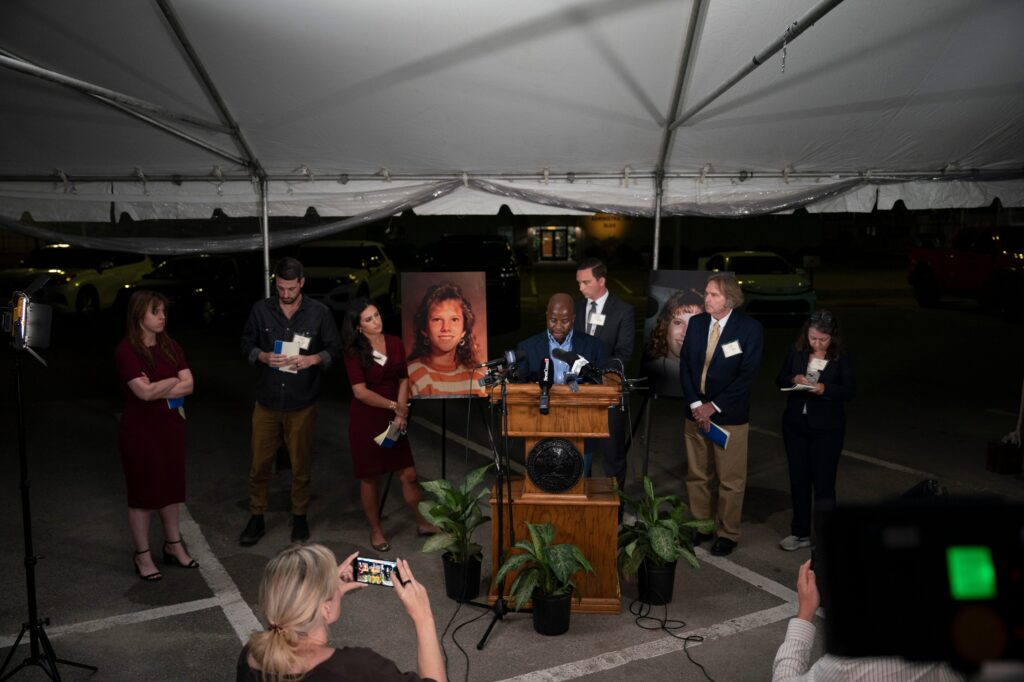
After Tennessee tried and failed to execute Christa Pike by lethal injection Wednesday, the state’s governor announced that executions would be halted there amid an investigation into what happened.
In effect, Tennessee took two starkly different approaches to the death penalty this week. First, the state pushed to carry out an execution. When that was unsuccessful, it shifted to becoming a place where executions would not take place for the time being.
The conflicting actions highlight the unsettled, sometimes tumultuous state of the death penalty in America today: It remains on the books in many states, but executions have dropped sharply across the country in recent decades and capital punishment has diminished in other ways, with little to suggest that decline will reverse anytime soon.
Executions are now carried out by a relatively small share of states — including Florida, Texas and Alabama — and the annual number taking place nationwide has fallen significantly since the turn of the century. New death sentences have plummeted, while the number of states banning capital punishment has increased.
The broad decline in capital punishment likely stems from various factors, experts say, including lower violent crime rates, a wave of exonerations that have highlighted missteps in the justice system and better overall legal defense. “Jurors and the public at large understand a little bit more how the death penalty system works and doesn’t work,” said Emily Hughes, a law professor at the University of Iowa.
“With more information comes more skepticism, and you see it playing out in jury verdicts,” added Hughes, who runs annual death penalty defense training sessions. “You see it in prosecutors’ decisions not to seek death. You see it in states deciding to stop.”
Botched executions like Pike’s have also fueled new calls to halt executions, with death penalty opponents saying the Tennessee case shows its inherent cruelty. Pike’s lawyers said officials there tried giving her two doses of lethal injection drugs, leading her to end up unconscious and on a ventilator afterward.
Supporters and opponents of the death penalty alike have also criticized the amount of time people spend on death row, which has skyrocketed. The Washington Post found in 2024 that the average person on death row was sentenced more than 20 years earlier, more than triple the amount of time in 1994.
Capital punishment was once far more common in the United States. Prosecutors in the 1980s and 1990s — a period marked by high levels of crime and violence — frequently sought and won death sentences. The number of people on death row swelled, climbing into the thousands during this period.
The ultimate punishment was also broadly popular among Americans. Gallup polling found that by 1994, 4 in 5 people supported the death penalty for someone convicted of murder. By 1999, there were an average of nearly two executions each week nationwide.
A third of those were carried out in Texas, and the following year, the state’s governor, George W. Bush, was elected president after a campaign in which the death penalty was a prominent topic.
“The reason I support the death penalty is I believe it saves lives,” Bush said in 2000. “That’s why I support it. It so happens the people of my state support it as well.”
After the turn of the century, though, the death penalty began a decades-long decline. There were 98 executions nationwide in 1999; the number dropped to 22 by 2019, the last pre-pandemic year. Public support also declined from mid-1990s levels, with Gallup finding last year that 52 percent of people said they support the death penalty for someone convicted of murder.
New death sentences also plunged, dropping from hundreds annually handed down during the 1990s to 23 new capital sentences imposed last year, according to the Death Penalty Information Center, which tracks capital punishment.
But while the death penalty has diminished, it has not disappeared. In a handful of states, executions are regular occurrences. Southern states including Florida, Texas and Alabama, along with Oklahoma and Missouri, regularly carry out executions.
The number of executions nationwide rose to 47 last year, according to the Death Penalty Information Center — the highest since 2009, but still far lower than it was around the turn of the century. The figure appears almost certain to be lower this year.
The increase last year was driven largely by executions in Florida, where Gov. Ron DeSantis (R) — who is term-limited and leaving office next year — has said he views capital punishment as “an appropriate punishment for the worst offenders.” Since the start of last year, Florida has accounted for nearly half of all executions nationwide.
At the same time, many states have moved away from the practice entirely, with a string of states abolishing or reducing its use over the last two decades.
In 2022, then-Oregon governor Kate Brown (D) commuted the sentences of the 17 people on the state’s death row before leaving office.
“I have long believed that justice is not advanced by taking a life, and the state should not be in the business of executing people — even if a terrible crime placed them in prison,” Brown, who had kept a moratorium on executions in place, said in a statement.
California Gov. Gavin Newsom (D) imposed a statewide moratorium there in 2019, and a coalition of activists has now filed a challenge in the state hoping to end capital punishment in California for good on the basis that it is racially discriminatory.
While the death penalty remains on the books in 27 states and available to the federal government and U.S. military, many places that have it do not use it.
President Joe Biden commuted the sentences of 37 of the 40 people on federal death row shortly before leaving office, saying he was “guided by my conscience.”
California and North Carolina last carried out executions in 2006, while Pennsylvania’s last execution was in 1999. Some places have moratoriums blocking executions, while in others, court orders are preventing them from taking place.
In these states and others, death sentences linger for years and decades.
“The imposition and implementation of the death penalty seems capricious, random, indeed, arbitrary,” former Supreme Court justice Stephen G. Breyer wrote in a 2015 dissent. “From a defendant’s perspective, to receive that sentence, and certainly to find it implemented, is the equivalent of being struck by lightning.”
Opponents of the death penalty say leaving people on death row for so long is cruel, subjecting them to overly restrictive conditions and years-long uncertainty about their fates. Supporters of capital punishment also rue how long people linger on death row, saying it harm victims’ relatives and undermines the justice system by announcing punishments that may never be carried out.
Support for the death penalty is “declining in some circles because it’s just so expensive,” said Daniel Nagin, a Carnegie Mellon professor of public policy and statistics. “It’s a source of never-ending appeals, and people realize that it’s extremely costly.”
Death penalty supporters say the solution is to speed up the process, including potentially by shortening the amount of time the condemned can mount appeals.
Actually carrying out death sentences, though, has proved difficult for some states, as Tennessee has shown twice this year.
Some states have also struggled to obtain the drugs used in lethal injection, with pharmaceutical companies objecting to their products being used to kill people. That has prompted a scramble among states figuring out how to get drugs and sometimes adopting other methods, such as electrocution, the firing squad or using nitrogen gas to deprive the inmate of oxygen.
In Tennessee, officials have not said how long the execution moratorium could last.
Gov. Bill Lee (R), who announced the pause, is leaving office in January. The issue could linger for the next governor to decide. Sen. Marsha Blackburn, a Republican running to succeed him, called this week for a return to the electric chair, while Democrat Jerri Green favors abolishing the death penalty altogether.
President Donald Trump has long backed the death penalty, and he has pushed his administration to ramp up its use.
This spring, the Justice Department said it was moving to make firing squads and the electric chair options for carrying out federal death sentences. The agency has also lifted the Biden administration’s pause on executions.
During Trump’s first term, his administration carried out a wave of executions. Fearing a second Trump term would continue this, opponents of capital punishment had called on Biden to commute federal death sentences before leaving office.
When he did so in December 2024, Biden left three people on federal death row: the surviving Boston Marathon bomber and the gunmen convicted of massacring people in a Pittsburgh synagogue and a South Carolina church.
Trump and his allies excoriated Biden’s commutations. After taking office last year, Trump issued an executive order directing the attorney general to help push for greater usage of capital punishment nationwide.
While the Justice Department is seeking the death penalty in dozens of cases, including for the man charged with killing a couple at the Capital Jewish Museum in D.C., the agency has not won any new federal sentences so far during Trump’s second term.
The post Tennessee’s botched execution highlights unsettled state of death penalty in America appeared first on Washington Post.