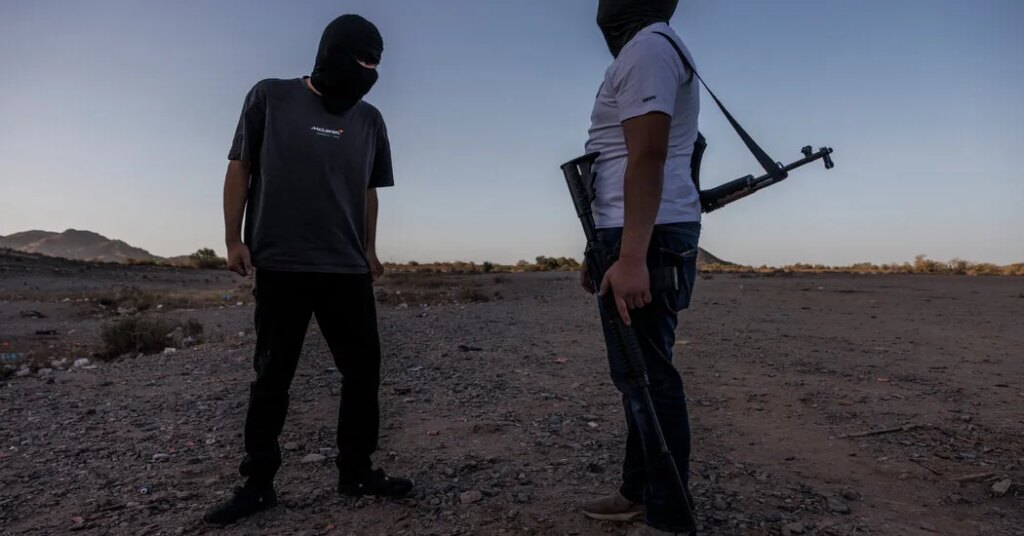
Earlier this year, I was in Phoenix watching three teenagers shoot high-caliber rifles into the desert. Each shot cracked through the air and echoed across the open expanse.
These teenagers are part of a network of American high school students and young adults who serve as key conduits in transnational gun trafficking, buying military-style rifles and selling them directly to Mexican cartel operatives.
According to law enforcement officials, trafficking experts and the American high schoolers I interviewed, the emerging network relies on American youths who are motivated not by cartel loyalty, but by profits and social status.
The gun trade is often understood primarily as a smuggling problem — American weapons carried south and delivered into the hands of ruthless drug traffickers. I reported from both sides of the border and found that it begins long before a firearm ever reaches Mexico.
It starts in an American marketplace where firearms can be remarkably easy to buy, trade and resell, and where a teenager can become a supplier in a deadly international pipeline almost without leaving the familiar terrain of high school life.
Here are some takeaways from the reporting.
American teenagers are becoming part of the cartels’ U.S. supply network.
Mexican criminal groups are relying on teenagers and young adults in border states like Arizona to help supply their weapons, according to current and former U.S. law enforcement officials. The phenomenon is not new, the authorities say, but the role young Americans play in the gun trade has never been documented in such detail.
The teenagers are part of a much larger network of American intermediaries that separates cartel operatives from the people who actually obtain the guns. The chain includes independent brokers, logistics operators, recruiters, straw purchasers and, increasingly, young traffickers, many of them U.S. high school students.
The four young American traffickers I interviewed supply weapons primarily to the powerful Sinaloa Cartel but do not describe themselves as cartel members, nor do they profess any particular loyalty to any one criminal group.
Instead, many began buying and selling firearms at a very young age, they said, sometimes almost as a hobby, before quickly becoming cogs in an international arms pipeline.
The system can pull teenagers in without cartels’ directly recruiting them.
The teenagers I interviewed did not describe a conventional recruitment system in which cartel operatives target vulnerable young people and force them into gun trafficking. Instead, they said they initially got into the gun trade on their own, and as they became more prolific and made connections with cartel operatives, turned into reliable suppliers for Mexican cartels.
They described negotiating gun deals between classes or after school, and spending afternoons scrolling through WhatsApp group chats for weapons. One said he gave up dreams of becoming a doctor or dentist after seeing how much he could make selling guns.
Their paths into the gun trade varied. One student said he learned through friends and social media that there was a large market for firearms and substantial money to be made supplying them. Another one began buying guns to “be cool,” he said, and started reselling the guns only after realizing how easily he could make money.
In many ways, the youths I interviewed are quintessential American teenagers: preoccupied with girls and parties, glued to their phones and eager for money and status. But the financial incentives can be too powerful for someone so young. Speaking on the condition of anonymity because of the criminal nature of their activities, they described profits that can reach thousands of dollars a month — extraordinary sums for someone still in high school.
Money, however, is only part of the draw. Several talked about a culture in which posing with firearms on Instagram or TikTok confers status among classmates or simply offered them a sense of belonging, turning teenage fascination or the lure of quick money into an entry point to the international gun- trafficking networks.
Technology and encrypted apps make the trade easier.
The use of encrypted apps and social media platforms has transformed the scale and accessibility of the gun underground market. WhatsApp, Telegram and Signal, along with websites where firearms can be legally bought and sold, have helped turn a trade that once depended heavily on personal connections into a digital marketplace, according to former and current U.S. law enforcement officials.
Beyond those platforms, the teenagers said they obtain weapons in a variety of ways.
Some said they buy firearms legally once they turn 18, while others recruit friends who can. Others said they steal weapons from homes, cars and even their own parents, or find sellers through WhatsApp and Telegram. The guns are then resold to cartel-connected buyers, dropped at stash houses or handed to intermediaries who move them across the border, they said.
In states like Arizona, where firearms are widely available, the distance between wanting a gun, finding one and discovering that it can be profitable to sell one can be remarkably short.
The post What We Learned About American Teenagers Supplying Guns to Cartels appeared first on New York Times.