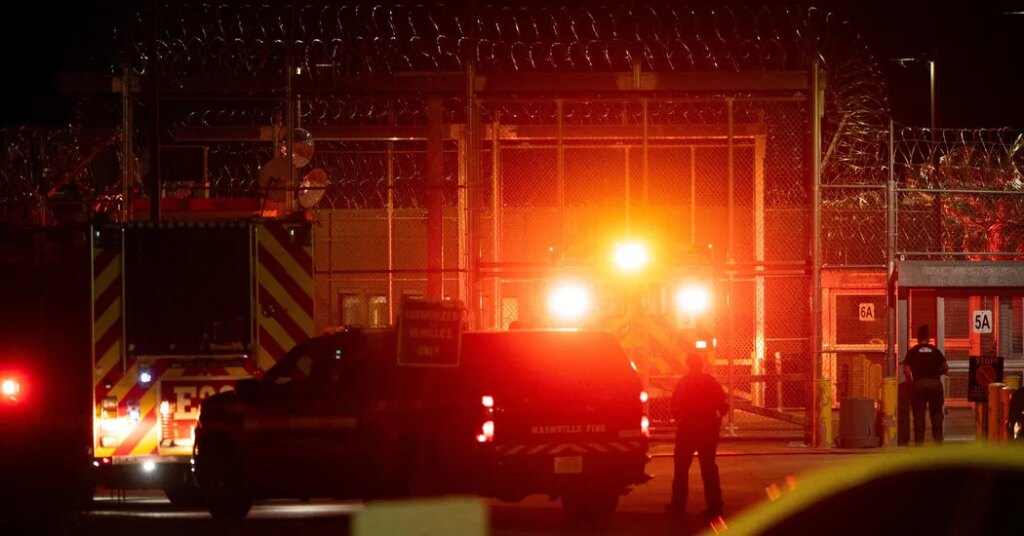
The failed effort to kill Christa Pike has placed a harsh spotlight on the practice of capital punishment in America, one of 17 countries to carry out an execution last year, as well as the regularity with which those executions go awry.
Ms. Pike was given two doses of lethal pentobarbital but then rushed for medical care when it was clear she was still alive. She was unconscious, intubated and on a ventilator in a hospital as of Thursday night.
“It is hard to see how this can be allowed to continue — not only in Tennessee, but nationwide,” said Maya Foa, the chief executive of Reprieve, an anti-death penalty group. She called the failed attempt to kill Ms. Pike “one of the most catastrophic executions” in U.S. history.
In 2025, 47 people were executed in the United States, more than in any year since 2009, though still below the peak of 98 executed in 1999. Yet even as technology has evolved and new tactics have been tried on death row prisoners, officials continue to botch executions.
Prisoners have suffered for long periods as doctors fail to find a suitable vein. Some have died in gruesome, unintended situations involving blood or flames. But Ms. Pike, who was convicted of murder in the 1995 killing of her classmate, survived, and is now part of a minuscule cohort of prisoners to have done so.
On Thursday, President Trump expressed disbelief at Tennessee’s error. “How does that happen?” he said. “It shouldn’t be very difficult.”
Mr. Trump, an outspoken advocate of capital punishment, began his second term by ordering prosecutors to pursue the death penalty in more cases. And in April, he said the Justice Department would allow additional methods of execution such as firing squads.
A majority of Americans continue to support capital punishment, but that backing has declined in recent decades, according to public opinion polls.
Ms. Pike’s botched killing was the second time this year that Tennessee officials failed to administer a lethal injection. In May, the state called off the execution of Tony Carruthers because staff members couldn’t find a suitable vein.
On Thursday, Gov. Bill Lee paused executions in Tennessee and called for a review of the state’s policies. Mr. Lee, a Republican, had ordered a similar review in 2022 after officials failed to properly test the drugs before an execution.
Many expressed frustration that a process meant to kill Ms. Pike ended with her being rushed for lifesaving care. The mother of Colleen Slemmer, the 19-year-old woman killed by Ms. Pike, said she’d been deprived of justice for her daughter’s killing.
America Favors Lethal Injections
While 27 states have the death penalty on the books, fewer than half of those have carried out an execution in the last five years. And several states have issued brief moratoriums, like Tennessee did, in recent years after errors in the death chamber.
Virginia, which over its history executed more people than any other state, became the first Southern state to abolish the death penalty in 2021, and Ohio’s governor said in June that he wanted his state to abolish it, too.
By far, the most common execution practice in America is lethal injection.
Lawsuits and pressure on drug suppliers have made these injections more difficult to carry out, forcing some states to explore alternate methods. South Carolina executed three men by firing squad last year, doubling the number of firing squad executions in modern times, and several other states have authorized the method.
One of the lawmakers who proposed the firing squad in South Carolina said he believed it was more instantaneous and caused less suffering than the electric chair.
The Death Penalty Information Center, a research group, says that lethal injection, introduced in 1982 as a more humane alternative to the electric chair, has had the highest failure rate in executions.
These failed attempts include the 2021 case of John Grant, who vomited and shook for several minutes during Oklahoma’s first execution since 2015, when it had mistakenly used the wrong drug to stop another prisoner’s heart.
In Alabama, executioners tried for hours to find the veins of Joe Nathan James in 2022 as he lay in the death chamber. They eventually sliced into one of his arms in what is known as a “cutdown” in order to give him the fatal drugs, according to a private autopsy.
And in 2024, Idaho executioners tried for nearly an hour to insert an intravenous line into the arms, then hands, and then legs of Thomas Creech, who was then 73. He remains one of eight people on Idaho’s death row.
A Move Toward Nitrogen Gas
Alabama pioneered another tactic in 2024, when it began killing prisoners with a nitrogen gas that deprives them of oxygen. State officials heralded the first nitrogen execution, of Kenneth Smith, as a new frontier.
“Alabama has done it, and now so can you,” said the state’s attorney general, Steve Marshall, encouraging other states to adopt Alabama’s protocol. One did: Louisiana carried out its first execution in 15 years last year, using nitrogen gas for the first time.
Several witnesses to Alabama’s execution, though, told The New York Times that they were disturbed by what they saw in the death chamber.
Mike Sennett, a son of Mr. Smith’s murder victim, Elizabeth Dorlene Sennett, said he was advised by officials that the prisoner would take a few breaths and succumb. “That ain’t what happened,” he said. “After about two or three breaths, that’s when the struggling started.”
“With all that struggling and jerking and trying to get off that table, more or less, it’s just something I don’t ever want to see again,” Mr. Sennett said.
That description is not dissimilar to those offered after the United States’ first execution by electric chair, in New York State in 1890.
A front-page headline in The Buffalo Evening News said the death of William Kemmler in Auburn “was an awful sight” and declared “the process a failure.”
In that execution, a doctor had announced Mr. Kemmler’s death only to realize, in a panic moments later, that he was still alive.
“This man is not dead,” the doctor cried, according to the Evening News account, and asked for the current to be turned back on.
Mr. Kemmler’s lips dripped, his chest moved, and he made a loud wheezing and groaning sound. Finally, he was again pronounced dead.
“FAR WORSE THAN HANGING,” The New York Times wrote on its front page on Aug. 7, 1890.
One doctor involved predicted there would never be another electrocution.
The post ‘How Does That Happen?’: America’s Execution System Is Long Flawed appeared first on New York Times.