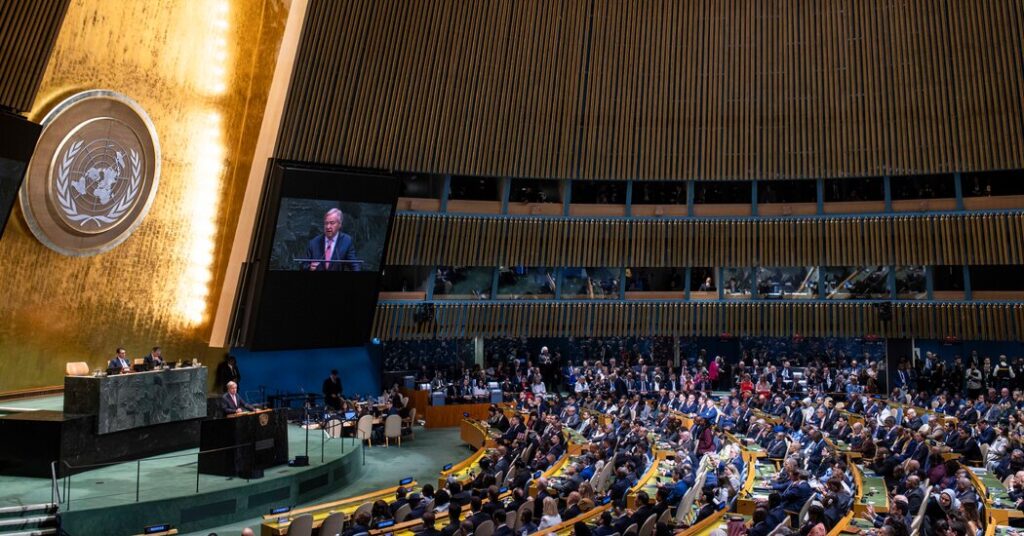
As other world leaders pleaded for international cooperation and an end to wars in the Middle East, President Trump warned the United Nations General Assembly on Tuesday that he could either strike a deal with Iran or obliterate the country.
“I have a big decision to make,” Mr. Trump said from the podium of the assembly’s annual meeting in New York. “Will a deal be made with Iran that lets them rebuild and create a far greater country than it ever was before — maybe one of the greatest in the Middle East or even the world? Or do I annihilate the Islamic Republic and do it quickly, never giving them a chance to kill and destroy people and countries again?”
Mr. Trump seemed to indicate that Iranian officials have been dragging out the war that the United States and Israel began almost seven months ago, in hopes of hurting Republicans, who are trying to retain control of the House and Senate in the midterm elections in November.
“Do I drive them into hell with no chance of survival and no hope of future greatness or generations?” Mr. Trump said. “But I believe we’ll make a deal right after the election because it doesn’t make sense for them not to. They’re waiting to see how I do in the midterm election.”
Mr. Trump’s threats echoed a social media post that he made in April, when he warned Iran that “a whole civilization will die tonight,” a threat he did not carry out, which legal experts said would amount to a war crime. But even by the standards of Mr. Trump’s bellicose rhetoric, it was startling to hear an American president issue such a dire threat at the United Nations, a body created in the aftermath of World War II with the goal of peaceably resolving conflicts.
Stone-faced diplomats from Iran and other countries listened as Mr. Trump, the second world leader to address the General Assembly, alternately trumpeted his own power and lashed out at nations and institutions he held up as worthy of scorn, including Cuba and the International Criminal Court.
While many world leaders refrained from head-on condemnation of the United States, several criticized the war in Iran and many blasted Israel, a close U.S. ally, accusing it of committing genocide in Gaza and of trampling the rights of Palestinians in the Israeli-occupied West Bank.
Speaking after Mr. Trump, King Abdullah II of Jordan devoted much of his speech to the Israeli-Palestinian conflict, calling the Israeli military campaign in Gaza “an attempt to erase Palestinian life and impose a new territorial reality.”
The Jordanian king also decried the war in Iran, pointing out that the costs of the conflict have been felt in places far from the Middle East. “If anyone had any doubt that conflict from our region stays there, just look at the energy and grocery bills of ordinary families, from Mumbai to Minnesota,” he said.
This year, like last year, the U.S. State Department barred the Palestinian government — recognized as a state by most of the world’s nations — from attending the General Assembly by refusing to issue visas to its top officials. Israeli and Iranian officials are expected to address the General Assembly later this week.
Turkey’s president, Recep Tayyip Erdogan, said that his country would “continue to be the voice of a free and sovereign state of Palestine” and he roundly condemned Israel’s actions in Gaza, saying that the world was “faced with a genocidal mind-set that can never get enough of killing.”
As he spoke, Israel’s delegates left the assembly hall.
President Emmanuel Macron of France was also highly critical of Israel’s actions in Gaza, saying the plight of the Palestinians there was a shameful “spectacle.”
Other sharp divisions were on display on the opening day of the General Assembly’s annual meeting, which is expected to draw 71 heads of states to New York. Cuban officials walked out when Mr. Trump declared that Cuba was “an absolutely failed state” and vowed that its government “will fall.”
“The US government proves incapable of accepting that #Cuba is, and has the right to be, a fully independent and sovereign country,” Cuba’s foreign minister, Bruno Rodríguez Parrilla, posted on social media after Mr. Trump’s speech. He added, “Cuba is not a threat to the US nor to any country.”
The United Nations itself is in a period of transition, searching for its next leader, as Secretary General António Guterres prepares to step down when his term ends in December.
Mr. Guterres, 77, who has led the United Nations since 2017, presided during a turbulent era convulsed by climate change, the rapid development of artificial intelligence, huge natural disasters and wars in Ukraine, Gaza, Iran and elsewhere.
“The fault lines in our world are widening,” Mr. Guterres said in his final address to the General Assembly. “Cracks have become canyons.”
Mr. Guterres said the events of this year in particular had demonstrated that even the strongest nations had their limits, and that building a better future “begins with a recognition, especially by superpowers, that their power isn’t so super.”
Brazil’s president, Luiz Inácio Lula da Silva, said in his address, the first by a world leader to the General Assembly, that the world was confronting a “profound leadership crisis.”
U.N. members, he said, have been “held hostage” by the Security Council, a reference to the power of some countries to block major actions. The Council’s five permanent members, the United States, China, Russia, France and Britain, all hold veto power.
Russia’s full-scale invasion of Ukraine, which began in 2022, was also a focus of concern. After briefly touching on Iran and Gaza, President Gitanas Nausėda of Lithuania said that the conflict in Ukraine posed the “greatest threat to world order.”
He condemned what he called “numerous violations of our airspace by combat drones” during the war.
President Volodymyr Zelensky of Ukraine and Mr. Trump met on the sidelines of the General Assembly. The two also spoke by phone over the weekend, amid efforts by the White House to revive negotiations to end the war in Ukraine.
“We talk about it a lot, including with President Putin, and I think something is going to happen,” Mr. Trump told reporters after the meeting, referring to President Vladimir V. Putin of Russia. He described the Ukrainians as “very good fighters” and said “they can be proud of themselves.”
Mr. Trump’s speech came as traditional American allies have begun to openly question whether the United States remains a credible partner, committed to international alliances.
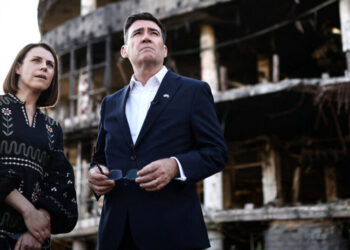
Sitting next to Prime Minister Andy Burnham of Britain in a meeting on the sidelines of the General Assembly, Mr. Trump said he believed a settlement with Iran would eventually be reached.
Iran’s foreign minister, Abbas Araghchi, met with Steve Witkoff, the U.S. special envoy, and Jared Kushner, Mr. Trump’s son-in-law who has been aiding in negotiations, on the sidelines of the General Assembly, according to two Iranian officials. Mr. Trump told reporters it was a “very good” three-hour meeting, but did not provide any details on the talks.
“It’s potential greatness or obliteration” he reiterated.
At a separate ceremony in New York with officials from Greenland and Denmark, Mr. Trump signed a revised security agreement for Greenland. Details of the new accord remained vague, but it appeared to fall short of Mr. Trump’s vows to buy or seize the island, a semiautonomous territory of Denmark. Speaking to the General Assembly, Mr. Trump said that the United States planned to build two new military bases on Greenland — something it could have done in previous decades.
Ranging across other topics, Mr. Trump also dismissed calls from top programmers, executives and experts to restrain the development of artificial intelligence, saying those warnings were coming from the “same group of people” who promoted what he called “the Russia hoax.”
“We will only encourage super intelligence,” Mr. Trump said. “We’re going to encourage it, not rein it in.”
Mr. Trump also celebrated the American military operation in Venezuela, where the United States has expanded its control over that country’s vast oil reserves.
“To the victor belong the spoils,” Mr. Trump declared.
Reporting was contributed by Yonette Joseph, Zane Irwin, Tyler Pager, Max Bearak, Aaron Boxerman, Michael Crowley, Ismaeel Naar and Ana Ionova.
The post At U.N., Trump Says He Will Strike a Deal With Iran or ‘Annihilate’ It appeared first on New York Times.