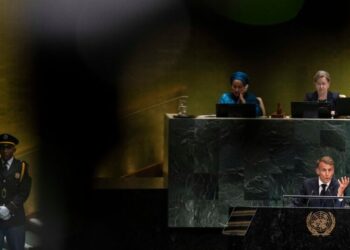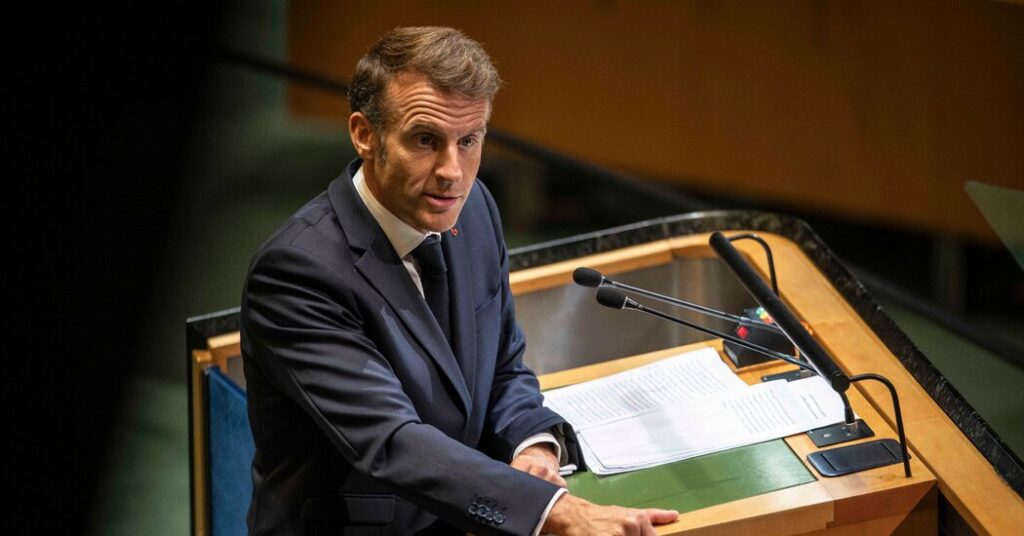
For President Emmanuel Macron of France, this year’s United Nations General Assembly is a swan song.
Mr. Macron will step down in May after 10 years in office, during which he became a fixture at the annual event in New York, evolving from a 39-year-old political upstart into one of Europe’s senior statesmen.
It has been an eventful voyage for Mr. Macron, marked by triumphs and frustrations. Last year, the president led a parade of countries in recognizing the state of Palestine, a move that thrust France into the diplomatic spotlight but antagonized Israel and its biggest ally, the United States.
At the same meeting, the police stopped Mr. Macron and his entourage on a Manhattan street that had been blocked off for President Trump’s motorcade. After trying fruitlessly to negotiate with a police officer to pass, Mr. Macron whipped out his cellphone and called Mr. Trump directly.
“Guess what,” he told the president, as TV cameras recorded the scene, “I am waiting in the street because everything is frozen for you.”
The episode is an apt metaphor for much of Mr. Macron’s decade on the world stage. He has been active and ambitious but so often hostage to an American president whose mercurial style and unorthodox policies have disrupted trade relations, rattled the NATO alliance and poisoned the trans-Atlantic relationship.
This year, according to French officials, Mr. Macron is not expected to go to New York with a major new diplomatic initiative. France stepped back recently and let Britain take the lead in announcing the latest Western effort to apply pressure on Israel over Gaza — a suspension of trade with Jewish settlements in the West Bank, which are widely viewed as illegal under international law.
France joined the trade suspension, along with Canada and nine other countries. But Mr. Macron has left it to the British to explain the move, which drew bitter recrimination from Israel. Instead, the French president has focused on Lebanon, another traditional French interest in the Middle East.
Last Thursday, in Paris, Mr. Macron convened Lebanon’s president, Joseph Aoun, and King Abdullah II of Jordan to discuss efforts to fortify the Lebanese armed forces. At the United Nations, French officials said, Mr. Macron will speak about the need to replace a U.N. peacekeeping force in southern Lebanon, where Israel regularly clashes with the Iran-backed Hezbollah militants. The force’s mandate expires at the end of 2026.
He will also try to keep a French hand in two other major global conflicts — Ukraine and Iran — by meeting with President Volodymyr Zelensky of Ukraine and seeking a session with President Masoud Pezeshkian of Iran.
Mr. Macron is not limiting himself to geopolitics. On Tuesday evening, he plans to meet with filmmakers in New York, picking up a theme he struck at a recent conference on the French Riviera, at which he called on the United States and other countries to join to protect the future of cinema.
The post A Quiet Swan Song for Macron After a Decade in the U.N. Spotlight appeared first on New York Times.