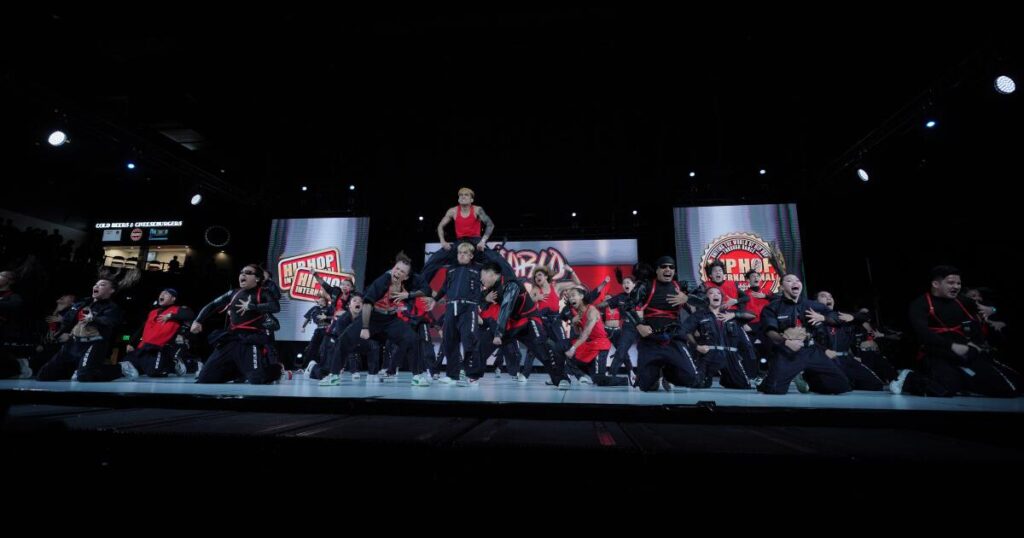
Hip Hop International, which turns 25 this year, brought some of the world’s best dance crews and choreographers to mainstream attention. Groups including Jabbawockeez and Quest Crew, and choreographers such as Parris Goebel (Lady Gaga, Rihanna, Justin Bieber) and Sienna Lalau (BTS, Blackpink, Ciara) all got their start through the group’s annual dance competition, which connected dance cultures in a pre-YouTube era through global shared artistry when breaking was a mostly underground activity.
This year’s weeklong contest concludes Saturday in Phoenix, when a new world champion will be crowned. Involving 3,000 dancers from 55 countries, the competition has grown to be among the largest in the world due to the efforts of founders Howard and Karen Schwartz, whose globetrotting history led to HHI’s current prominence in the dance world.
In the late 1980s, the Schwartzes were known as “the mother and father of aerobics.” The duo were pioneers of the aerobics craze that gripped the nation during that decade and helped create the National Aerobic Championship. ESPN followed the Schwartzes’ competitions. So did the Soviet Union, which was in the midst of the massive social, economic and cultural upheaval that culminated with the fall of the Berlin Wall in 1989.
Soon after, the Soviet Union asked the Schwartzes to bring their aerobic champions to teach fitness and aerobics there, Karen said. So they did.
“We grew that,” Howard said, adding that the aerobics championship became “almost as big as what HHI is now. We were all over the world with it.”
The pair later transitioned out of aerobics but still had the desire to create communal experiences. While traveling, the Schwartzes went to Paris and saw kids breaking on the street. The seed of an idea was planted. It blossomed later on a trip to Tokyo, as they emerged from a subway.
“We were walking and we saw a group of dancers that were practicing in the streets, but utilizing a storefront window reflection where it became a mirror,” said Karen, who was struck by the creativity of the art form.
When the Schwartzes first began to establish HHI, they reached out to people who would lend credibility, including Don Campbell, creator of the street dance style Locking; Ken Swift, a longtime b-boy and member of the Rock Steady Crew; and Toni Basil, a member of the 1970s dance crew the Lockers (with Campbell) and singer of the ’80s hit “Mickey.”
Basil has since received HHI’s Icon Award and is often a judge during championship weeks and worldwide competitions. She is a stalwart ambassador of dance worldwide. The Lockers were the first group of dancers to travel outside of the “Soul Train” sphere to be seen on television as a singular act. They appeared on “The Tonight Show” and “The Carol Burnett Show,” and were among the first crews to legitimize the art form by making a living from it.
“I don’t know how Karen and Howard organize it,” Basil said of the HHI competitions, noting that so many “kids get to come to America. It’s a big deal. It’s their life. It’s incredible. And to be dancing morning, noon and night, that’s a serotonin-raising life. I mean, everybody’s high on dance.”
Basil touts the international expansion of hip-hop dance and says that “there’s no more important crew battles in the world than HHI. Period.” She also said that HHI’s penchant for group choreography in the U.S. has translated worldwide. Dancers like Goebel and Lalau have graduated from the HHI community to stand on global stages as choreographers and artistic directors with music’s biggest artists.
Goebel operates out of Auckland, New Zealand, in a dance studio she created called the Palace. Her large dance crew, the Royal Family, helped establish the mold of choreographer-dancer-musician after unprecedented success at the HHI competition.
“Definitely the Royal Family competing at HHI and winning three gold medals in a row gave us international recognition for the dance crew and in turn made the Palace well known as I had many crews coming of out my studio,” Goebel wrote in an email.
Lalau‘s classes during the competition week at the HHI championships are coveted events, and she has led numerous classes and groups for the Lab, a Los Angeles-based hip-hop dance crew and studio.
“As my career evolved, I realized HHI is about so much more than competition,” Lalau wrote in an email. “It’s a place where culture, community, and creativity come together. That mindset has stayed with me throughout my career. Whether I’m creating for an artist, building a cast, or teaching a class, I always come back to the idea that the strongest work comes from collaboration.”
In 2008 the Schwartzes’ success led to them serve as producers for the Emmy Award-winning “America’s Best Dance Crew,” an MTV dance competition series that ran for eight seasons. Success stories from the show include crews such as the Jabbawockeez, which has been a fixture in Las Vegas since its first-season win, Quest Crew, Snoop Dogg and Far East Movement.
“ABDC” shone a spotlight on background performers and treated its participants with respect. JC Chasez, a member of N*Sync who also served as a judge on the show and was a talent competition participant himself, wrote in an email that he was excited to be in the mix.
“I know a lot of shows are about the judges, but I thought ‘ABDC’ did a really good job at making sure the audience at home knew that the stars of the show were the dancers,” Chasez wrote.
Chasez, now a producer on the Broadway musical “Titanique,” also noted that “ABDC” alumni are everywhere.
“I’ve really been enjoying seeing crew members succeed … on different projects,” he said. “I was in New York for the Tonys, and some of the people in ‘Jellicle Ball,’ … had competed on ‘Dance Crew.’”
Now that it’s hit the 25-year mark, supporters believe HHI will continue to evolve along with hip-hop dance itself. Always looking forward while reaching back to keep the past alive.
Reinvention is necessary, Chasez said, because hip-hop music today no longer sounds like it did in the ’80s.
“And so as the sonics change and as the rhythms evolve, I think that’s where interpretations will continue to evolve as well because they are visualizing the rhythms that you’re hearing and telling a story in a unique way.”
Lalau said she expects the next 25 years will bring even more authentic creativity, but that she hopes “that we still prioritize the human side of dance [over tech advancements]. Hip-hop has always been rooted in community, connection and self-expression.”
“We really are so proud of a number of the things that we have been able to accomplish, because it’s made a difference,” Karen Schwartz said of herself and her husband, adding that it’s hard to stop and think about those things because they’re so busy thinking about the future.
“That’s the problem, actually,” Howard said. “We’re constantly, ‘What can we do next? What can make the experience better for everyone?’
“Our ultimate goal is of course to bring ‘ABDC’ back,” he said, “and we haven’t stopped trying.”
Until then, a new world champion will be crowned Saturday night, continuing a tradition that has become much more than a trend.
The post ‘Everybody’s high on dance’: At 25 years, Hip Hop International has big plans for the future appeared first on Los Angeles Times.