ANKARA, Turkey ― U.S. forces Wednesday launched strikes on Iran for a second consecutive day, officials said, hours after President Donald Trump declared the ceasefire between Washington and Tehran “over,” and predicted additional U.S. military action “probably” would occur.
American forces carried out the strikes at the direction of the president “to further degrade [Iran’s] ability to threaten freedom of navigation in the Strait of Hormuz,” according to a statement from U.S. Central Command, which oversees operations in the region. The waterway has been a source of friction both militarily and economically in recent weeks, as Iranian forces have been accused of attacking commercial vessels and the United States has responded.
“The United States is holding Iran accountable for recent unjustified aggression against commercial shipping and civilian crews freely navigating a vital international waterway,” the Centcom statement said.
Trump, speaking in Turkey, had said earlier in the day that “I think” a tenuous ceasefire agreement reached between U.S. and Iranian officials in June was “over.” However, he later qualified his remarks, saying that any military action would end “very quickly” and that he didn’t think the U.S. military would return to full-scale war.
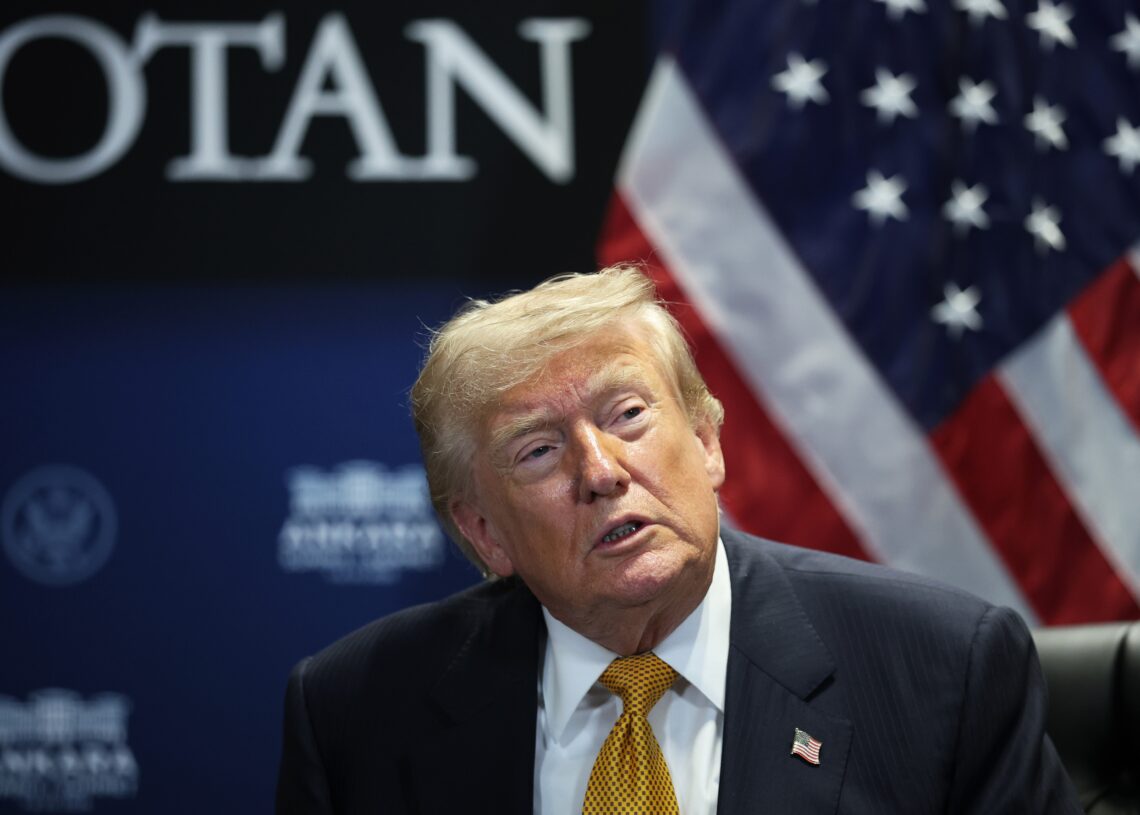
Trump spoke at a meeting of NATO leaders on Wednesday after U.S. forces launched over 80 strikes on Iran in response to attacks on ships passing through the Strait of Hormuz.
Trump said the U.S. hit Iran “very hard last night” and would “probably hit them hard again tonight.”
The president also suggested the U.S. could reimpose a naval blockade on Iran and that Washington was “not attacking at the highest level,” repeating previous threats to strike infrastructure such as bridges, desalinization facilities and electricity plants. U.S. officials declined to detail what might be planned but said in a social media post later in the day that more than 20 U.S. warships remain in the Middle East.
Oil prices had eased but quickly spiked on Wednesday. Brent crude futures rose more than 5 percent to over $78 per barrel on fears that a renewed war would further disrupt energy supplies.
But Trump offered an evolving account of his plans in multiple appearances over the course of the day, by nightfall suggesting that any additional fighting was likely to remain contained.
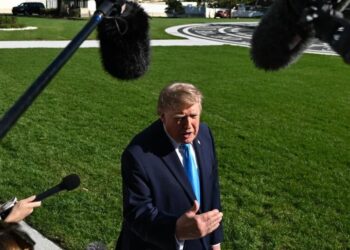
“I don’t think it’s going to start again,” he said at a news conference before returning to the United States. “I think it’s going to go very quickly. They hit a couple of ships, and so we hit them much harder. … We use their language. We speak their language.”
The president spoke after Iran launched heavy retaliation overnight, with the Islamic Revolutionary Guard Corps saying it had targeted 85 U.S. military facilities in Bahrain and Kuwait on Wednesday, according to the semiofficial media outlet Fars.
“They’re scum. They’re sick people. They’re led by sick people, and they’re vicious, violent people,” Trump said in his comments earlier Wednesday. “Far as I’m concerned, it’s just a waste of time dealing with them. They’re liars … there’s something wrong with them. They’re cuckoo. As far as I’m concerned, it’s over.”
Trump said that talks with Iran could continue, but that he was deeply skeptical they would be productive.
“They can talk, but I think they’re wasting their time. They’re a bunch of lying guys,” Trump said. “They’re bad people, and frankly, I don’t want to waste my time with them. Now, I’ll let our wonderful negotiators keep talking if they want, but I don’t see it.”
Later in the day, Trump declared that he was Iran’s top target for assassination.
“I’m their number-one target. It’s out all over the place,” Trump said. “Because they’re scum. That’s the way they act, and that’s the way they’ve done it for 47 years.”
Adding to speculation about Iranian threats to his life, Trump also abruptly announced Wednesday that he would not be departing Turkey on the new Qatari luxury 747 that he debuted as Air Force One last week. Instead, he said he will depart on one of the older, smaller 747s that have been in service since 1990, jumping back on the fancier plane in Britain.
The Qatari jet — whose $400 million overhaul was accelerated by the U.S. Air Force when it took possession of the plane last year — is unlikely to have the same self-defense capabilities as the older, highly modified plane. That could pose a problem when flying out of Turkey, which shares a border with Iran.
Trump framed the move as a chance for U.S. service members based in Britain to explore the new jet. But asked Wednesday whether he had changed his plans because of security concerns, he didn’t answer directly.
The president’s tone about Tehran was a marked change from his assessment of Iranian leaders just weeks ago, when he praised their interest in making a deal shortly after they agreed to the ceasefire.
Asked why he was now dismissing them as scum, Trump said that “I got to know ’em.”
The secretary general of the International Maritime Organization, Arsenio Dominguez, in a statement Wednesday, urged shipowners to avoid exposing their crews to danger by crossing the Strait of Hormuz “as long as the safety and security of crews cannot be assured.”
The U.S. and Iran reached a preliminary peace deal last month to reopen the strait to shipping traffic while continuing to discuss the thornier nuclear issue and possible lifting of U.S. sanctions against Tehran. The strait is a crucial shipping choke point through which 20 percent of global oil products normally flow.
But the tentative agreement appeared to collapse less than halfway through the 60 days that negotiators had allotted to reach a more durable accord. Trump previously had expressed hope that the negotiations would lead to strict controls on Iran’s nuclear program.
The renewed hostilities were a setback for the president, who cited his concern about becoming a new Herbert Hoover as a major reason for seeking peace when he announced the initial deal last month. Hoover was president at the start of the Great Depression in 1929.
Iranian leaders, too, had seemed to be interested in peace. The country has been focused on days of mourning and funeral rites for its supreme leader, Ayatollah Ali Khamenei, who was killed in an airstrike during the first hours of the war.
But negotiations have stalled. Talks began with days of delays before Vice President JD Vance flew to Switzerland to kick them off. And the two sides traded barbs, and sporadic strikes, from the get-go. Trump expressed frustration on Wednesday that Iran’s public representation of what was being discussed differed from his understanding.
“We make a deal. Everyone’s agreed. No nuclear weapon. We make a deal. They go outside, joke to the press, they say we never even talked about it,” Trump said.
Iran’s leaders in recent days have appeared emboldened, with several senior officials appearing in public for the first time since the start of the war as part of the mourning rituals for Khamenei.
The possible resumption of war sparked some concern in Congress, which has sought to rein in Trump’s ability to keep fighting.
In June, the House and Senate passed a resolution to block Trump from resuming military action in a bipartisan effort to rein in the Iran war. The White House has argued the measure does not have the force of law, setting up a clash with congressional Democrats who sponsored the legislation.
The top Democrat on the House Foreign Affairs Committee, Rep. Gregory Meeks (New York), who helped lead a vote to restrain Trump from resuming the war, said in a statement Wednesday that he was exploring “any and all legal pathways to hold Trump accountable” for the renewed strikes.
Iran’s Islamic Revolutionary Guard Corps on Wednesday described the strikes on the 85 targets as its “initial response to the U.S. aggression.”
Inside Iran, national news coverage remained dominated by the supreme leader’s funeral that began commemorations in neighboring Iraq on Wednesday. A number of senior Iranian officials had traveled to Iraq for the events in Najaf and Karbala.
Iran has interpreted the initial peace deal with Trump as granting Tehran authority over all vessels transiting the waterway, and has raised the idea of collecting tolls.
Iranian attacks appear to be targeting vessels seeking to skirt Iranian authority by using an alternate route along the coast of Oman.
“There is no other way: recognize the new Iranian regime in the Strait of Hormuz,” said Ebrahim Azizi, a senior member of the Iranian parliament who is also the head of parliament’s national security committee.
Three tankers were damaged in recent days while passing through the strait, said U.K Maritime Trade Operations, a monitoring agency that is part of Britain’s Royal Navy.
The latest round of U.S. strikes hit Iranian air defense systems, command-and-control networks, coastal radar sites, anti-ship missile weapons and more than 60 small boats associated with the IRGC, Iran’s paramilitary force, according to a statement from U.S. Central Command, which oversees U.S. military operations in the Middle East. The effort is meant to degrade Iran’s ability to continue attacking commercial shipping, the statement said.
Both the U.S. and Iran accused each other of violating the previously agreed-upon ceasefire.
Iran’s parliamentary Speaker Mohammad Bagher Ghalibaf said “the era of bullying and extortion is over,” in a post on X Tuesday. “It leads nowhere. We don’t fold,” Ghalibaf added.
Iran’s Foreign Ministry blamed the U.S. for the latest escalation in a statement Wednesday, saying the U.S. had violated the tentative peace agreement by revoking a waiver for Iranian oil sales a day earlier.
The extent of the damage from Iran’s overnight attacks on U.S. allies in the Gulf was unclear early Wednesday. Kuwait’s Ministry of Defense said it had intercepted two ballistic missile and 13 drones, while the country’s Ministry of Foreign Affairs condemned Iranian aggression as efforts to de-escalate regional tensions are underway.
Bahrain’s defense ministry denounced Iran’s “treacherous” missile and drone strikes in a statement Wednesday, saying air defenses had intercepted a number of aerial attacks, without elaborating on the targets or if any damage was caused.
Craw reported from London and Lamothe reported from Washington. Susannah George in Tehran, Suzan Haidamous in Beirut and Noah Robertson in Washington contributed to this report.
The post Trump orders new round of strikes after calling Iranian leaders ‘scum’ appeared first on Washington Post.