Two hundred fifty years and two days into the American experiment, a 55-year-old bespectacled bald man from Liverpool enters a sterile hotel conference room in Atlanta, shaking his head. “It’s all gone to hell, hasn’t it?” he mutters.
In 14 hours, the United States men’s soccer team is scheduled to play Belgium in the World Cup Round of 16, a match that ought to be a celebration of the U.S.’s triumphant, and somewhat unexpected, run in the world’s biggest sporting event. But Folarin Balogun, Team USA’s star striker, was given a red card during the previous match with Bosnia-Herzegovina—he stepped on another player’s ankle—that made him ineligible to play. This led President Trump to petition FIFA to review the penalty, which, of course, triggered allegations of collusion and corruption: International lawyers were summoned to draft appeals, and a joyous sporting event started to look more like a legal drama.
For Roger Bennett, the scandal threatened to overshadow every value he has been working 16 years to promote. “This is not why we watch,” he told me just after 6 a.m., settling into a chair for what would be almost two straight hours of TV appearances. “It’s antithetical to the beauty we are trying to protect.”
If this kind of language about sports turns you off, you will likely not enjoy Bennett or the many hundreds of pieces of World Cup content that his company, the Men in Blazers Media Network, has put out over the past month. In the broadest terms, Bennett is a soccer podcaster and new-media executive. A better description of him might be: America’s chief soccer evangelist. Before we knew that the U.S. would get crushed by Belgium 4–1, before the team’s chances for World Cup glory died on the field, Bennett declared that Monday, July 6, would be the most important day in the country’s history. In theory, he was joking—but honestly, I wasn’t sure.
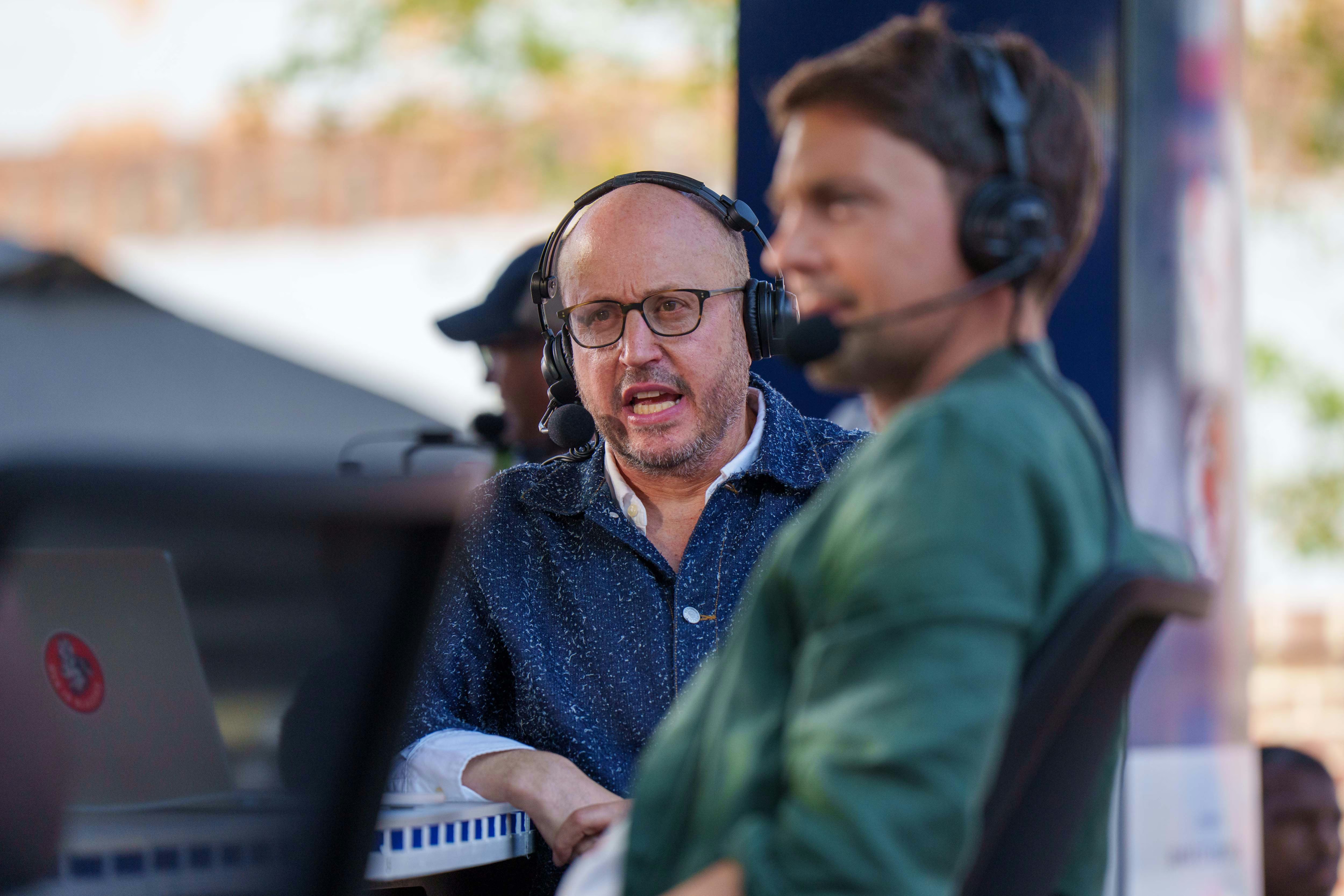
Ever since Bennett started his podcast, on a whim in 2010, he has been monomaniacally devoted to getting Americans not just to enjoy soccer but to become emotionally invested in it. For Bennett, the sport is a way to access the big, complex feelings and topics that typical sports fans don’t always talk about: community, love, agony, joy, Emily Dickinson’s poetry. A box of tissues emblazoned with the phrase Cry Proudly is prominently displayed in his podcast studio.
I first met Bennett in 2014, when his stint covering the World Cup for ESPN made him a niche celebrity among the set of weirdos in America (me) obsessing over soccer and waking up before dawn to cheer on clubs from English towns they’d never been to. Bennett was certain that the United States would soon embrace soccer—an intoxicating but tenuous idea that now reads as prescient. Millions of Americans have watched the men’s team make a run in the World Cup this year—the first time the country has hosted the men’s tournament since 1994. In fact, Monday’s game against Belgium reportedly pulled in more viewers than the 2025 World Series and Game 5 of the NBA Finals.
[Listen: How the World Cup explains the world]
This is a moment of vindication for Men in Blazers, but it also has a greater meaning for Bennett, who became an American citizen in 2018. He routinely ends his podcast monologues with the phrase “I love America” and openly expresses his patriotism. “I grew up in the dying embers of the English class system,” he told me. “I felt very trapped. America always felt like the opposite, like opportunity. For me, that was life-affirming, life-saving.”
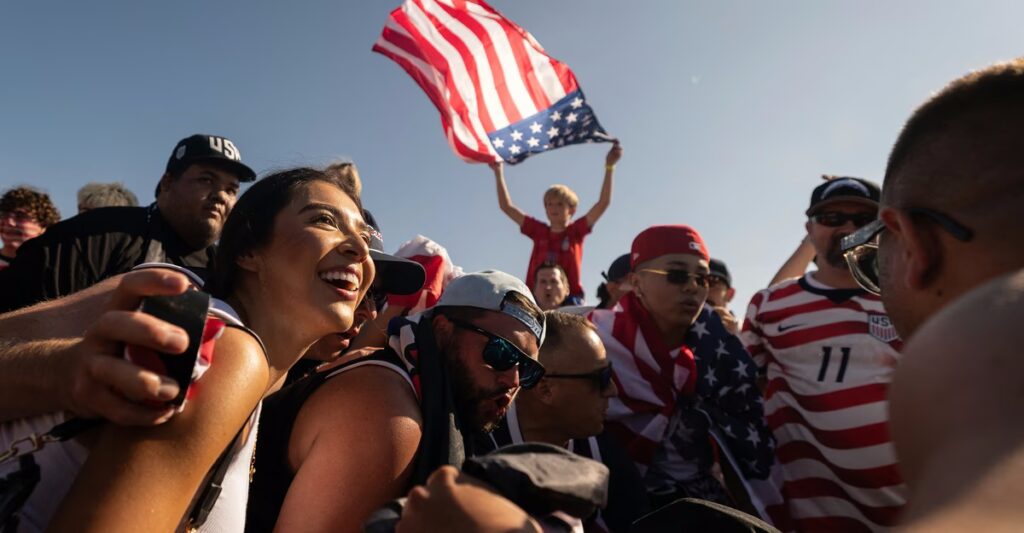
Maybe that all sounds cheesy. But it’s been hard to miss the collective enthusiasm and sense of American community emanating from the tournament: the initial delights of watching Scotland’s Tartan Army drink and bagpipe its way through New England, winning over steely Bostonians along the way; or the residents of Lawrence, Kansas, embracing the Algerian team with marching-band pep rallies. There was the viral pleasure and even pride in seeing foreigners encounter Buc-ee’s with reverential appreciation or giddily experience industrial quantities of Mountain Dew Baja Blast at Taco Bell.
Then there were the games themselves, seemingly broadcast on every available public television in America. Over the past month, I’ve seen strangers in the airport rapturously celebrating over last-second goals, gaggles of men and women kicking soccer balls on city streets while clad in a veritable United Nations of jerseys. People in my life who are normally allergic to sports have come over for marathon World Cup viewing sessions. At one point I found myself—a man from Cleveland—wearing a Senegal jersey, sweatily embracing a Senegalese man after a spectacular volley sent the ball to the back of the net. It felt like a dream.
Dreams always end, and in a way, that’s what happened on Monday. But Bennett’s larger ideology, that soccer is the “most important, least important thing,” may yet endure. There’s a reason he hired more than 100 people and retrofitted a coach bus into a mobile podcasting studio—a reason he spent the past month traveling across the country for a series of rowdy pre-match shows with fans. Moments like these forge bonds that don’t easily break.
Before the sun is up, I watch as Bennett goes on Morning Joe and CBS Mornings, and rips through a slew of radio and podcast hits. He calls nearly everyone he works with on these shows “a beautiful human being” and ends every interview with the same sign-off: “Big, big love to you.”
Bennett pops up from his table the instant his last interview ends. Within 30 seconds he’s on his phone, rifling off voice memos to people on his staff and agents of players he’s trying to book. “When’s Jon Stewart coming on?” he asks his producer, who pulls up a booking sheet a mile long. He completes seven phone calls in as many minutes just after 9 a.m., and tells each person on the other end that he loves them before hanging up. By 9:30, we’re in a production meeting for that day’s Men in Blazers live show; Bennett is Zooming in from his phone, because he’s outside picking up coffees for his team. A staffer on the call informs him that they’ve made a giant cardboard cutout of a lemon-pepper-wet chicken wing—an Atlanta delicacy—for somebody in the crowd to wave. “You could not be a more beautiful soul. You make the world a better place,” Bennett replies.
The day moves on. A detailed planning meeting is convened to discuss next summer’s Women’s World Cup. Men in Blazers is already pitching sponsors based on its online engagement numbers—according to Blinkfire, a marketing-analytics firm, the company has almost twice the engagement per follower across social media this tournament than the World Cup’s official broadcast partner, Fox Sports. Bennett out-hustles more established outlets by relentlessly blanketing the internet with instant-reaction clips, multiple daily podcasts, and memes; he then uses that attention to drive people to Men in Blazers’ frequent live shows, building an army of loyal obsessives. Listening to Bennett articulate this strategy and then jump into another TV interview, I’m struck by the realization that this whole operation resembles a political campaign as much as a media company. It’s hope and change and a bright new vision for America complete with stoppage time and hydration breaks.
[Listen: How short-form clips took over the internet]
Somewhere around coffee No. 5, Bennett and a few people from his team head to Busy Bee, a legendary soul-food café in Atlanta, to document some of the World Cup host city’s culture—another page from the campaign playbook, though Bennett’s excitement for the chicken and waffles is palpable. Outside next to the parking lot, sitting on a swelteringly hot picnic table, Bennett attempts to explain why he’s been averaging just three and a half hours of sleep a day for the past 26 days. He argues that what many people have been feeling over the past month, with each watch party or viral video of fans going crazy, is what the sociologist Émile Durkheim calls collective effervescence—a feeling of unity that emerges from a shared experience.
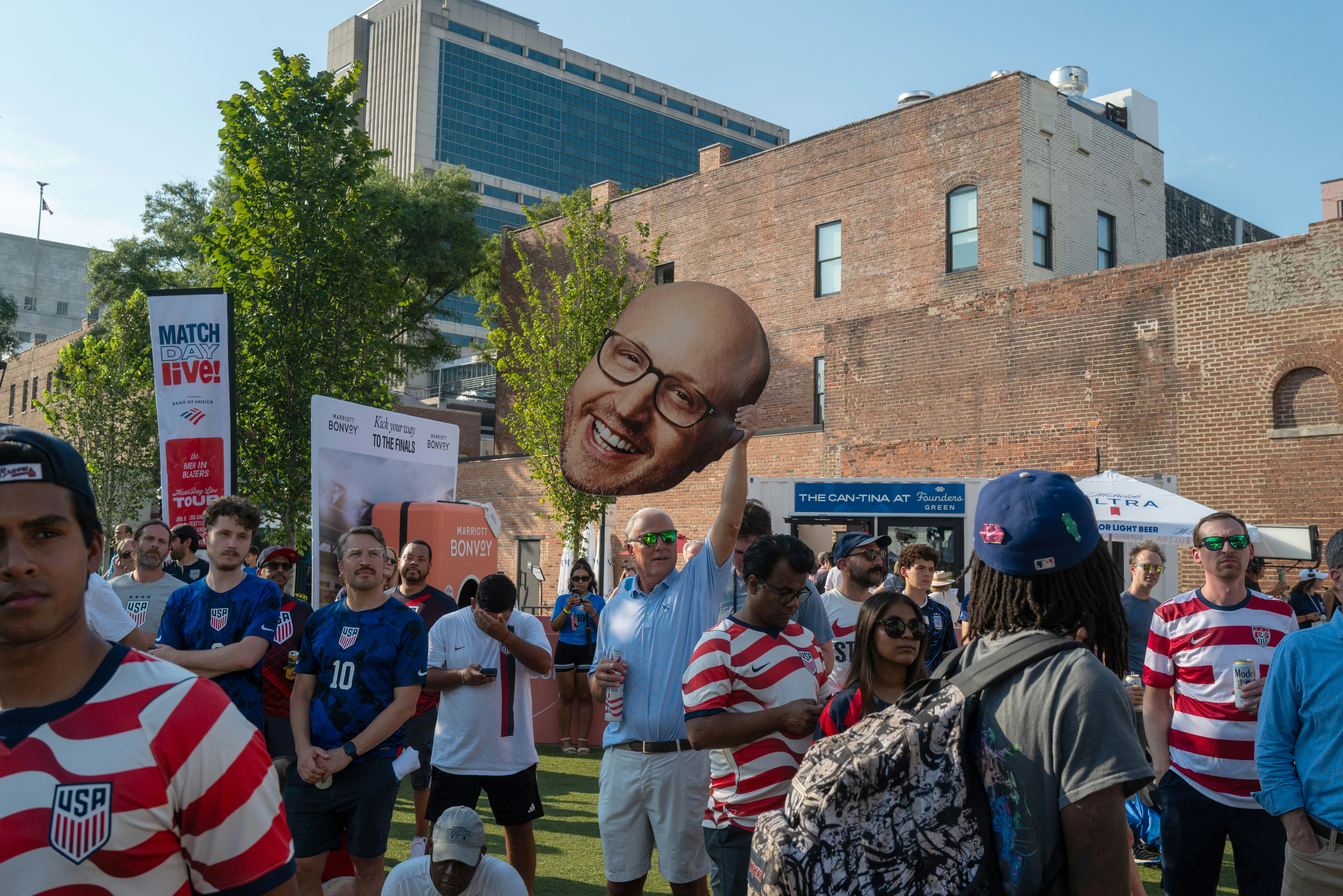
Bennett’s theory is that the World Cup, a rare monocultural event in today’s fragmented world, is one of the few reliable producers of such effervescent spectacles; it’s good for the internet, but also good for the soul. His media-distribution system ties it all together: “When Congo scores that goal, they need the immediate reaction, then they need the Congo fans across America; they need the scene in Kinshasa, the postgame on the field and the tears, the locker room, the Congo fans in Queens or Brooklyn,” he said. “It’s just incredible and it’s happening every single game.”
I can see why one would get swept up in what Bennett describes as “a very profound moment for the nation, which is so busy falling back in love with the world, and the world falling back in love with America.” The entire event feels at times like a summer vacation, a much-needed reprieve from harrowing world events. A cynic could see it as artificial or inauthentic—geopolitics, only without all the horrific stuff. And yet the moments are authentic, which may be why the White House intervention and FIFA’s arbitrary and unusual red-card suspension felt so jarring, even offensive, to die-hard fans of the tournament. It was a reminder that politics always lurk in the background, and that the euphoria is fragile. A U.S. loss would be a stress test.
About an hour into the game, with the U.S. down 2–1 to Belgium and looking positively shell-shocked, Bennett distracts himself by asking another Men in Blazers host, Becky Sauerbrunn, a former U.S. women’s team captain and two-time World Cup champion, what it feels like when you get scored on by your opponent immediately after you score. (Not good is the answer.) Later, when a flub by the U.S. goalkeeper puts Belgium up 3–1, Bennett yells at the television: “Not like this!” The agony is genuine. A close, competitive U.S. loss would hurt, but maybe it would be fine. This result, though—an impotent, scared team that is clearly not ready for the moment—feels like two steps forward and one very large step back. “This is not good for business,” Bennett said to me, cracking a weak smile.
What I’ll remember most about the game is how quickly confidence turned into insecurity. Shortly after the final whistle, announcers on Fox offered a sheepish plea to their massive broadcast audience: This doesn’t have to be the last game you watch. Sitting in a room with Bennett and Sauerbrunn and others like them, people who’ve devoted their lives to the sport, you could sense just how precarious the moment felt to them. How can you promise hope and change if the results stay the same?
Bennett was adamant that the Men in Blazers’ YouTube livestream start the minute the game ended, as if to avoid giving the audience too much time to think about what they’d seen. For almost two hours, Bennett and his cohosts, plus special guests including the The Fault in Our Stars author John Green, dissected the match, which Bennett dubbed “a cup of tears and darkness, self-loathing, fear, and human agony.” As far as podcasting goes, the show should have been a grueling, dismal spectacle. But Bennett, who had been up early enough to text me at 4:35 a.m., was slaphappy, making jokes about Thomas the Tank Engine and quoting lines about pain from Dante’s Inferno. All the while, listeners poured into the stream, which became a strange, beautiful form of catharsis. “Football,” Green said one hour into the show, “is not about destinations; that’s the thing that we mistake all the time. It’s about journeys. Because if it was about destinations, no one would like it.”
After the show, Bennett rallied half a dozen people—many of whom had been up for almost a full 24 hours—for a midnight Waffle House excursion. “I’ll always remember this night and being with all of you,” he told the group. The pep talk reminded me of an anecdote Bennett had told me earlier. His mother-in-law had become obsessed with taking family photos at every get-together, no matter how inconvenient or annoying. “What she’s realized is that photographs and memories are inextricably connected,” he said. “I’m very aware of how memory is formed. And in this moment, this tournament, memory is being formed.” Suddenly, it clicked: Bennett is obsessively documenting the insanity, the joy, the collective effervescence so that we remember how this all felt. So we don’t lose it.
I had plans to meet Bennett early the next morning, but I slept through my alarm. When I texted to apologize, he confessed that he had almost missed a morning TV hit, having fallen asleep, laptop on his chest. Political campaigns are exhausting. But Bennett wasn’t defeated. Too much progress had been made. “As I speak to you, I am headed to Atlanta Stadium to watch Lionel Messi face Mo Salah,” he texted back. “The streets are packed. Football is here and thousands of people are ready to make memories again.”
The post 20 Hours Inside America’s World Cup Fever Dream appeared first on The Atlantic.