American military forces launched attacks on Iran for a second straight day on Wednesday, hours after President Trump said that he believed that a temporary truce he signed with Iran was “over” and called its leaders “scum” and “evil people.”
U.S. Central Command, which oversees operations in the Middle East, said the attacks on Wednesday were intended to further degrade Iran’s ability to threaten ships in the Strait of Hormuz, the critical oil and gas route off Iran’s southern coast.
Iranian state media reported explosions across parts of southern Iran, including in Konarak and nearby Chabahar, two coastal cities east of the Strait of Hormuz, and the sound of warplanes flying over Kish, a small coral island 10 miles off the Iranian coast. A state television reporter said two projectiles had struck Abu Musa, an Iranian-controlled island in the Persian Gulf.
“The United States is holding Iran accountable for recent unjustified aggression against commercial shipping and civilian crews freely navigating a vital international waterway,” Central Command said in a statement.
Mr. Trump, posting on Truth Social, said the strikes were carried out “in retribution” for Iranian attacks on ships this week.
“If it happens again, it will get much worse!” he wrote.
The strikes came hours after Iran fired a barrage of missiles and drones across the Persian Gulf in retaliation for a wave of American attacks on Iranian targets on Tuesday.
With both sides accusing each other of violating the truce and some Iranian media outlets calling for the deal to be torn up entirely, the cease-fire that Iran and the United States signed three weeks ago appeared to be on the verge of collapse. Ship traffic in the Strait of Hormuz had already ground to a halt after the United States accused Iran of striking three commercial vessels in the waterway, reigniting the latest hostilities and driving oil prices to their highest level in weeks.
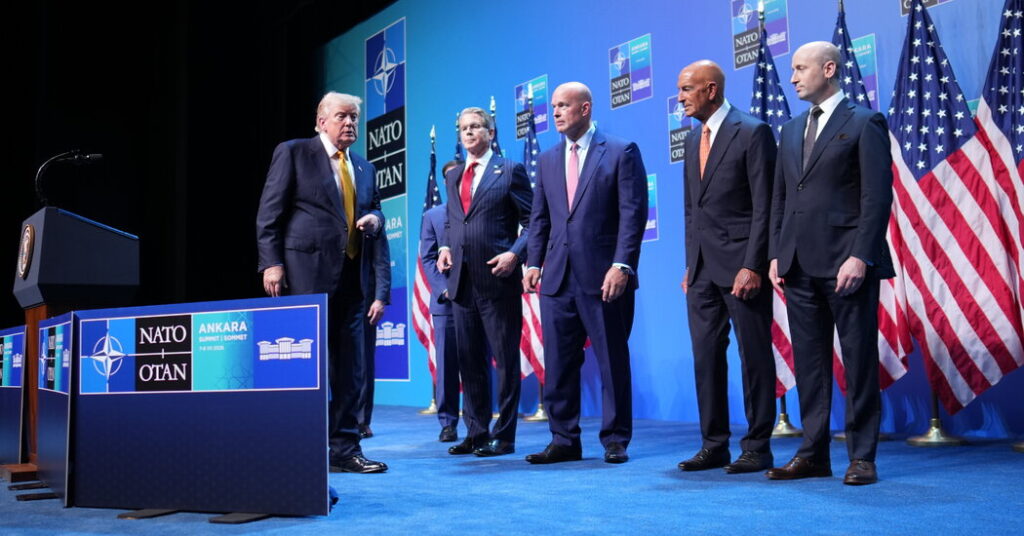
Speaking at the NATO summit in Ankara, Turkey, earlier on Wednesday, Mr. Trump had foreshadowed the latest attacks on Iran, saying he was going to hit the country “hard” in the coming hours. He also said he was once again considering taking Kharg Island, the hub of Iran’s oil industry, and could reimpose a blockade on ships entering and leaving Iranian ports that the U.S. military lifted just three weeks ago.
Asked about the truce, he said: “To me, I think it’s over. I don’t want to deal with them anymore. They’re scum.”
Mr. Trump went on to call Iran’s leaders “sick people,” “evil people” and “cuckoo,” but said he was still open to talks with them aimed at a durable peace deal. The disparaging remarks were the latest zigzag by Mr. Trump, who only weeks ago praised Iran’s leaders as “very rational people” who “were nice to deal with” and were “looking to help their country.”
The conflict, which began when American and Israeli forces attacked Iran in late February, has been characterized by a dizzying back and forth between intermittent strikes and talks aimed at securing peace. The uncertainty has roiled the global economy, largely because the war throttled the flow of oil and gas from the region.
The truce was intended to reopen the Strait of Hormuz and pave the way for negotiations. It left some of the thorniest issues — including the fate of Iran’s stockpile of highly enriched uranium and the future of its nuclear program — to be sorted out during a 60-day period.
The talks have been paused this week while Iran holds funeral ceremonies for Ayatollah Ali Khamenei, the supreme leader, who was killed in an Israeli strike on the first day of the war. But Mr. Trump indicated on Wednesday that he was not eager to restart negotiations.
“I’m not sure I want to make a deal with them,” he said at a NATO news conference. “We can play games, but I’m not sure I want to make a deal. Let’s just finish the job.”
Mr. Trump also said that he is a target for assassination by the Iranians. While boasting that Iran’s leaders were “gone,” he said, “I may be gone too, because I’m their number one target.” U.S. officials have said that an Iranian covert unit plotted to kill Mr. Trump in 2024, and that the leader of the unit was killed in a U.S. strike in Iran in March.
Iranian officials issued their own ominous statements, accusing the United States of violating multiple clauses of the truce agreement. “The enemy aggressor and its accomplices will be severely punished,” Mohsen Rezaei, an adviser to Ayatollah Mojtaba Khamenei, the Iranian supreme leader, wrote on social media after the latest U.S. attacks.
Iranian media outlets close to the country’s powerful Islamic Revolutionary Guards Corps went further, publishing editorials calling for an end to the truce. The Tasnim news agency, for instance, argued that Iranian officials should respond to U.S. strikes by “burning the understanding.”
The editorials did not reflect official Iranian policy, but they underscored how hard-liners in the country have split over the temporary agreement with the United States.
Prime Minister Benjamin Netanyahu of Israel said in a podcast interview that Mr. Trump had made an “important statement” in saying that the framework agreement with Iran was over. Israel was not a party to the truce. “What will he do?” Mr. Netanyahu said, referring to Mr. Trump. “We’re prepared for every scenario.”
Under the terms of the cease-fire, Iran was supposed to provide “safe passage” for ships in the Strait of Hormuz, free of charge, for 60 days. But Iran has asserted that the agreement gives it sole oversight of the economically vital waterway and has demanded that ships use its preferred routes.
The latest attacks began, the U.S. military said, when Iran fired on three vessels, including a Saudi oil tanker and a Qatari liquefied natural gas carrier, in the Strait of Hormuz earlier this week.
In response, U.S. forces attacked Iran on Tuesday, hitting what the American military said were air defense systems, command-and-control networks, coastal radar sites, anti-ship missile sites and more than 60 Islamic Revolutionary Guards Corps boats in and near the strait.
The Iranian Army said that eight members of Iran’s air and naval forces were killed in those strikes. They were the first military casualties that Iran has reported since the cease-fire was signed.
Iran, which has not claimed responsibility for striking the ships in the strait, condemned the U.S. attacks on Tuesday as an “overt act of aggression,” and vowed “a crushing response.”
Hours later, Iran’s armed forces fired missiles and drones in a barrage that it said had targeted U.S. military bases in Bahrain and Kuwait. U.S. Central Command, which oversees Middle East operations, did not immediately comment.
The Kuwaiti government said at least two ballistic missiles and 13 drones had been fired at its territory, all of which were intercepted. There were no reports of casualties, although Kuwait’s energy ministry said power lines had been damaged by falling shrapnel.
In Bahrain, air-raid sirens sounded throughout the morning. The country’s military said it had intercepted Iranian missiles and drones, without specifying whether there had been any damage.
After the attacks, Pakistan, which has acted as a mediator in talks between the United States and Iran, called on “all parties” to exercise restraint and refrain from actions that could undermine regional stability.
“There is no alternative to continued engagement, dialogue and diplomacy,” the Pakistani foreign ministry said.
The International Maritime Organization, a United Nations agency, on Wednesday urged ship operators not to send vessels through the Strait of Hormuz, saying it wanted to avoid exposing nearly 6,000 sailors in the region to “unnecessary danger.”
The price of Brent crude oil, the international benchmark, jumped over 5 percent on Wednesday to around $78 a barrel, the highest level in weeks, a sign of the economic turmoil that rising attacks could unleash.
Reporting was contributed by Aaron Boxerman, Leily Nikounazar, Jenny Gross, Shawn McCreesh, Farnaz Fassihi, Johnatan Reiss, Sanam Mahoozi.
The post U.S. Strikes Iran for a Second Day After Trump Says Truce Is ‘Over.’ appeared first on New York Times.