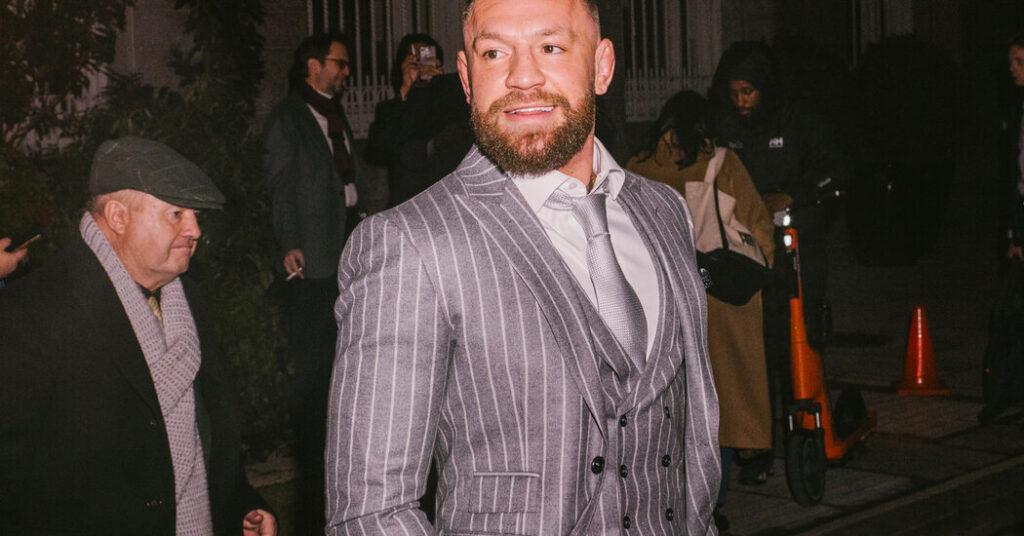
The Ultimate Fighting Championship star Conor McGregor has defended his use of banned performance-enhancing drugs in the wake of the revelation last month that he used the substances.
McGregor, along with the U.F.C. and his surgeon, has cast the decision as a medically necessary one to ensure that his badly broken leg healed properly.
But according to two people with knowledge of the matter, McGregor took two of the most powerful performance-enhancing drugs — anabolic steroids and human growth hormone — even after his leg healed.
One of the people said U.F.C. officials learned from McGregor that he had remained on the drugs because he liked how they made him feel and the energy they gave him.
McGregor, now 37, took the substances during the more than two years he opted out of the sport’s drug testing program, a move that antidoping experts contend allowed him to exploit a loophole in which he could use banned drugs and face no suspension.
It is not clear how long he used the drugs. He began being tested again for the banned substances in October 2023.
His use of anabolic steroids and human growth hormone is significant and gives greater insight into McGregor’s recovery as he prepares to return to fight on Saturday for the first time since his injury in 2021, at a highly anticipated match in Las Vegas.
In a statement to The New York Times, McGregor’s manager, Audie Attar, said that “as confirmed by the U.F.C., Conor has been in full compliance with the rules of its comprehensive drug program and stands by his extensive history of testing.”
The U.F.C. released a similar statement saying that McGregor “sustained a potentially career-ending injury and sought medical guidance, who advised the appropriate recovery and rehabilitation protocol.”
McGregor, the U.F.C. said, “did not compete for five years and has been tested 22 times over the last two years with 15 of those tests occurring in 2026. All samples that he provided over that time period (32 separate samples) were reported as negative.”
Among scientists and antidoping experts, anabolic steroids and human growth hormone are considered to be among the most powerful combinations of substances an athlete can take because they help the body build muscle, tissue, tendons and ligaments at rates far faster than the body can on its own. Many antidoping experts contend that those substances can benefit athletes — and give them an unfair advantage over their opponents — for years, if not the rest of their lives.
McGregor’s use of human growth hormone also raises questions about whether doctors broke the law in writing a prescription for the substance and endorsing his use of that substance.
Under federal law, human growth hormone is treated like a controlled substance and doctors can prescribe it only for specific diseases or conditions set by the Food and Drug Administration, like major height deficiencies in children, as well as wasting disease caused by H.I.V., the virus that causes AIDS. Helping to heal a broken leg is not one of them.
Doctors caught writing prescriptions for human growth hormone for off-label reasons can face felony charges, although those cases are rarely brought, according to Lars Noah, a professor at the University of Florida Levin College of Law and an expert in pharmaceutical regulation.
April Henning, an antidoping expert at Heriot-Watt University in Scotland, said: “This is a nightmare if you’re concerned about fair sport. From a competitive standpoint, his competitor is walking into a situation where McGregor has been able to operate by a different set of rules. There’s the potential he’s still getting an advantage from these drugs, and that’s the unfairness we’re trying to prevent.”
The two people with knowledge of the matter based their accounts on what drug testers and U.F.C. officials learned from McGregor after he broke his leg, took himself out of the pool of athletes who were subject to drug testing and then, in 2023, re-entered the pool. When McGregor re-entered the testing pool, he was encouraged to disclose what substances he had taken in the previous year while outside the pool so that if he tested positive for those substances, he would not face a penalty.
The two people spoke on the condition of anonymity because they did not want to be identified discussing a matter that was supposed to remain confidential.
At a July 2021 match, McGregor suffered a gruesome break in the lower half of his left leg. Afterward, Neal ElAttrache, a prominent sports doctor and the team physician for the Los Angeles Dodgers and Los Angeles Rams, oversaw the surgery, which included inserting a rod, plates and screws into McGregor’s leg.
The Times reported last month that while McGregor recovered, he took powerful banned drugs, unsuccessfully sought a special exemption to use the substances without having to face a penalty, engaged in an active effort to evade drug testers and was supported in using the banned drugs by ElAttrache. The report did not specify which drugs McGregor took.
After overseeing the surgery, ElAttrache said he feared that McGregor’s bones would fuse slowly or not at all, so he recommended that he consult with specialists in bone healing, ElAttrache told The Times earlier this year.
One of the specialists McGregor consulted with wrote McGregor prescriptions for human growth hormone and at least one anabolic steroid, the two people with knowledge of the matter said.
While ElAttrache said he did not write the prescription, he told The Times that he supported McGregor’s taking the drugs and even wrote a letter endorsing McGregor’s application to the United States Anti-Doping Agency — which oversaw the U.F.C.’s drug testing program at the time — for what is known as a therapeutic-use exemption that would permit him to use banned substances.
The exemption was never granted.
ElAttrache did not respond to a question from The Times on Tuesday about why he endorsed McGregor’s use of a drug that cannot be legally prescribed to repair a broken leg. In the wake of the Times story last month, Major League Baseball interviewed ElAttrache and then put out a statement clearing him of wrongdoing.
McGregor said in a televised interview in June that he needed to take extraordinary measures to ensure that he would walk again, adding that he wanted “to be able to play with my children in a normal capacity again.”
The specialist’s guidance to McGregor was to take the substances for only a short period of time, like weeks, to help the leg heal, according to the two people.
In October 2023, McGregor re-entered the testing pool. In the year that followed, drug testers failed on three occasions to locate McGregor for drug tests, according to the U.F.C. In October 2025, the U.F.C. suspended McGregor for the missed tests for 18 months but backdated the suspension, allowing it to expire this month.
There are few peer-reviewed controlled studies of how the substances said to have been used by McGregor affect the human body, because it is widely considered unethical to give humans amounts of those drugs similar to ones that athletes are known to have used, according to Keith Baar, a professor of molecular exercise physiology at the University of California, Davis. The drugs are considered dangerous because they can increase cardiovascular problems and can lead organs to become bigger — like enlarging the heart — or grow cancer cells, Baar said.
But, Baar said, studies in rodents have shown that the animals benefit for an extended period of time even after they are no longer being administered the drugs.
The post U.F.C. Star Is Said to Have Continued Use of Banned Drugs After Injury Healed appeared first on New York Times.