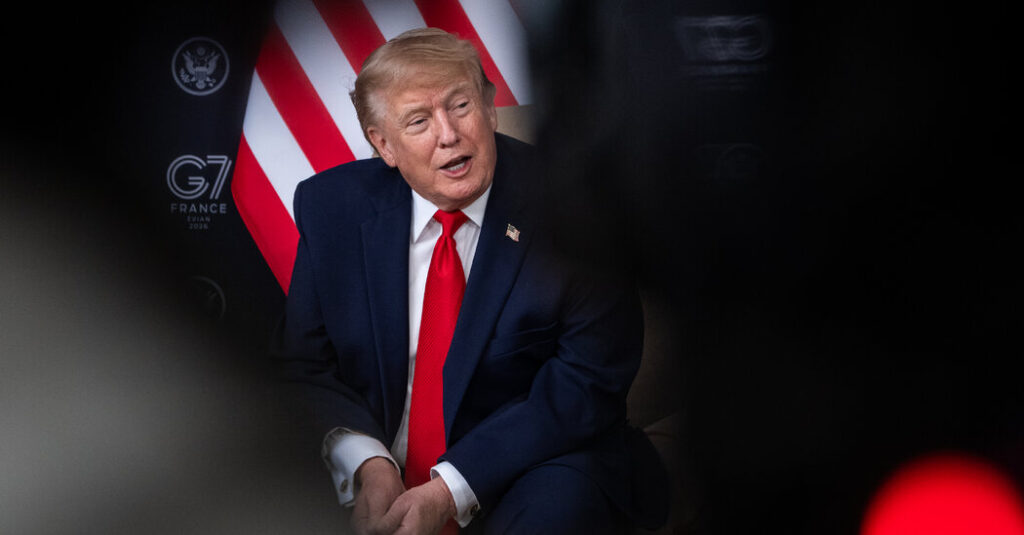
President Trump on Wednesday again complicated efforts in Congress to renew a powerful national security surveillance program, increasing the likelihood that the law that enables it will remain expired for weeks or months.
In his announcement that he was delaying the nomination of Jay Clayton as director of national intelligence, Mr. Trump also threatened to block any extension of the spying statute, Section 702 of the Foreign Intelligence Surveillance Act, unless Congress links its fate to unrelated legislation to impose national requirements on voter identification and registration. Republican leaders have repeatedly said the election measure does not have the votes to pass.
The president’s actions were the latest twist in his long and complicated relationship with Section 702 and the broader FISA law. Mr. Trump has for years veered sharply between condemning it — including by airing conspiracies about it being used to spy on him — and embracing it as a necessary intelligence tool that helps prevent terrorism, cyberattacks and other threats.
Mr. Trump is now undermining top officials in his administration who lobbied lawmakers to extend Section 702 by arguing that its lapse could severely harm national security. The law allows the National Security Agency to vacuum up the private communications of foreigners overseas from U.S. providers like Microsoft and Verizon, but it has long attracted bipartisan scrutiny for also ensnaring an unknown volume of communications belonging to Americans.
Democrats in Congress who were working with Republicans on creating legislation that would renew Section 702 walked away from that effort this month over outrage about Mr. Trump’s selection of Bill Pulte as the acting director of national intelligence. Delaying Mr. Clayton’s appearance in the Senate all but ensures Mr. Pulte will take the reins at the spy office on Friday.
This is not the first time Mr. Trump vacillated on renewing Section 702. When the law was up for renewal in January 2018, during his first term, Mr. Trump posted on social media just hours before Congress was to vote on it to suggest without evidence that the program had been abused by the Obama administration to surveil his presidential campaign. John F. Kelly, Mr. Trump’s chief of staff at the time, ran into the White House residence to persuade Mr. Trump to write another post endorsing the law, U.S. officials said at the time.
After Mr. Kelly’s intervention, Mr. Trump then posted: “Today’s vote is about foreign surveillance of foreign bad guys on foreign land. We need it! Get smart!” Congress passed the renewal.
Mr. Trump’s threat to block the law’s renewal fueled suspicion among some Democratic aides that the president still harbors resentments toward FISA.
It also may reflect another reality: The surveillance program can legally continue until March because of a legal quirk with how the court established by the law certifies the categories of permissible spying annually.
Lawmakers in both parties — and perhaps the president — are aware of this dynamic, meaning the renewal can most likely be tabled for months without genuine national security ramifications. One wrinkle is that U.S. communications providers could try to stop complying with the spy program by refusing to share data with the government, but most surveillance law experts believe they would quickly be compelled to continue compliance.
The post Trump’s Threats Show His Complicated History With a Surveillance Law appeared first on New York Times.