Just after midnight in Tehran earlier this week, a motorcade speeding to the airport came to a sudden stop. Qatari officials emerged from their cars and huddled on the side of the road. Yet another last-minute crisis had come up in the marathon Iran talks, and the Qataris had clear instructions from their leadership not to leave without an announced deal.
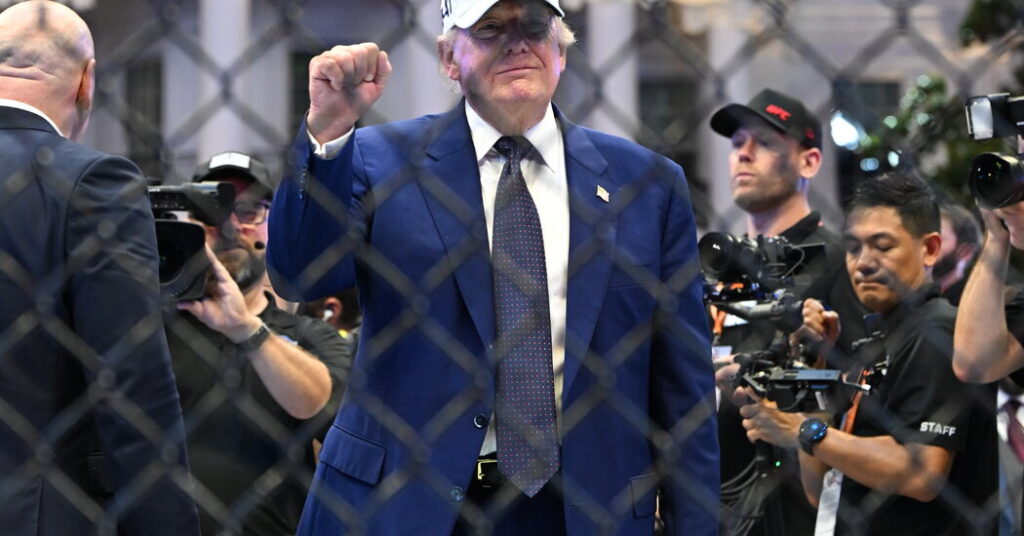
In Washington, President Trump was getting ready for a birthday dinner. International mediators believed the birthday — and the U.F.C. cage match scheduled for Sunday night — could put Mr. Trump in the mood to sign the agreement on that day.
In Israel, officials were already grappling with a humiliating setback, in what appeared to be their closest ally’s imminent separate agreement with Israel’s archenemy. The deal appeared on track despite Israel’s decision to attack a Beirut suburb that day without consulting with the United States.
But on the Tehran roadside, the Qataris were dealing with disagreements about the phrasing of the announcement. Finally, after more calls, the Qataris got back in their cars and headed for the airport. Pakistan’s prime minister, Shehbaz Sharif, announced the deal at 12:45 a.m. Monday in Tehran and Mr. Trump confirmed it minutes later, revealing a good-will gesture to the Iranians: the United States would lift its naval blockade of Iranian ports immediately.
Last weekend, four months of war and 47 years of confrontation between the United States and Iran came to a head in an extraordinary diplomatic rush that repeatedly threatened to spiral into more bloodshed. Negotiators were wrangling over issues with wide significance for the world economy, Mideast geopolitics and U.S. domestic politics.
Mr. Trump sought a deal he could sell as making good on his promise to prevent Iran from having a nuclear weapon, even though the establishment of specific protections was being kicked to a later negotiation. Iran was determined to avoid giving up what it says is its right to enrich uranium, while maximizing what it could extract in exchange for reopening the Strait of Hormuz.
This account of the final hours of the negotiations for a deal to declare a cease-fire and begin nuclear talks is based on interviews with officials in Washington, Europe and across the Middle East, most of whom spoke on condition of anonymity to discuss the secret talks.
Already, Mr. Trump is facing criticism even from some supporters that the “memorandum of understanding” between the two sides gives away too much to Iran. The agreement, the text of which was released by the White House on Wednesday, would reopen the Strait of Hormuz to shipping and outlines a $300 billion plan for Iran’s reconstruction and development. But it also pushes talks about Iran’s nuclear program into future negotiations, essentially punting on the hardest issue.
Throughout the weekend, Iran showed a willingness to keep pushing for more U.S. concessions despite the constant threat of more airstrikes, which Mr. Trump renewed on Wednesday. Israeli officials fretted they were failing to convince the United States that the deal could create grave risks to Israel’s security and leave the nuclear issue unaddressed. And Qatari officials led a back-channel mediating effort, telling the Iranians they needed to give their final sign-off to the deal before the start of the U.F.C. match on the White House lawn.
Mr. Trump appeared eager to get the deal done, a circumstance not lost on another key mediator, Pakistan. Two experts familiar with Pakistan’s mediation said Syed Asim Munir, the country’s powerful army chief, wanted the deal to be signed on Mr. Trump’s birthday.
“The birthday was a way to woo him,” Qamar Cheema, the head of an Islamabad-based research institute privy to Pakistan’s role in the mediation, said about Mr. Trump.
Another person familiar with the matter insisted that Mr. Trump’s birthday had nothing to do with the timing.
But two Iranian officials said Tehran waited until the clock passed midnight local time to finalize the agreement, because it did not want the momentous occasion to coincide with Mr. Trump’s birthday. The seven-and-a-half-hour time difference allowed both Tehran and Washington to claim their preferred version of when the deal was finalized. Mr. Trump had said it would be on Sunday, and Iran had said it would be on a later day.
Cycles of Escalation
Since announcing a cease-fire with Iran in April, Mr. Trump had repeatedly cycled between claiming that a peace deal was near, threatening to order a devastating bombardment and then backing away from the threats.
Last week appeared to be another such episode, with a cycle of escalation that began with the downing of an American helicopter and ending last Thursday with Mr. Trump calling off a planned attack on Iran. A drawn-out period of stalled talks and simmering violence seemed to be a likely scenario.
U.S. intelligence officials were deeply skeptical of Iran’s willingness to make meaningful concessions. Intelligence collection was showing that Iranian officials were taking a different stance among themselves than what they were expressing to the lead U.S. negotiators, Steve Witkoff and Jared Kushner, according to people familiar with the assessments.
The C.I.A. even assessed last week — incorrectly, it turned out — that Iran’s supreme leader, Ayatollah Mojtaba Khamenei, would not agree to the memorandum of understanding that Iran and the United States were negotiating, according to a person familiar with the matter.
But Mr. Trump remained bullish on the possibility of a deal. Speaking to The New York Times on Sunday, Mr. Trump said that the airstrikes he had launched on Iran in recent weeks were “very brutal,” and that the attack he called off would have been even more intense.
“We explained to them that they can’t do anything about it,” Mr. Trump said. “They said, ‘Please don’t do it; we will make a deal.’ And we made a deal right after that.”
On Saturday, Pakistan’s prime minister said Iran and the United States were “closer to a peace deal than ever before” and promised an agreement within 24 hours.
The same day, Mr. Khamenei told Gen. Mohammad Bagher Ghalibaf, the lead negotiator and speaker of Iran’s parliament, that he approved of the final text of the agreement, according to four Iranian officials.
He directed Mr. Ghalibaf to put the document to a vote at the 13-member Supreme National Security Council and, if a three-fourths majority was reached, to proceed with signing, according to the four Iranian officials.
Gathering in a secret location, the council approved the deal, though at least two hard-line members voted against it.
“There were, of course, some minor differences of opinion on a limited number of issues,” Iran’s president, Masoud Pezeshkian, said in televised remarks.
On Sunday morning, Qatar’s main negotiators, Ali al-Thawadi and Hamad al-Kubaisi, landed in Tehran to hammer out the details. Qatar’s negotiating team had been shuttling for weeks between the United States and Iran, at one point flying to Tehran via Turkey to keep the trip under wraps. Qatar’s prime minister, Sheikh Mohammed bin Abdulrahman al-Thani, had hosted Iranian officials for a 12-hour session in Doha on May 25.
During the war, the United States and Iran had asked the Qataris to mediate between them, but they refused as long as they were coming under Iranian missile and drone attacks. It was only in mid-May, when a cease-fire was in place but the talks were at a nadir, that Qatar took on a prominent mediating role.
Then, on Sunday, Israel struck a Beirut suburb, killing three people, setting off another scramble. There was no coordination with the United States before the strike, only a notification to the U.S. military a few minutes before it began, according to an Israeli defense officials and a U.S. military official.
It was an aggressive response to attacks by Hezbollah, the Iran-backed force in Lebanon, that wounded two Israeli soldiers.
Iran had defined targeting the Beirut suburb as a red line and said any agreement between Tehran and Washington needed to include an end to the conflict in Lebanon. But Israel, which had been left out of the U.S.-Iran talks despite having waged war against Iran alongside the United States, had repeatedly signaled that it did not feel bound by such agreements.
A Deal on Thin Ice
Military advisers to Prime Minister Benjamin Netanyahu told him that the move would almost certainly lead to the launch of Iranian ballistic missiles against Israel. They warned the world could interpret Israel’s strike as an attempt to derail a deal on the verge of being signed.
But Mr. Netanyahu was facing sharp criticism at home for not taking a more aggressive approach in Lebanon and for failing to thwart a deal that the Israeli leadership sees as creating grave risks to Israel’s security.
Israel soon learned that Iran was, in fact, preparing to respond with missiles. In Tehran, Israel’s attack seemed to validate the skepticism voiced by many officials about America’s good faith in the negotiations. Instead, some saw the United States and Israel playing a good-cop, bad-cop game against Iran that they were coordinating behind the scenes, four Iranian officials said.
Ballistic missiles were placed in launchers along Iran’s western borders and the order was to fire them toward Israel at around 1 a.m., said two Iranian officials, one with the Islamic Revolutionary Guards Corps.
Furious Iranian officials told the Qataris that they were planning an attack on Israel and would suspend signing the agreement. The Qataris pushed back in talks with their main Iranian interlocutors, Mr. Ghalibaf and Abbas Araghchi, the foreign minister.
Striking Israel would only play into the hands of the deal’s opponents, the Qataris told the Iranians. Repeatedly, the Qataris made calls to the United States, conveying messages from the Iranians to Mr. Witkoff, Mr. Kushner and Vice President JD Vance.
Internally, there were divisions among Iran’s leadership. Mr. Pezeshkian, Mr. Araghchi and Mr. Ghalibaf argued that Mr. Netanyahu was setting a trap for Iran and the attack on Beirut was bait for Iran to respond. Tit-for-tat fighting would ensue, they warned, and the deal would fall apart.
The deal again seemed to be on thin ice. Iran sought to insert last-minute language into the text. The Qataris insisted the wording could not be changed in the 11th hour. As the haggling dragged on, the Qataris warned the Iranians they risked Mr. Trump’s patience, especially as the start of the U.F.C. match on the White House lawn approached.
But Mr. Trump also showed he was eager to seal the deal. He posted on Truth Social that the Israeli attack on Beirut “should not have happened.” When he confirmed the deal in another post hours later, Mr. Trump also declared that he would order “the immediate removal” of the U.S. blockade on Iran.
The text of the agreement said the United States would end its blockade within 30 days. Administration officials insisted that promising an immediate end to it was not an added inducement to get Iran on board, but rather, one said, “an act of graciousness.”
Afterward, Mr. Trump placed a call to a New York Times reporter to explain the deal, even as, he said, his “wonderful family” was waiting for his birthday dinner to begin.
Julian E. Barnes and Eric Schmitt contributed reporting from Washington.
The post How the U.S.-Iran Deal Came Down to the Wire appeared first on New York Times.