Federal Reserve officials Wednesday signaled they might soon need to raise interest rates instead of cutting them, a sharp shift in thinking amid a rapid rise in inflation.
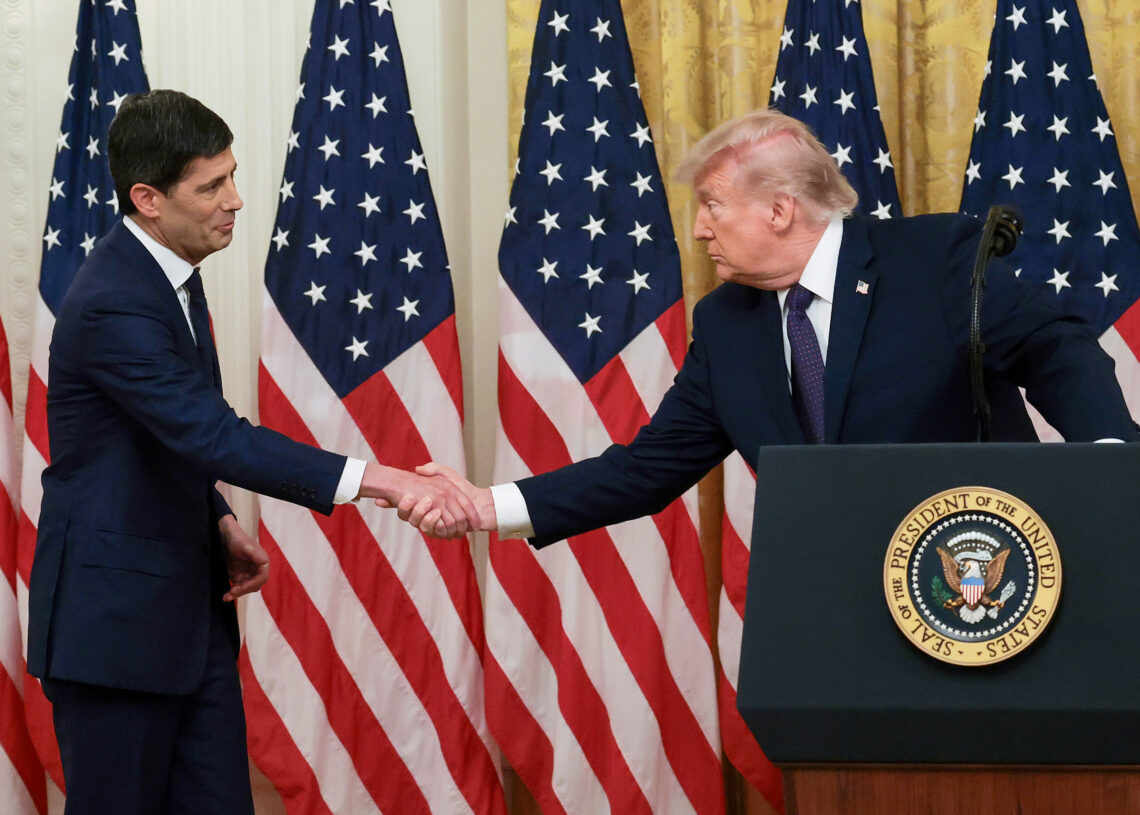
The Fed kept interest rates steady Wednesday at Kevin Warsh’s first meeting as Fed chair, as the new central bank chief inherited an economy hit by energy-driven inflation that is squeezing consumers’ wallets and a White House pushing for lower borrowing costs.
Nine of the 19 officials who participate in Fed policy meetings penciled in at least one rate increase by the end of the year, up from zero in March, when most Fed officials still anticipated cutting rates.
Financial markets fell on the signals of higher interest rates. The Dow Jones Industrial Average closed down about 1 percent, and the tech-heavy Nasdaq fell 1.3 percent. Yields on U.S. Treasury bonds jumped, as investors demanded higher returns to compensate for the prospect of potentially rising interest rates.
Wednesday’s move came as inflation jumped above 4 percent last month for the first time since 2023, remaining well above the Fed’s 2 percent target. Energy prices, driven higher by the Iran conflict, have put Warsh in the uncomfortable position of inheriting an economy where the political pressure runs in one direction and the price data in another.
“We recognize that inflation has been running well ahead of the Fed’s long-stated inflation goal,” Warsh said at a news conference. “Persistently high prices are a burden for the American people. But the recent past need not be prologue.”
Warsh deflected repeated questions about why the Fed held rates while so many officials signaled hikes ahead, citing his opposition to “forward guidance.” The decision to hold was unanimous, and the Fed didn’t consider hikes at its meeting, he said.
Under Warsh’s leadership, the Fed substantially shortened the statement it releases after each meeting, eliminating guidance for how it might adjust interest rates in the future. The half-page statement acknowledged that inflation remains elevated but said the Fed “will deliver price stability.”
A ceasefire agreement to reopen the Strait of Hormuz has raised hopes that some of the energy-driven price pressure could ease in the months ahead. But economists and former Fed officials caution that relief, if it comes, will arrive slowly and that prices were already elevated before the conflict.
Inflation “rises like a rocket and falls like a feather,” said Patrick Harker, a former president of the Philadelphia Fed and a professor at the University of Pennsylvania’s Wharton School, earlier this week.
Krishna Guha, an analyst at Evercore ISI, said easing energy prices could provide some relief in the months ahead. But he cautioned in a research note that the interest rate outlook has become untethered from oil prices — a sign of deeper uncertainty about whether underlying inflation will cool enough to keep the Fed from eventually having to raise rates. Beyond energy, Guha said, two other pressures remain: the ongoing pass-through of tariffs and cost spillovers from the boom in artificial intelligence infrastructure investment.
Warsh said he intends to offer fewer forward-looking clues about the Fed’s next move than his predecessors, having previously said the central bank’s economic forecasts tend to be wrong and constrain its flexibility. On Wednesday he criticized forward guidance as “not well suited to the current policy conjuncture.”
He also stopped short of committing to holding a news conference after each Fed meeting, saying “when you have one, you want to make sure you have something important to say.”
In the latest quarterly economic projections, in which nine officials signaled future hikes, Warsh said he didn’t submit a projection and would not do so until changes are made to the document.
He added that the Fed is setting up a series of task forces to probe a handful of topics, such as central bank’s communications and the data sources it relies on to assess the health of the economy. They are likely to begin work in the next couple of weeks and conclude by the end of the year, he said.
Jerome H. Powell, whose term as a Fed governor runs until 2028, remains on the seven-member central bank board in Washington — an unusual arrangement that leaves Warsh to chair a committee that includes his predecessor. After eight years in charge of the central bank, Powell’s term as chair expired last month.
The White House, meanwhile, has sought to pressure against rate hikes.
President Donald Trump, preparing to leave France for the United States, told reporters that “it’s hard to believe” the Fed might raise rates but praised Warsh. “We have a very good guy over there right now, so I’m guided by what he wants,” Trump said of the new Fed chair.
Raising rates carries its own risks. Higher borrowing costs would bear down on an economy already squeezed by energy prices, potentially pushing up unemployment and slowing growth — the classic dilemma the Fed faces when inflation is driven by supply disruptions rather than excess demand. Unlike the pandemic, when a red-hot labor market gave the Fed room to tighten aggressively, the current economy offers no such cushion.
Claudia Sahm, chief economist at New Century Advisors and a former Fed economist, said Tuesday she doesn’t yet see the conditions — an overheating labor market or expectations for inflation becoming unmoored — that would typically warrant a Fed response to supply-driven inflation.
But she acknowledged the case for action is building. “I can see the case that the Fed should be ready to, if things worsen, step in and raise rates,” she said. The Fed could move faster than it did during the pandemic inflation surge, she added, because “they’re already having this debate.”
The post Fed holds rates steady amid elevated inflation, but future hikes more likely appeared first on Washington Post.