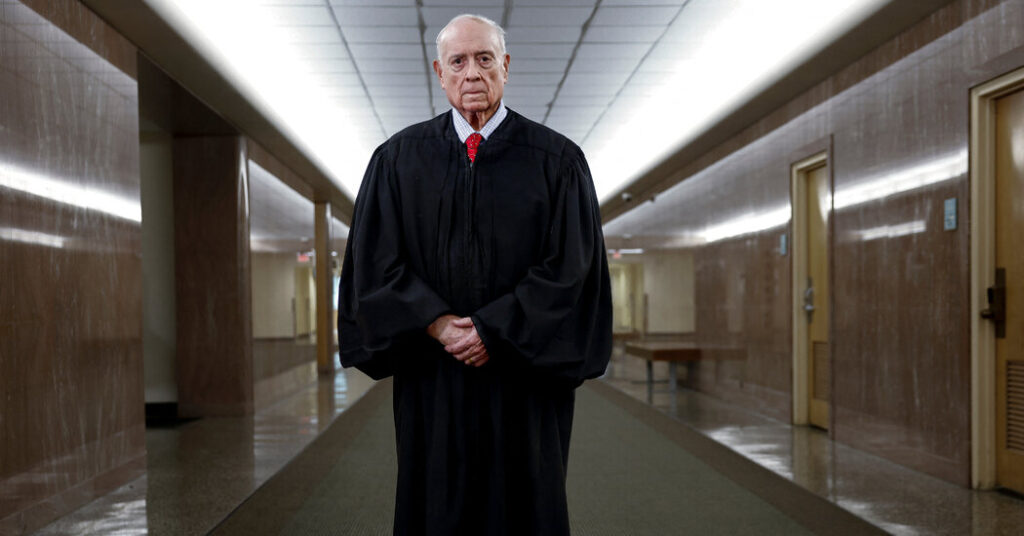
A federal judge ordered the Bureau of Prisons on Wednesday to continue providing hormone medications to transgender inmates, rejecting, at least for now, the Trump administration’s decision to no longer provide such medical treatment for prisoners.
Judge Royce C. Lamberth, of the Federal District Court for the District of Columbia, issued a preliminary injunction, finding that doubts the government has raised about hormone therapy were unlikely to satisfy a legal requirement that federal agencies offer a reasoned explanation for reversing existing policies.
Amid an array of legal fights over the Trump administration’s policies on transgender Americans, the case is rare for focusing broadly on medical treatments for transgender adults, rather than minors. The federal health department, for instance, has asserted that hormone therapy for gender transition is not appropriate for adolescents, who may not understand its associated risks, such as infertility.
But Bureau of Prisons officials have taken the position that even for adults with gender dysphoria — significant distress linked to a mismatch between a person’s birth sex and gender identity — the benefits of hormone therapy are unclear. In a policy document issued earlier this year, the agency called for trans prisoners to be given psychotherapy and antidepressants instead of hormone therapy and items like undergarments that match their identities.
Lawyers for transgender prisoners have said transition-related treatment, which can include cross-sex hormones, social transition and in some cases surgery, is the only approach known to effectively treat gender dysphoria. The treatment has come under scrutiny for adolescents, but has been accepted as effective for adults for several decades, and is supported by the major medical and mental health organizations in the United States.
The ruling is a setback for the Trump administration, which has largely prevailed in legal challenges to its efforts to end recognition of self-identified genders. The administration has succeeded in requiring transgender people to display their birth sex on U.S. passports and banning them from serving in the military. It has allowed government employers to bar them from bathrooms that match their identity, persuaded several hospitals to end gender medicine for youths and has announced plans to redirect grants to arts, education, research and health organizations that “deny the biological reality of sex.”
On trans prisoners, however, the administration has been blocked in its efforts since early last year. In a related case, Judge Lamberth found earlier this month that a Bureau of Prisons plan to transfer to male facilities 14 transgender women it had previously placed in women’s housing was likely to violate the Eighth Amendment’s prohibition on cruel and unusual punishment.
Judge Lamberth was appointed to the bench by President Ronald Reagan.
About 1,028 federal prisoners have been diagnosed with gender dysphoria, according to the Bureau of Prisons. Of that group, 628 prisoners receive cross-sex hormone therapy to bring certain physical traits — facial and body hair, voice range, breast tissue, and distribution of fat and muscle — in line with their identities.
The ruling is the second time Judge Lamberth has blocked the Bureau of Prisons from denying transgender prisoners access to hormone medication. Last June, the judge had agreed with three inmates who sued the prison system, arguing that by adjusting their medical treatment, the bureau had most likely violated the Administrative Procedure Act, a 1946 law that requires federal agencies to justify policy changes. The judge’s order last year blocked the policy for all inmates with a gender dysphoria diagnosis.
The ruling on Wednesday concerned a new policy, “Management of Inmates with Gender Dysphoria,’’ that the Bureau of Prisons announced in February. That policy calls for inmates to be tapered off hormones and treated instead with psychotherapy and psychotropic drugs. It also bars inmates from acquiring items known as “social accommodations,’’ like bras and cosmetics, for a gender other than the one that matches their birth sex.
In April, the government asked Judge Lamberth to dissolve his earlier order, saying that it had satisfied the legal requirement to justify its action. The Bureau of Prisons said that it had concluded after a monthslong assessment that evidence of hormone therapy’s effectiveness in treating gender dysphoria in adults was weak. “The pendulum has swung” regarding support for the treatment, a government lawyer told Judge Lamberth during a hearing this spring.
The inmates, represented by the Transgender Law Center and the A.C.L.U. Foundation, argued that the Bureau of Prisons had manufactured a medical rationale to carry out President Trump’s policies. The agency was aware of the risks of withholding hormone therapy, lawyers for the inmates said, because its own doctors had previously deemed it clinically necessary.
Risks of denying the treatment, they said, include exacerbated depression, anxiety, suicidal thoughts and self-harm. And they noted that there was no evidence that psychotherapy or psychotropic drugs alleviate the distress of gender dysphoria. One of the plaintiffs, Solo Nichols, said in a sworn declaration that he had tried many psychotropic medications before hormone therapy and found them all to be ineffective.
In his 31-page opinion on Wednesday, Judge Lamberth concluded that the agency’s policy was still likely to be found “arbitrary and capricious” under the Administrative Procedure Act. The policy, he said, was “objectively unreasonable,” because it failed to consider the Bureau of Prisons’ own history of providing hormone therapy and social accommodations to prisoners with gender dysphoria.
The agency, he said, had instead relied on a declaration by a doctor it retained who has limited experience treating gender dysphoria, and who promotes psychotherapy as a treatment which “he himself acknowledges is not evidence-based.” The judge also said the agency appeared to have “reverse-engineered” its rationale to fit President Trump’s executive order, which is prohibited by the statute.
“No length of consideration can convince the court that a policy is anything other than pretext when the agency has not demonstrated that it considered the relevant evidence and drew a reasonable conclusion from that evidence,’’ Judge Lamberth wrote.
Seamus Hughes contributed research.
The post Federal Prisons Must Provide Hormones Sought by Trans Inmates appeared first on New York Times.