The police in Northern Ireland were increasing their presence on Wednesday, and political leaders were urging restraint, after a night of violence roiled the country in the wake of a brutal stabbing attack in Belfast.
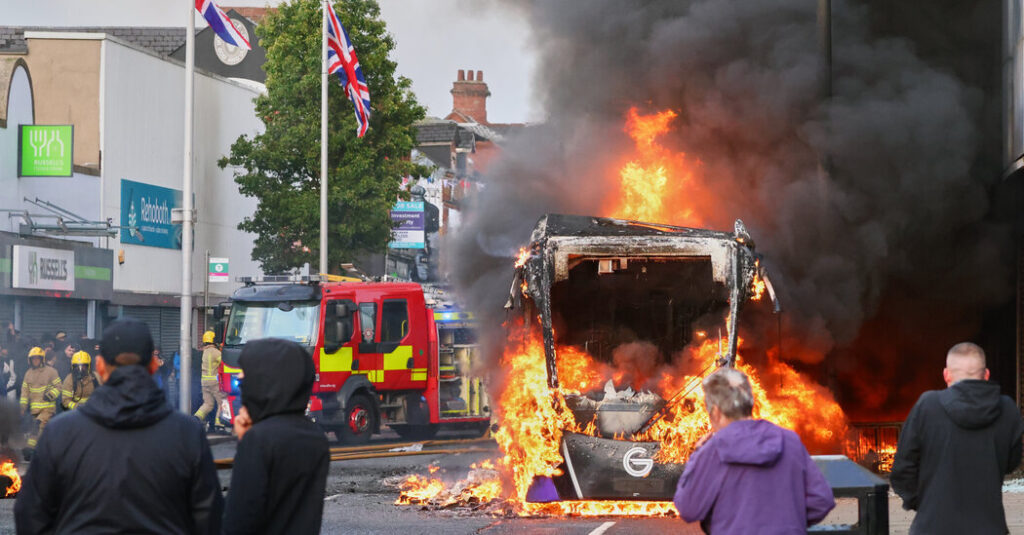
Firefighters and emergency responders escorted immigrant families from homes that had been set alight in Belfast on Tuesday night. Burning cars blazed on the street, and a city bus was set on fire by a group that appeared to be mostly young men, many of them masked. Garbage cans engulfed in flames were used to create roadblocks elsewhere in the city.
Two police officers were injured in the unrest, described by the police as sporadic pockets of disorder across Northern Ireland. The violence came after the authorities charged Hadi Alodid, a 30-year-old Sudanese man, with attempted murder in the stabbing attack Monday night, prompting calls from anti-immigrant activists for protest amid heightened tensions in the United Kingdom over immigration.
Mr. Alodid, a refugee and legal resident, appeared in a Belfast court on Wednesday morning. Prosecutors identified the attack’s victim as Steven Ogilvy. He is in the hospital with serious injuries to his face, neck and back, and prosecutors said he had lost an eye. Mr. Ogilvy’s family, in a statement released on Wednesday, said “unrest is not welcome” and asked for calm.
The Police Service of Northern Ireland said in a statement that a large policing presence would be maintained across the country in the coming days “to reassure communities and ensure public order.”
Some of the most harrowing scenes played out in Belfast, where families had to flee burning homes.
Paul Doherty, a community worker and local councilor from west Belfast, described what he’d seen on Tuesday night as “absolutely appalling.” He said there were “mobs of people basically chasing people from their homes.”
“People were being terrorized simply because of the color of their skin or where they came from,” he said, adding that he met with and provided help to two women, one Sudanese and another from Somalia, and four children, who were forced from their home after an arson attack.
Government leaders issued sweeping condemnations of the unrest.
Michelle O’Neill, the first minister of Northern Ireland, appealed for calm, saying there could be “no excuse and no justification for these attacks,” in a statement issued early on Wednesday.
“Groups of masked men burning families out of their homes is nothing less than disgusting cowardice,” she wrote. “This has nothing to do with community. This is outright thuggery.”
She called the earlier stabbing of Mr. Ogilvy in north Belfast “heinous and wrong” and added that “there are dangerous attempts to exploit that to target and attack innocent people who are simply trying to live, work and raise their families here.”
Prime Minister Keir Starmer of Britain, in a statement posted on X, called the violence in Belfast “shocking and completely unacceptable,” adding, “It is clear that people were targeted last night because of their background, and I will not tolerate it.”
Graphic video of the stabbing, showing the suspect swiping at a man whose face and neck are covered in blood, had spread quickly online on Tuesday, spawning a number of anti-immigrant posts and calls for protests.
Among those stoking outrage over the stabbing was Tommy Robinson, a far-right English agitator with a number of criminal convictions. Mr. Robinson, whose real name is Stephen Yaxley-Lennon, had urged people to take to the streets after what he called an “invader attack on our people” in posts on social media.
The billionaire Elon Musk had shared lists of locations around Northern Ireland for people to gather and reposted messages of far-right figures in Britain.
Jon Boutcher, chief constable of the Police Service of Northern Ireland, urged young people to think twice about the calls for violent protest, saying in a Wednesday news briefing that “it’s very easy, these days especially, to look online and be persuaded by people who know nothing about Northern Ireland.”
“Stop looking at this nonsense, stop listening to these idiots,” Mr. Boutcher said. “We will be going after them for the incitement they have been doing. Everybody, please think about what happened last night and the terror that you caused to innocent families.”
While he declined to identify anyone specifically, he said the police would be working to understand “who is orchestrating this online and in person.”
The police and local community members in Belfast acknowledged that some protesters had gathered peacefully. The violence was carried out by young people, many of them masked, who specifically targeted immigrants, according to the police, witnesses and online video footage.
Northern Ireland is the least ethnically diverse part of the United Kingdom, with just about 3.4 percent of residents from minority ethnic backgrounds.
But in the years since the 1998 Good Friday Agreement brought peace to the region after decades of sectarian violence, immigration to Northern Ireland has grown; the country is steadily becoming more diverse, particularly in urban areas like Belfast. Still, Northern Ireland remains the most deprived part of the United Kingdom in terms of resources and opportunity, and neighborhoods in Belfast are among the country’s poorest and most disadvantaged.
In some communities people feel left behind, struggling against a lack of jobs and opportunity. That helped created the conditions for anti-immigrant and far-right sentiment to grow and be picked up by fringe groups.
“People being burned out of their homes is not new to Belfast,” said Carl Whyte, a local councilor who grew up in the north part of the city, alluding to the sectarian conflict known as the Troubles. “And last night, we saw that being used toward immigrant families.”
Jonathan McKee, a local pastor, said he received a distressed call from one of his congregants, a woman in her 50s, who has lived in Belfast for over 20 years. Protesters had smashed her windows, targeting her home “because she’s Black,” and her neighbor’s house was on fire, Mr. McKee said in an interview. The woman, who was born in Uganda and is a care worker, is afraid to return home, Mr. McKee said.
“To be burning people out of their homes is not the way forward for this community,” Mr. McKee said.
Chinonso Uche, 32, a nurse who works at a Belfast hospital, said footage of the overnight protests left her fearing for her life on Wednesday. Originally from Nigeria, she has lived and worked in Belfast for five years and said in a phone interview that she had been the victim of racist attacks twice in the last year, including when a rock was thrown at her.
On Tuesday, she and other immigrant staff members ended their shifts early, fearing attacks. She said three of her colleagues were stopped on their way home by people demanding that they confirm that they had the right to work in Northern Ireland. Police officers had to escort at least one of them home, she said.
Mr. Doherty, the community worker and representative, said that he was “hopeful” that tensions would calm, and that people needed to be talked down from further violence by leaders from across the political spectrum.
“It doesn’t matter if you’re Catholic, Protestant, whatever your background is, think of your own children,” he said, adding, “Think of the fear that children went through last night, whenever their home was being torched. I think we need to bring it down to a human level, and respond to this in a way that everyone can move forward together.”
Michael D. Shear and Lynsey Chutel contributed reporting.
The post Police Step Up Security in Northern Ireland After Night of Violence appeared first on New York Times.