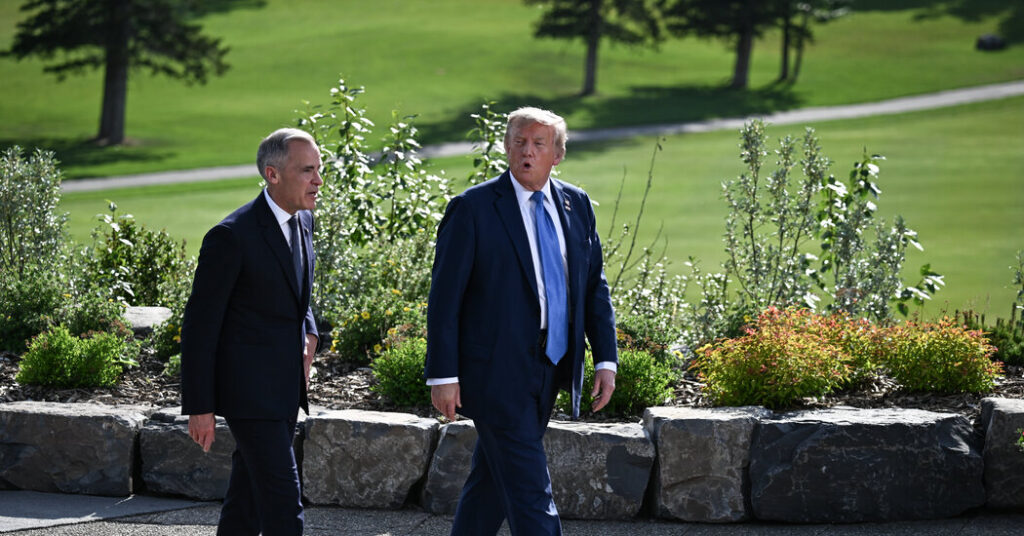
President Trump on Wednesday threw nascent trade talks with Mexico and Canada into disarray, saying he wasn’t sure he would renew the pact that has shaped the North American economy over the past three decades.
Asked about the ongoing process to renew the free-trade deal between the United States, Mexico and Canada, Mr. Trump sounded off on Wednesday: “I don’t know that I’m going to renew it.”
He went on to repeat claims that the United States had no need for Canada or Mexico, the country’s two top trading partners. The three-nation agreement underpins $2 trillion in annual trade and has, over the years, knitted several economic sectors across the borders together.
But Mr. Trump has been casting the pact, and that close integration, as a burden for the American economy since his re-election.
“We don’t need anything that Canada has, we don’t need anything that Mexico has, but they need everything that we have,” Mr. Trump said in the Oval Office, adding “We don’t need their cars, we don’t need their lumber, we don’t need their energy, we don’t need anything that they have.”
The comments come as Jamieson Greer, the United States Trade Representative, has started talks with Mexico over the pact, known as the U.S.M.C.A. Mexican officials are scheduled to come to Washington next week for the next round of talks.
Canada has been behind Mexico in launching its own parallel discussions with the United States, but its trade minister visited Washington earlier this month to meet with Mr. Greer, and signaled that technical discussions were about to begin.
Mr. Trump’s dismissive comments on Wednesday highlighted how hard it will be to renew the U.S.M.C.A., the successor of the North American Free Trade Agreement and a trade deal the president himself signed during his first term.
At the time, in January 2020, Mr. Trump called it “the fairest, most balanced, and beneficial trade agreement we have ever signed into law. It’s the best agreement we’ve ever made.” Since then, Mr. Trump’s opinion of the pact appears to have soured, as U.S. trade deficits with Canada and Mexico have generally trended higher.
Mr. Trump has a long history of threatening to scrap free trade deals, including the U.S.M.C.A. and its predecessor, NAFTA. So far the deal has been untouched — and even reinforced — by Mr. Trump’s dramatic changes to trade policy.
The Trump administration’s decision to exempt goods produced under the pact from most of its tariffs last year has been a major source of relief for many companies as U.S. tariffs on products from other countries have fluctuated dramatically.
Most goods imported into the United States from Canada and Mexico now come in tariff-free under U.S.M.C.A. rules. The U.S. imported more than $900 billion of goods from Canada and Mexico last year.
But as the three countries take up a renegotiation of the pact, its future is far from assured.
Companies in industries from automobiles to agriculture have argued that the U.S.M.C.A. is central to the U.S. economy.
Bob Hemesath, an Iowan corn and hog farmer who chairs the pro-trade group Farmers for Free Trade, said that the idea that America didn’t need anything from Canada “does not match the reality on my farm or any farm I know.”
Canada was the source of 80 percent of U.S. imports of potash, an important fertilizer, and Canada and Mexico now buy roughly one-third of everything American farmers sell abroad, he said.
“American farmers are rightly going to be concerned by today’s comments that the administration is not looking to renew U.S.M.C.A.,” he said. “Failing to extend and strengthen this agreement would be a self-inflicted wound for American agriculture at the worst possible moment.”
In Canada, the question of the future of the pact is a major source of economic uncertainty, but it also feeds into a much broader national reckoning with the level of dependence the country has on the United States. Mr. Trump’s animus toward Canada, and his repeated claims that it should become the 51st state, have shaped the country’s political fortunes and propelled Mark Carney, a career banker, to become prime minister with a mandate to diversify Canada’s alliances away from the United States.
The text of the U.S.M.C.A. called for a review of the agreement six years after it came into effect, which falls on July 1. But the three countries have indicated that negotiations will continue past that date. U.S. officials traveled to Mexico for negotiations in late May and have scheduled further meetings in Washington next week, and in Mexico during the week of July 20.
During the first round of talks in Mexico, U.S. officials discussed raising requirements for the proportion of a car that needs to be American-made in order to qualify for the pact’s benefits, as well as extending similar rules to other industries.
Spokespeople with Mexico’s economy ministry and Canada’s trade ministry, which lead the trade negotiations, did not immediately respond to requests for comment.
Emiliano Rodríguez Mega contributed reporting from Mexico City.
The post Trump Says He May Not Renew Canada-Mexico Trade Deal appeared first on New York Times.