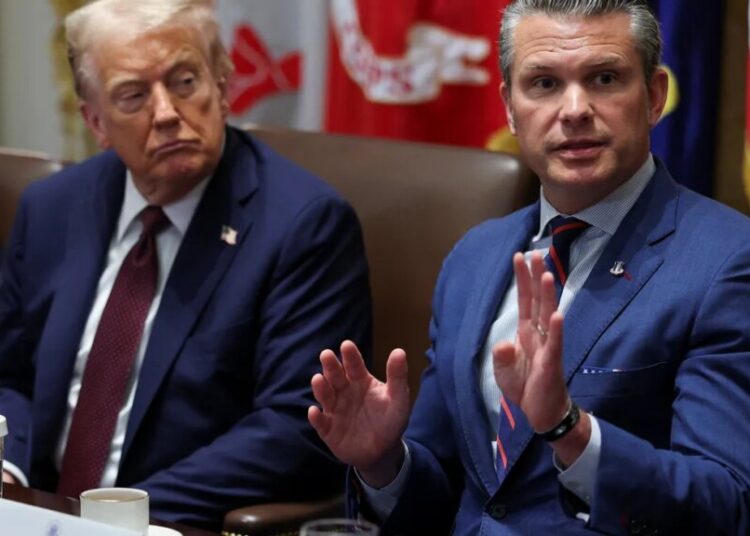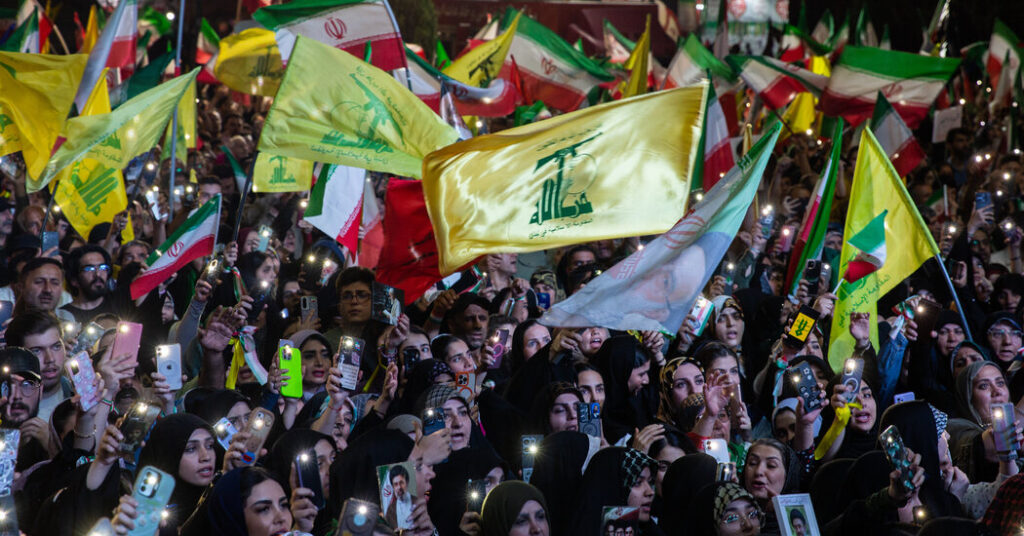
Just a day ago, President Trump said that a peace deal with Iran was imminent. Hours later, the United States and Iran attacked each other. On Wednesday, Mr. Trump said Iran was taking “too long to negotiate” peace, and later said, “We’re going to hit them hard again today.”
As Mr. Trump alternates between promising peace and threatening to return to full-scale war, neither has happened. Since a cease-fire was declared two months ago, U.S. and Iranian forces have continued to trade strikes while blaming each other for the violence and the lack of a peace deal.
With no end to the turmoil in the Middle East, the U.N. secretary general, António Guterres, lamented on Wednesday that the cease-fire that was announced in April “is more like a lesser-fire, as we have seen with the escalating attacks and rhetoric over the last 48 hours.” Speaking to the Security Council, he pleaded with all parties to negotiate a lasting peace agreement and warned that the ongoing attacks could mushroom into a wider war.
Mr. Trump chastised the Iranians for, he said, not agreeing to a peace deal after weeks of indirect talks. “They’ve taken too long to negotiate a deal that would have been great for them, now they will have to pay the price!!!” he wrote on social media.
Hours later, at the signing of an immigration enforcement bill in the Oval Office, he warned that U.S. forces would attack Iran again, a day after Air Force and Navy fighter jets struck Iranian targets in response to the downing of an American Apache helicopter near the Strait of Hormuz on Monday.
“We hit them hard yesterday, and we’re going to hit them again hard today,” Mr. Trump said, adding: “We were really close to a deal, but they keep tapping us along. They keep playing us for suckers, because — you know what? — they dealt with some very stupid presidents.”
The spokesman for Iran’s foreign ministry, Esmail Baghaei, said the U.S. attacks on Tuesday had undermined diplomatic efforts to end the war, according to Mehr, a semiofficial Iranian news agency. Talks cannot advance, he said, without “a minimum level of conducive conditions.”
In a bid to push the talks forward, a delegation of Qatari officials arrived in Iran on Wednesday, according to a regional official who spoke on the condition of anonymity to discuss sensitive matters. Qatar, alongside Pakistan, has served as a key mediator between Iran and the United States.
Iranian officials have neither admitted nor denied shooting down the U.S. Army helicopter. The two crew members aboard the helicopter were rescued off the coast of Oman and were in good condition, the U.S. military said.
U.S. Central Command said its strikes had hit air defenses, ground control stations and radar sites near the Strait of Hormuz. It called the strikes a “proportional response to recent attacks on U.S. forces and international commercial ships transiting regional waters.”
The Iranian state broadcaster, IRIB, reported that the U.S. attacks had hit drinking water facilities in the southern province of Hormozgan, cutting off water for thousands of people.
Mr. Baghaei accused the United States of deliberately striking civilian infrastructure that supplied drinking water to more than 20,000 residents in 10 villages. He called it “a calculated war crime” and a violation of international humanitarian law.
U.S. Central Command did not respond to a request for comment.
During the summer, Hormozgan Province is among the hottest places on earth, with temperatures that can reach 122 degrees. The chief executive of the regional water company, Abdolhamid Hamzehpour, said that temperatures in the province were “unbearable” without water and that the damage had been repaired in less than 12 hours, IRIB reported.
Manoochehr Shirzaei, an environmental expert and geophysicist at Virginia Tech, said: “In a region already facing extreme heat, chronic water scarcity and a rapidly warming climate, the loss of drinking-water infrastructure is more than physical damage. It threatens the health, resilience and daily survival of entire communities.”
In retaliation for the strikes, Iran said it had launched drones at U.S. naval targets in Bahrain and fired missiles at American military facilities in Jordan. Bahrain, Jordan and Kuwait all said they had intercepted incoming Iranian attacks, and a U.S. official said there were no reports of American casualties or damage to bases in the region.
The attacks inflamed tensions between Iran and Arab states in the Persian Gulf that host American military bases and have been repeatedly targeted by Iranian fire. Bahrain’s military described the barrage as “treacherous,” and the foreign ministers of Arab states in the Gulf called on Iran to immediately stop its attacks on their countries.
“Persistence in this aggressive approach will only lead to further isolation,” the ministers said in a joint statement after a meeting in Bahrain.
On Tuesday, the U.S. military, which has been enforcing a blockade on ships entering and leaving Iranian ports, said it had disabled a vessel registered in Palau, an island nation in the Pacific Ocean, by firing into its engine room. It said the crew had repeatedly failed to obey American orders not to proceed toward Iran through the Gulf of Oman. On Wednesday, India said that three of the 24 Indian crew members on board the vessel, the Settebello, were missing, and summoned a top U.S. diplomat in New Delhi to protest the attack.
American forces disabled another Palau-flagged vessel, the Marivex, on Monday. It, too, carried 24 Indian crew members, and it, too, was accused by the U.S. military of violating the blockade. The crew members sent frantic SOS messages for more than two hours before they were rescued by helicopter and taken to Masirah Island, off Oman’s coast.
“The continuing incidents of attacks on shipping in the region are deeply worrisome and a direct result of the ongoing conflict in the region,” India’s foreign ministry said in a statement. “We reiterate our call for immediate de-escalation of tensions, and the conclusion of ongoing negotiations for a diplomatic solution so that peace and stability can return to the region.”
Reporting was contributed by Farnaz Fassihi, Vivian Nereim, Pragati K.B., Shirin Hakim, Leily Nikounazar and Michael Levenson.
The post Trump Threatens More Strikes Against Iran, Citing Stalled Peace Talks appeared first on New York Times.