Who’s actually cool? Empirically, undeniably, stand-the-test-of-time cool?
James Dean and the James Bonds all have a reasonable claim; so do David Bowie and Marvin Gaye, Lauryn Hill and Kate Moss, Grace Jones and Nina Simone, Paul Newman and Yohji Yamamoto.
If you detect a whiff of recency bias, well, cool is a decidedly 20th-century invention. And one man was not just its father, but announced the birth.
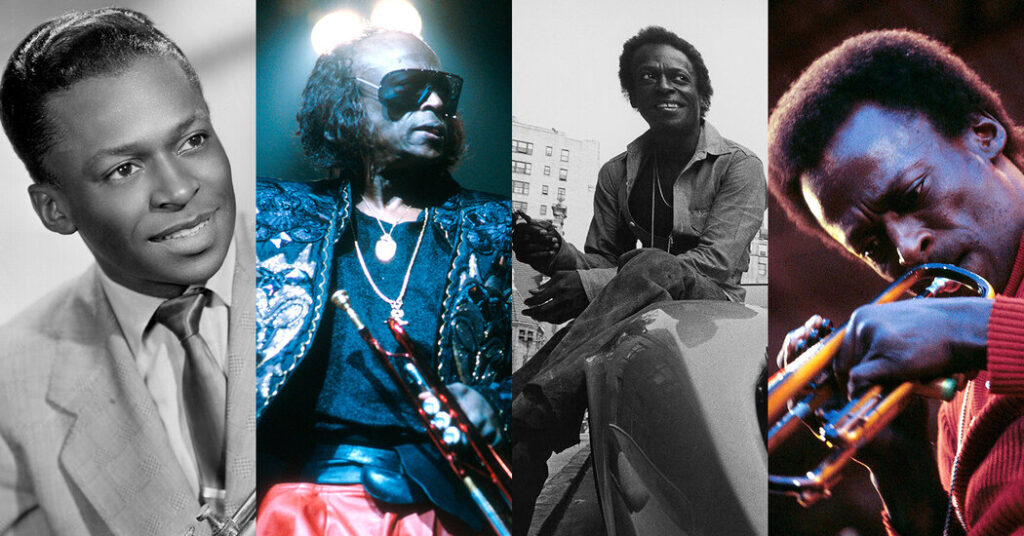
Miles Davis, the jazz legend and style innovator who would have turned 100 this month, remains for many people the pre-eminent avatar of cool. And while Davis’s greatest legacy is musical, he also cut a distinctive image over the course of his five-decade career. (Davis died of pneumonia in 1991, at 65.) His style shifted alongside his sound, but he had his touchstones — face-obscuring sunglasses and ticket-magnet sports cars among them.
Ahead of Davis’s centennial on May 26, writers from the Styles desk reflected on the specific elements of the trumpeter’s public image that made him a genius of cool.
His Trumpet
He Was ‘Miles on Any Instrument’
Miles Davis was not someone who would have been considered a “gear head,” said Billy Buss, an associate professor in the brass department at the Berklee College of Music in Boston. Davis did not often obsess over his equipment. Rather, the trumpet was merely a “vessel for his artistic expression,” Buss said, and Davis would play whatever instrument allowed him to do that.
“These days, everybody is looking for: What’s the coolest mouthpiece? What brand is going to help me be a better trumpet player?” Buss said. “Miles Davis was not about that. It was very much: I’m a trumpet player, and I’m an artist, and this is my sound, and I’m going to sound like Miles on any instrument.”
For much of his career, that instrument was a Martin Committee trumpet, along with an accessory that became a hallmark: a stemless Harmon mute, which, as Ian Carr wrote in his biography of Davis, was used to “express the most delicate nuances of feeling,” with a timbre that was “round and full.”
At the time that Davis was developing his sound, in the 1950s, jazz was all about “higher, louder, faster” forms of music, Buss said. But Davis was no follower, and his more subdued style was distinct.
In a 1989 interview, Davis said he liked playing the trumpet with a mute because it “sounds human, sounds like a voice.” The result was that his music was haunted by a sort of cool lyricism.
The Martin Band Instrument Company went out of business in 2008, but some of Davis’s trumpets are still kicking around. In March, one of his custom-made Martin Committees, which was made around 1980 and featured a black lacquered finish and gold-plated hardware, went to auction. It sold for more than $1.6 million.
— Scott Cacciola
His Sunglasses
Framing the Face of Cool
No accessory assured Davis’s reputation as the dark prince of jazz quite like his sunglasses did.
Whether Davis was playing the horn in his hard bop era or his fusion era, his bold and unsubtle frames added an impossibly cool accent to his style. He favored oversize and avant-garde shades — sometimes large enough to resemble goggles — from designers like Philippe Chevallier and Jean Paul Gaultier and brands like Vuarnet, and he paired them with his dashikis, Issey Miyake ensembles and Brooks Brothers suits.
In his clean-cut 1950s mode, Davis wore classics like Ray-Ban Wayfarers as he struck out in New York playing clubs like Birdland and Café Bohemia. As his jazz explorations traveled into rock and fusion, and his style grew groovier, he embraced Chevallier frames as his signature, wearing bug-eyed tortoiseshell designs and a pair that resembled ski goggles. Blowing through changes at the Newport Jazz Festival in 1969, he wore bulbous red acetate frames. At the Zénith concert hall in Paris in 1986, he donned futuristic Porsche Design shield sunglasses.
As Davis’s stature grew into that of an American cultural icon, his sunglasses also became something of a mask for him, a shield from the harsh glare of his fame. When television hosts like Dick Cavett interviewed him about his life as a jazz legend, he answered questions simply, raspily and profoundly from behind his shades.
Davis was in poor health in 1991 when he performed one of his last big concerts, at the Jazz à Vienne festival in France. Playing a red trumpet, and wearing welder-goggle-like black sunglasses, he blew through tunes like “Human Nature” and “Hannibal.” He died just three months later, but to everyone in the crowd that night, jazz’s dark prince had unquestionably been summoned.
— Alex Vadukul
His Sports Cars
A Taste for the Faster Things in Life
For Davis, personal transportation needed to meet two requirements: It had to be flashy, and it had to be fast. The first sports car Davis bought when he found success in music, a Mercedes-Benz 190 SL, hit the former mark but not the latter. So in the early 1960s, he traded the Mercedes for a white Ferrari 250 GT California Spyder — the beginning of his lifelong association with Italian supercars.
Davis drove his Ferraris to gigs daily, often at high speeds, sometimes high on cocaine. But more than their horsepower, as a Black man, he appreciated exotic cars as markers of success and spectacle. In his autobiography, Davis described the scene he created when he and his first wife, Frances Taylor, a dancer, pulled up in their white Ferrari convertible: “Man, it was something, people stopping and looking with their mouths hanging open and everything.”
When he returned to live performing in 1981 after years of health struggles, Davis bought a canary yellow Ferrari 308 GTSi and drove it from New York to a gig in Boston. “I wanted everyone to see me arriving to work in my new Ferrari,” he wrote. “I wanted them to know that I was really back.”
Davis encountered speed bumps along the way: In 1972, he broke both legs when he crashed his lime green Lamborghini Miura on the West Side Highway in Upper Manhattan. And he was constantly harassed by police officers who couldn’t reconcile the high-end sports car with the Black man behind the wheel. By the time he owned his last Ferrari, the same model as the one featured on the TV show “Miami Vice,” he had come up with preventive measures. “I had my lawyer call ’em up and say, ‘Miles has just bought a Testarossa and it’s gray. He just thought you’d like to know that,’” Davis told “60 Minutes” in 1989. The drivers who were dusted at red lights could identify the musician by his vanity plates: MILES22.
— Steven Kurutz
His Hair
The Only Constant Was the Color
Davis’s musical legacy is one of evolution, and his style was just as mercurial. For practically every new iteration of his music, there came a different image.
In the 1950s, around the time he released one of the most influential records of his career, “Birth of the Cool,” Davis wore his hair in its natural state and kept it closely cropped.
By the 1960s, already established in the world of jazz, there was a subtle but poignant change in his hairstyle. At the 1964 Monterey Jazz Festival, his short hair appeared smoothed out, as if it had been chemically straightened with a relaxer. The look was reminiscent of a conk, a hairstyle that was popular with African American men starting in the 1940s, but was by then on its way out.
As the hippie style of fringe, denim and wild hair took hold in the 1970s, Davis’s music took a turn for the looser as well. On the cover of “Isle of Wight,” released in 1971, he wears his hair in an Afro. The style signified a pride in Blackness and the freedom not to conform.
In the 1980s, the chameleonic Davis transformed yet again, shifting his look to incorporate color block, lamé, nylon and jackets with broad shoulders. His hair appeared taller: straightened, softly curled and creeping around his face and down his neck. As a guest on “The Dick Cavett Show” in 1989, he wore microbraids, his receding hairline plainly visible.
At the 1990 Chicago Jazz Festival, in what would be one of his last performances before he died in 1991, he wore what appeared to be a wig in the soft curl style, one that gave him the appearance of a full head of hair — the picture of follicular vitality. It was the final progression of his ever-changing image.
— Sandra E. Garcia
His Downtown Raiment
A Style Chameleon’s Natural Habit
His fashion eras are many and well studied. There were the early prep looks that the author Jason Jules examined in his book “Black Ivy.” There were the slick European suits the trumpeter favored during his Paris sojourn. There would be further mutations, Davis the fashion plate having been as resistant to pigeonholing as was Davis the musician.
Yet if one style era has burned itself into the mind’s eye, it is the Davis of “Bitches Brew.”
Those were the snakeskin years of 1969 and 1970. Those were the years of skintight, studded jeans from the leather wizard Hernando of Greenwich Village and of knee-high lace-up boots imported from Sweden and sold from a basement atelier at the Crafty Seaman on West 10th Street. Those were the years of torso-hugging jerseys and fringed suedes devised for Davis by the then-unknown designer Stephen Burrows and his buddy Bobby Breslau.
Those were the years when hip New Yorkers flocked to Andrea Aranow’s seminal East Village boutique Dakota Transit for shirts made from block-print Indian cottons or custom items like the floor-length patchwork snakeskin cape that Aranow designed specifically for Davis.
That those were also the Betty Davis years is a fact the Davis hagiographies tend to overlook. And that is a pity, since the period during which Miles Davis was married to the former Betty Mabry proved profound in its influence not only on his image but also on his music.
Would “Bitches Brew” have been the musical monument it became if not for Betty Davis? Who can say? Yet it is worth remembering that it was Betty who brought Miles into unfamiliar spheres, bringing him into both her coterie of creative gay New Yorkers and the adjacent musical worlds of psychedelic rock and funk. It was Betty, after all, who introduced Miles to Jimi Hendrix, the music and the man.
Pause a minute to reflect on that.
— Guy Trebay
Reporting was contributed by Scott Cacciola, Sandra E. Garcia, Steven Kurutz, Guy Trebay and Alex Vadukul.
The post Miles Davis: A Visual Dictionary appeared first on New York Times.