On May 7, amid the din of protesters, Tennessee’s Republican-majority legislature met to vote on a bill that would eliminate the state’s lone majority-Black and Democratic House district, divvying its voters up between three heavily white ones. Outraged, State Representative Justin Jones of Nashville stood in the hallway of the State Capitol and set afire a paper replica of the Confederate battle flag. The words “We will not go back” were printed along the top.
But going back is precisely what the legislature voted to do, as Tennessee became the first of the former Confederate states to create and approve new congressional maps since the Supreme Court’s recent decision to eviscerate the 1965 Voting Rights Act.
A week and a day before the Tennessee vote, the Supreme Court, led by Chief Justice John Roberts, had finally achieved the right’s decades-long goal of nullifying what’s considered the most successful civil rights law in our nation’s ignoble racial history. After upholding unrestrained partisan gerrymandering in other recent decisions, the court now determined that creating congressional maps that sought to ensure political representation for racial minorities violated the Constitution.
For students of history, what Tennessee did on May 7 felt like a premonition. One hundred and fifty years ago, when this nation’s first experiment with interracial democracy began to collapse, Tennessee — a former slave state and the birthplace of the Ku Klux Klan — was the first domino to drop. In 1870, the Tennessee legislature rewrote the State Constitution to disenfranchise Black men. As the historian Manisha Sinha writes in “The Rise and Fall of the Second American Republic,” Tennessee “provided a template to other Southern states” for how to “overthrow Reconstruction.” Within three decades, Black representation, in Congress and in local and state offices across the former Confederacy, would be wiped out.
It was not just Tennessee that echoed history, but the Supreme Court as well. The case that felled the Voting Rights Act was Louisiana v. Callais. Louisiana is the state where in 1896, in Plessy v. Ferguson, another superlatively conservative Supreme Court used the 14th Amendment to license segregation, setting off a race across the South to strip Black people of the franchise and codify their second-class citizenship.
The day after the Callais ruling, Gov. Jeff Landry took the unprecedented action of suspending the state’s U.S. House primary — in which tens of thousands of voters had already cast ballots — so legislators could redraw the election maps. Though one in three Louisiana residents is Black, Republicans intend to jettison at least one of two Black-majority districts. “Well, the failed narrative is actually that people in Louisiana are racist,” Landry insisted, “that basically we won’t elect Black people. I mean, I disagree with that.” In fact, since the Plessy era, Louisiana has sent only four Black people to Congress, and a Black candidate has never won in a white district there.
Georgia, South Carolina, Alabama and Florida quickly moved ahead with their own redistricting plans. And the governor of Mississippi — which has just a single Black U.S. representative despite having the nation’s highest percentage of Black residents, at 38 percent — announced his intent to do the same.
Voting and civil rights experts warn that America now sits at a familiar precipice. The Voting Rights Act helped transform the South: In 1965, the region had not a single Black representative in the U.S. Congress; today, it has 31. Now, Black representation may once again disappear in the South, where more than half of Black Americans live. This could lead to the largest decimation of Black political power since the fall of Reconstruction. And just like then, what is at stake is no less than American democracy itself.
In 1901, Representative George Henry White of North Carolina delivered a farewell speech for his entire race to the U.S. House. White, a Howard University graduate whose mother was most likely born into slavery, was elected in 1896. By the time he left office, he was the last of a cadre of Black men who had, during Reconstruction, integrated Congress for the first time.
As White looked out across a now all-white Congress, he said he spoke on behalf of “an outraged, heartbroken, bruised and bleeding, but God-fearing people, faithful, industrious, loyal people — rising people, full of potential force.” His departure might be Black people’s “temporary farewell to the American Congress,” he said, but “phoenixlike, he will rise up some day and come again.” It took more than half a century.
The Reconstruction era that White was elegizing had been snuffed out with dizzying speed.
It began in the wake of the Civil War as new constitutional amendments transformed the South, then home to nearly the entire U.S. Black population. The 14th Amendment ensured legal equality for the formerly enslaved, and the 15th Amendment guaranteed Black men the vote. Black men who had been enslaved, or were born to parents who had been enslaved, flocked to the party of Lincoln, casting ballots and taking political office. Together, Black and white Republicans created representative governments that passed the most progressive legislation in the region’s history — establishing public education, investing in public infrastructure and social programs, and initiating land reform and labor protections.
But former Confederates, led by the Southern plantation oligarchy and consolidated in the pro-slavery Democratic Party, never accepted interracial democracy. Many white Southerners engaged in mass killings, assassinations, electoral fraud, terrorism and coups to overthrow it.
At first, the Republican Party tried to protect democracy. President Ulysses S. Grant created the Department of Justice in 1870, expanding the federal government’s ability to enforce Black Americans’ civil rights. Congress passed the Enforcement Acts, what Sinha calls the nation’s first federal hate-crime laws, to guard against the wanton violence of white supremacists. The laws allowed federal officials to supervise elections in towns where white supremacists were interfering and to aggressively prosecute the Klan.
But over the next two decades, starting in 1876, the all-white Supreme Court thwarted the federal government’s attempts to enforce equality. It struck down all or part of the Enforcement Acts; it nullified the part of a law that mandated punishing state and local officials who worked to deny Black voters the franchise; it asserted that the 15th Amendment did not guarantee Black people the right to vote, but only prohibited states from explicitly using race to discriminate against voters.
Then the court struck down the 1875 Civil Rights Act, which had outlawed discrimination in public accommodations. Using the same logic that today’s Supreme Court did when it gutted the Voting Rights Act, the court determined, a mere 18 years after the abolishment of slavery, that “there must be some stage in the progress of his elevation when” Black Americans must no longer “be the special favorite of the laws.”
White Southern officials, following the road map the court laid out for them, immediately adopted so-called race-neutral tools that could disenfranchise Black voters without ever mentioning race. They implemented poll taxes and grandfather clauses and literacy exams. And because nearly all Black Southern voters identified with the pro-civil-rights Republicans, and nearly all white Southern voters aligned with the Democrats, white racists knew they could attack Black citizenship by dismantling the Republican Party. They used partisan gerrymandering to dilute Black voting power and eliminate Black seats.
After a while, white politicians in the North grew tired of trying to enforce Black Americans’ rights, and Northern business interests saw opportunity in the South’s exploitable Black (and poor white) labor. A political deal was struck that ended Reconstruction in 1877 and along with it any federal enforcement of Black political rights.
With the assent of the Supreme Court and the ambivalence of the federal government, the South increasingly became, once again, a region with one-party, white-only and often minority rule.
White Southerners had their own name for the end of Reconstruction: Redemption. America would not see another Black man in Congress for nearly 30 years. And it would take an additional 41 years after that before a Black person represented the South again.
Black Americans would spend nearly a century after Reconstruction’s demise fighting and dying to restore the rights they had lost, especially the right that secures all others: voting. Most Americans know the culmination of this effort as the civil rights movement, which led to the passage of the landmark civil rights legislation of 1964, 1965 and 1968. But many scholars also describe this period as the start of the Second Reconstruction. If that’s the case, we may be witnessing the Second Redemption.
Today’s Supreme Court has thrown open the door for this, using the same logic as before — that efforts to ensure Black political representation illegally discriminate against white Americans.
A century and a half ago, Southern state legislatures knew partisan gerrymandering could provide cover for racist gerrymandering. While the party alignments are now reversed, the racial divide remains. “As long as Black folks have voted, there has been a party that’s basically pro-civil-rights and one that’s anti-civil-rights,” Theodore Johnson, a scholar of Black electoral politics and senior adviser at New America, told me. “Black folks have voted mostly uniformly against the party against civil rights. Most white people vote for the anti-civil-rights party.”
Since the end of Barack Obama’s second term as the nation’s first Black president, the racial partisan divide has only intensified, with Southern white voters moving even more fully into the Republican Party. White conservative politicians deeply understand this, though the court treats it as incidental.
The parallels to Reconstruction and Redemption are not perfect but they are conspicuous, the Yale historian David Blight told me. “You could argue here in big terms that Trumpism, in fact, that the modern conservative movement, has been a similar reaction to the modern civil rights revolution,” he said. Today’s rollback of civil rights relies largely on legal machinations rather than violence, but to Blight, its goal is no less radical.
Janai Nelson, who as president and director-counsel of the Legal Defense Fund argued the Callais case before the Supreme Court, told me that the court had greenlit a sort of wink-and-nod colorblindness, where majority-Black districts are automatically suspect but a legislative body can create voting maps where no Black people are elected, and as long as they do not say they are doing that for racist reasons, the Constitution is fine with that. And it is not just in the South that Black representation is imperiled. Illinois’s Democrat-controlled State Senate was planning to put forward a constitutional amendment to protect so-called majority-minority districts. After the Louisiana v. Callais ruling, it halted the effort.
The consequences for Black representation, in Congress and state legislatures, but also on school boards and county commissions and in judgeships, could be catastrophic — not just for Black Americans but for everyone.
Black rights movements have always been democratizing movements, and history shows this country cannot deny one and maintain the other. When Redeemers stripped Black Americans of their franchise and political representation, white Southerners who did not align with the Democratic Party also lost the ability to choose their leaders. These all-white conservative governments then decreased funding for public education and public services, implemented regressive tax systems that favored the elite and helped crush labor movements.
“It needs to be emphasized again and again: What is happening is an assault on democracy, and they’re using the easiest vector, which is anti-Black racism, because it’s the easiest thing you could do, the laziest thing you can do,” Nelson said. “They are cementing absolute minority control because they do not represent a majority of this country. And when they — if they — get away with the heist, we will be locked out of multiracial democracy for at least a generation.”
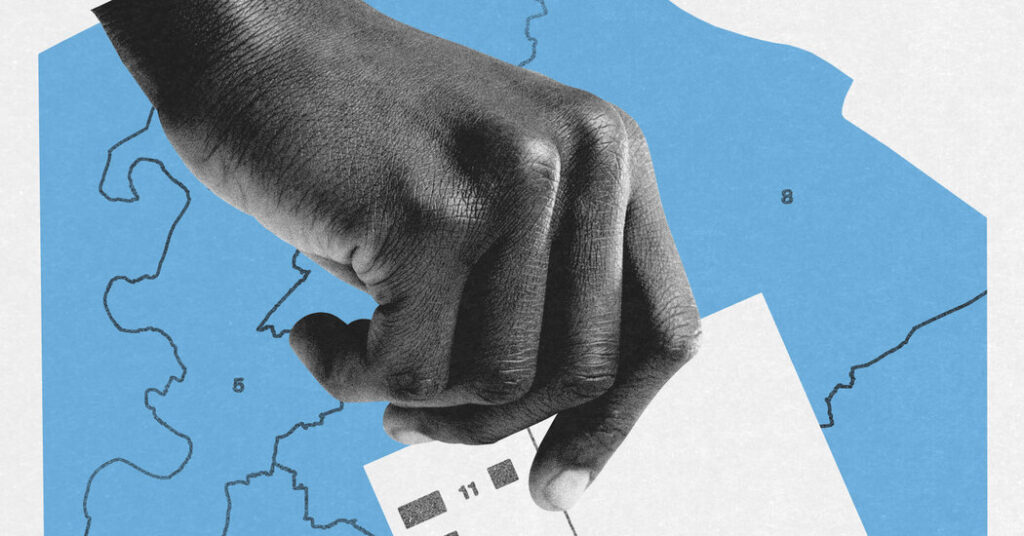
Source images for illustration above: The Image Bank RF, via Getty Images; iStock, via Getty Images; Prostock-Studio, via Getty Images; Tennessee Comptroller of the Treasury
The post The Civil Rights Era Is Collapsing Before Our Eyes appeared first on New York Times.