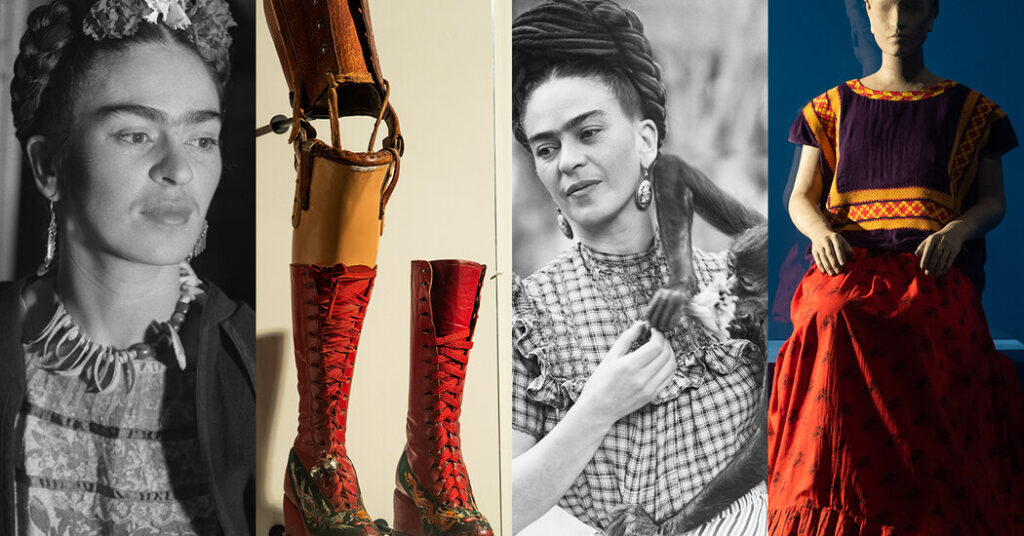
Frida Kahlo didn’t become one of the most famous figures of the 20th century by chance. The popular image of the artist that persists in Barbie dolls and on coffee mugs was a carefully constructed avatar — proof, according to the costume designer Jon Bausor, that “she was a living work of art.”
The daughter of an amateur photographer when that was still an eccentric thing to be, Kahlo had an awareness of the power of visuals from an early age: She chose clothing that concealed her disability but highlighted her heritage; she darkened her eyebrows, but refused to separate them. And whether posing for a photo or sitting for one of her many three-quarter view self-portraits, she was always, always aware of her angles.
“Everyone has a version of Frida in their head,” said Wilberth Gonzalez, who, along with Bausor, designed the costumes for “El Último Sueño de Frida y Diego” at the Metropolitan Opera. But too often, the men agreed, that image is informed by trickle-down kitsch: a dress in a meaningless selection of colors, or a braided hairstyle adorned with “a random bouquet.”
New York may be in the midst of one of its periodic flare-ups of Frida-mania — a new exhibition at the Museum of Modern Art features works by Kahlo and her husband, Diego Rivera — and frenzy can often lead to flattening, turning a complex artist into an icon, a vibe.
But for Kahlo, personal presentation was almost an extension of her artistic practice. Because to understand Frida Kahlo as a painter, it helps to understand her as a performance artist, forever putting on a show for the world.
Her Medical Corsets
Like a Canvas Under Her Chin
When the Victoria and Albert Museum in London held its blockbuster show “Frida Kahlo: Making Her Self Up” in 2018, it included, among the many self-portraits, photographs and textiles, a handful of the 28 corsets Kahlo wore throughout her life — not because she wanted a smaller waist, but because a devastating bus accident when was 18 snapped her spine (and caused other excruciating injuries). On their own, these devices might have been torturous contraptions of plaster, straps, steel and leather necessary to support her broken back, but in her hands, they became a literal canvas.
Forced to lie in bed for months wearing the various corsets, Kahlo would paint them with the aid of a mirror, adorning their dull frames with birds, a hammer and sickle, an eye, a sun and a fetus in utero. Sometimes, she affixed tiny mirrors, like stars, to the plaster. When doctors took away her materials, she used lipstick and iodine instead. In doing so, she reclaimed the corsets, as well as her own pain, turning an orthopedic apparatus (not to mention the whole idea of signing someone’s cast) into something glorious and indelible.
Circe Henestrosa, the co-curator of the London exhibition, has argued that by decorating her corsets, which the artist had to continue to wear throughout her life under her traditional Tehuana dresses, Kahlo made them seem like “an explicit choice,” rather than something forced upon her. She took a reminder of one of the worst times in her life and transformed it into a tool for self-expression; a part of her identity, and her art.
— Vanessa Friedman
Her Tehuana Dress
A Strategic Silhouette
Out of the fewer than 200 paintings that Kahlo made in her life, roughly a third of them are self-portraits. Kahlo was usually her own muse, and her fascination came across in how she styled herself.
She wore many types of dress, from men’s suits to the post-Mexican Revolution china poblana style. But in the popular consciousness, she is almost always imagined in the formal style of dress particular to the Isthmus of Tehuantepec in southern Mexico.
The look consists of a Tehuana skirt — floor-length, with a hem or flounce often made of lace from Manchester, England — and a square-cut, tunic-style blouse called a huipil that is often embroidered in bright colors or embellished with brocade.
Kahlo frequently paired the skirt and top with a rebozo — a rectangular shawl sometimes used to swaddle babies — draped over her shoulders, sometimes wrapped around her waist.
The garments created a silhouette that encouraged the eye to focus on her body from the waist up. The generously pleated skirt, known as an enagua, allowed her to conceal a right leg that was smaller than her left, a result of a bout with polio. Kahlo’s many expressive and artisanal styles allowed her to control how she was seen, putting forward a body on her terms, regardless of how disembodied she might have felt.
Cocooned in the Tehuana skirt, she hid the parts of herself that caused her the most pain, revealing them, instead, through her works.
— Sandra E. Garcia
Her Signature Blue
A Shade as Vibrant as She Was
Mexico City has no shortage of colorful buildings; there are enough purples, pinks, oranges and yellows dotting the streets to weave a Technicolor dreamcoat. But there is only one Casa Azul, the tourist-swarmed blue house in the bohemian neighborhood of Coyoacán where Kahlo took her first and final breaths.
Indeed, the building across the street from the family home is also blue, but it is not that blue. Approaching the Casa Azul — which was opened to the public as a museum in 1958 — it is impossible to miss the electric cobalt hue that seems to glow from within, undulating in the late afternoon sunlight that dapples through the lush trees and plants that dot the internal courtyard.
The blue, which Kahlo is said to have chosen for its power to ward off evil, can also be seen at another of the artist’s former homes, in the San Ángel neighborhood of Mexico City. And what of Yves Klein blue? More like Yves Klein who: The French artist didn’t debut artwork featuring what would become his signature shade of ultramarine until several years after Kahlo’s death.
— Madison Malone Kircher
Her Men’s Wear
Three-Piece Suit, or Second Skin?
Where did she buy the suit? Who was the tailor or the haberdasher who would agree to outfit a teenage girl from Mexico’s prosperous upper middle class in the garb of a man? The girl was Frida Kahlo. Although accounts vary, the photograph was most likely taken in February 1926. In a family portrait orchestrated by Kahlo’s father — a keen amateur photographer — her relatives are attired in clothes conforming to the conventions of their sex: sleeveless chemises or matronly frocks for the women, a sports jacket and shorts for her young cousin Carlos, staid suits for the men.
The outlier is Frida, just 18 and at the start of her spectacular, eventful and tragically brief existence. (She died at 47.) In the famous and often reproduced photo, Frida, too, is dressed in a suit: a bulky three-piece with vest buttoned tight, a high-collared shirt and lace-up Oxfords. Her hair is slicked down and parted in the middle. A dimpled necktie is at her throat. Her gaze is impudent and sure.
In most of the countless interpretations this image has inspired, viewers have tended to focus on Kahlo’s defiance of convention — of family portraiture, of middle-class propriety, of gender norms. Seldom remarked upon is the element that, in this viewer’s eyes, is most startling about the photograph. That is, the family’s seeming embrace of young Frida’s desire to dress, for an official family portrait, as a man. Particularly at a moment when gender identity is debated, contested and daily called into question, acceptance itself can perhaps be seen as a radical act.
And gender play continued to be intrinsic to Kahlo’s experiments in self-expression throughout her lifetime. Following a bitter divorce from her husband, the muralist Diego Rivera, in 1940, she hacked off her luxuriant mane and defiantly painted herself in men’s clothing for “Self-Portrait With Cropped Hair,” on view in the MoMA exhibition. Swimming in a dark gray suit, her shorn locks scattered about her, a masculinized Frida seems to invert the myth of Samson. Cutting off her hair, she restores herself to power.
— Guy Trebay
Her Animals
The Zookeeper of Coyoacán
When Kahlo was a girl growing up in the Casa Azul, her family home teemed with birds, cats, butterflies, dogs and caterpillars. When she turned 6, becoming bedridden with polio, her pets kept her company while her friends frolicked in the park outside. After her life-altering bus accident at 18, Kahlo’s bond with them only deepened, and she would find solace in the company of animals for the rest of her life.
There was her parrot, Bonito, who enjoyed perching on her shoulder. There was her fawn, Granizo, to whom she liked giving head scratches. Her hairless black dog, Señor Xolotl, sat beside her while she painted. When Rivera built a pyramid structure in the Casa Azul’s garden, he created a sanctuary for his wife’s menagerie, and her animals roamed around on it as if it were their own little kingdom.
Kahlo yearned for motherhood, but the collision left her unable to have children, and her attempts to become pregnant with Rivera ended in heartache. Two of her most beloved companions were her spider monkeys, Fulang-Chang and Caimito de Guayabal, whom she tenderly cradled as if they were her children.
Kahlo’s life was bookended with more suffering. Rivera’s rapacious infidelity, which had included an affair with her younger sister, cleaved her heart. And the amputation of her right leg resulted in depression and illness a year before her death. But when Kahlo died at 47 in the Casa Azul, she was dependably surrounded by her best friends.
— Alex Vadukul
Her Prosthetic Leg
An Extension Near the End of Her Life
As a child, Kahlo sought to hide her withered right leg — a deformity that she hated “all her life,” as Hayden Herrera wrote in her 1983 biography of the artist — by wearing multiple pairs of socks or long skirts. But Kahlo could not camouflage her limp, and other children mocked her by calling her “peg leg.”
The 1925 collision that left her with a fractured spine, a crushed pelvis and a shattered right leg also crushed her right foot, which would become a source of constant discomfort that often bordered on agony.
“From the accident onward,” Herrera wrote, “pain and fortitude became central themes in her life.”
Kahlo had been using a cane to help her walk even before the accident. In her final years, as her physical problems mounted, she had no choice but to rely on it as a sort of extension of her physical body — a pragmatic tool and a symbol of the role she adopted, both in life and in her first-person art, as “the heroic sufferer,” according to Herrera.
Kahlo underwent at least 32 surgical operations in the years after the accident, but it was not until 1953 — about 11 months before her death — that her lower right leg was amputated because of gangrene. But here, too, was an opportunity for art — and, perhaps, for joy in the face of misery. To get around on her flesh-colored prosthesis, Kahlo wore red leather boots that she adorned with little bells.
They would ring when she danced.
— Scott Cacciola
Her Unibrow
The Line of Beauty
About five years before she died, Kahlo sat for interviews with her friend Olga Campos, who was then studying to become a psychologist. In one interview, the artist belittles almost every single one of her physical attributes: her polio-stricken leg, her breasts and genitals, her head and faint mustache. But, she told Campos: “I like the eyebrows and the eyes. Aside from that, I like nothing.”
A feature common in many non-European cultures in which thick hair, facial or otherwise, is often regarded as a sort of ancestral treasure, Kahlo’s unibrow was a signifier of her being. It was a constant in her many self-portraits, even as they depicted the shifting context of her life: Whether the painting was somber, decorated with animals or stripped of every discernible Kahloism, that thick, untamed wave asserted itself.
So central is that single, undulating line of hair to her likeness that when Mattel introduced a Kahlo Barbie in 2018 with a gap where her brows would typically meet, it caused an uproar. Take away that brow, her fans said, and you have merely a feeble impersonator.
A feminist well before that word had currency, Kahlo declined to pluck her brow at a time when pencil-thin arches were popularized by movie stars like Greta Garbo and Rita Hayworth, instead keeping them big and bold in defiance of Western beauty standards. She combed them regularly and filled them in with a black powder meant to stimulate growth, according to Campos, whose interviews were later published in Salomon Grimberg’s book “Frida Kahlo: Song of Herself.”
And in 2004, hidden among her personal possessions that were locked away for 50 years after her death, archivists found another clue about she cultivated her image: a Revlon eyebrow pencil in “Ebony.”
— Alisha Haridasani Gupta
Reporting was contributed by Scott Cacciola, Vanessa Friedman, Sandra E. Garcia, Alisha Haridasani Gupta, Madison Malone Kircher, Guy Trebay and Alex Vadukul.
The post Frida Kahlo: A Visual Dictionary appeared first on New York Times.