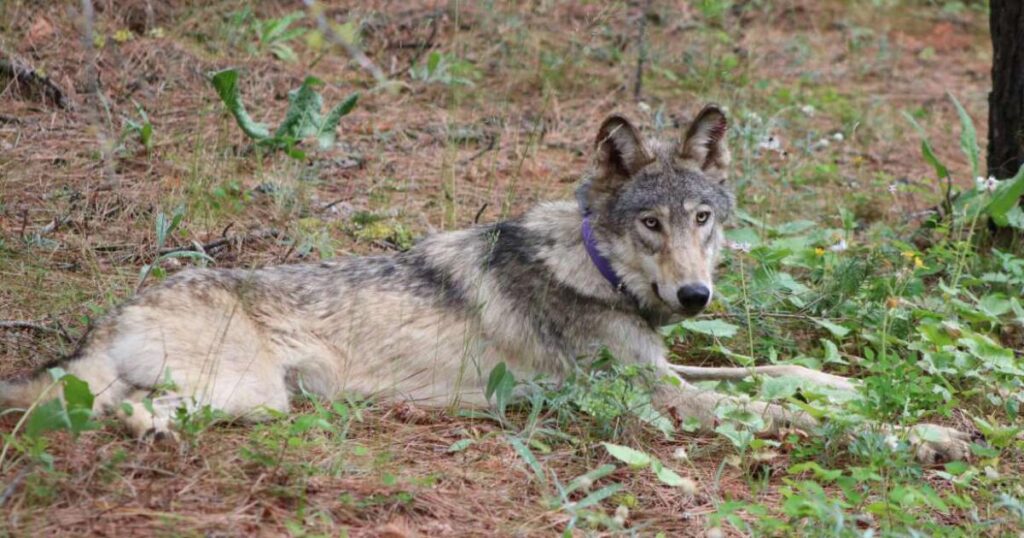
After being hunted to extinction a century ago, gray wolves are continuing their remarkable comeback story in California, with state wildlife officials reporting a modern record number of the apex predators.
There were 55 wolves confirmed alive and nine wolf packs by the end of 2025, the majority of which are clustered in the northeastern portion of the state, according to the California Department of Fish and Wildlife’s annual wolf report, released Thursday. That is up from 50 wolves and seven packs the previous year.
“More wolf packs and more new territories are exactly what we’d want for a wolf population that’s beginning to recover,” Amaroq Weiss, a senior wolf advocate at the Center for Biological Diversity, said in a statement.
Though the latest statistics bode well for the rebounding wolf population, the year was not without its challenges for the packs, as well as those who share their habitat.
The number of packs that were deemed breeding pairs — meaning they contained at least one adult male, an adult female and two pups — declined from five in 2024 to three in 2025. This drop was attributed partly to unsuccessful litters in the Lassen and Yowlumni packs, as well as the state’s decision to euthanize four wolves from the Beyem Seyo pack in response to a spike in livestock attacks.
There were 267 investigations opened into wolf-livestock predation in 2025, up from 74 the previous year. Of the investigations opened last year, there were 198 livestock losses confirmed likely due to wolves, 90 of which were attributed to the Beyem Seyo pack — generating outrage from Sierra Valley ranchers.
A study from the UC Cooperative Extension calculated the economic toll of cattle attacks by the Beyem Seyo pack reached at least $2.6 million over just seven months of last year, a figure that includes the loss of livestock and interventions aimed at deterring attacks.
In addition to the four euthanized wolves, two wolves died from vehicle strikes, three were found dead of unknown causes, and three additional deaths are under investigation.
“The fact the department is investigating their deaths suggests they may have been illegally killed, but the agency has yet to release any details,” the Center for Biological Diversity said in a statement. Gray wolves are a federally protected endangered species and illegal to kill in California.
The state has allocated approximately $5.6 million since 2021 for programs to compensate ranchers for animals killed by wolves and to support nonlethal deterrence methods.
This cost has been deemed worth the value of regrowing the state’s wolf population and reaping the ecosystem benefits after they were wiped out by hunters and trappers about a century ago. The last wild wolf known to call California home in those days was shot in Lassen County in 1924.
Then, in 2011, a small miracle happened. A plucky wolf known as OR-7 traveled into California from Oregon. Though he didn’t linger in the Golden State for long, his offspring later returned and formed California’s first modern pack in 2015.
Since then, the population has been slowly and steadily increasing in the Golden State, much to the delight of conservationists and frustration of ranchers who are now contending with the return of their historical nemesis.
As apex predators, wolves play an important role in managing the balance of an ecosystem. By keeping the population of mid-level predators in check, they help protect resources lower down on the food chain — allowing vegetation, streamside habitat and other wildlife species to thrive.
In Yellowstone National Park, their return has been praised with reducing the overabundant elk population and allowing decimated trees such as willows and aspen to recover, which subsequently brought the return of beavers and songbirds.
Despite the decrease in breeding pairs in 2025, California continues to see positive signs for wolf population growth. Three more wolf packs were identified in the first quarter of this year, raising hopes for the potential breeding pool.
“Wolves are a part of California’s natural heritage,” said Weiss, “and their return is an amazing conservation story to celebrate.”
Times staff writer Lila Seidman contributed to this report
The post The gray wolf’s improbable California comeback continues as population hits modern record number appeared first on Los Angeles Times.