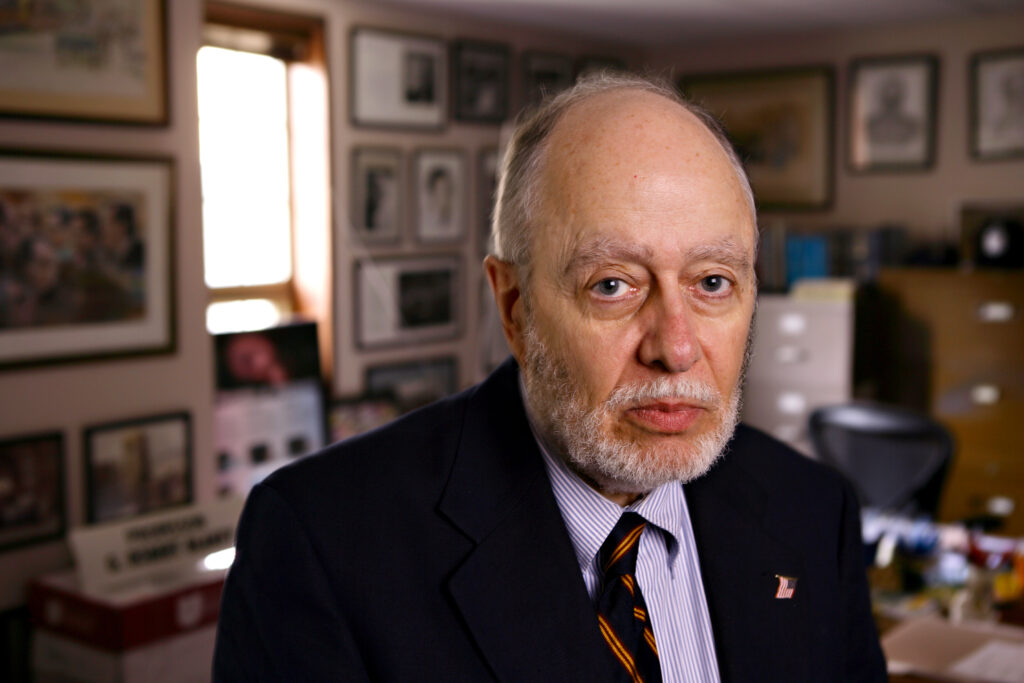
Although he never wore a gun on his belt or a badge on his chest, G. Robert Blakey was one of the mob’s most formidable opponents, the architect of a federal racketeering law that helped bring down crime bosses from New York to Las Vegas.
As the principal drafter of the Racketeer Influenced and Corrupt Organizations Act, better known as RICO, Mr. Blakey provided law enforcement with a broad new legal framework to target organized crime, public corruption, white-collar offenses and almost any other kind of complex criminal activity. Used in conjunction with a federal wiretap act that was also drafted with help from Mr. Blakey, RICO “allowed prosecutors to render the mob unrecognizable,” said Ronald Goldstock, the former director of the New York State Organized Crime Task Force.
Mr. Blakey could hardly be mistaken for Eliot Ness. A renowned law professor who taught thousands of students at Notre Dame and Cornell, he spent years arguing and consulting on RICO cases and helping to shape the next generation of lawyers.
But he also drew on his experience dealing with arcane legal problems, uncooperative witnesses and alleged criminal conspiracies to delve into one of the 20th century’s most consequential murder cases: the assassination of President John F. Kennedy, whose younger brother Robert F. Kennedy was Mr. Blakey’s onetime boss in the Justice Department.
Mr. Blakey, who served as the staff director and chief counsel of the U.S. House Select Committee on Assassinations — an investigative body that concluded in 1979 that John F. Kennedy and the Rev. Martin Luther King Jr. were each the likely victim of a conspiracy — died May 1 in the Chicago suburb of Oak Park, Illinois. He was 90, and had lived there in recent years with his son John Robert Blakey, a federal judge and former prosecutor with years of experience arguing and deciding RICO cases of his own.
Even among law professors, Mr. Blakey was set apart by his unusually wide-ranging intellectual appetite, and by his ability to synthesize vast swaths of information and spit out something new. “He was like AI before AI existed,” said Goldstock, a former Cornell colleague.
Mr. Blakey could speak at length about ancient Greek philosophy or the geology of the Grand Canyon, and had a boyish enthusiasm for art and history that led him to collect miniature medieval castles, gargoyles and religious paintings, and to acquire a full suit of armor and a replica sarcophagus. (He told his grandchildren there was a mummy inside.)
He was also well-versed in old Hollywood movies, a fact that fueled speculation as to whether he had named his landmark racketeering law after a gangster character, Rico, in the 1931 movie “Little Caesar.”
Mr. Blakey kept mum about the name’s origins. But in a 1990 law review article, he did acknowledge that “the statute was designed to change the ending of the movie,” in which Rico is killed by police while his boss, the gangster overlord Big Boy, gets off without facing prosecution.
More from A Notable Life
Forced to dance for Mengele at Auschwitz, she was called to help others heal
Biruté Galdikas, authority on orangutans, has died. She was one of ‘Leakey’s Angels.’
Mathematician Gladys West dies at 95. She was a hidden figure behind GPS.
Mr. Blakey liked to cite a pivotal moment in the early 1960s, when he was working for the Justice Department and prosecuting a mob case in Pennsylvania. During a break, he happened to find himself in the restroom with the defendant.
“You’re doing fine,” the mobster told him, “but you’re not going to win. The rules won’t let you.”
Through RICO, Mr. Blakey set about changing those rules. Signed into law in 1970, the act enabled prosecutors and investigators to target criminal enterprises in full, rather that focusing only on individual criminals and individual crimes.
“Previously law enforcement was a like a wolf to a herd of animals,” Mr. Blakey told the New York Times in 1985. “Prosecutors looked for single cases, they picked off the sick and wounded, and only made the herd — organized crime — stronger.”
Mr. Blakey drafted the legislation while serving as the chief counsel to the Senate Subcommittee on Criminal Laws and Procedures. But the law was such a departure from the norm, Goldstock said, that it took almost a decade before prosecutors and law-enforcement officials began putting RICO into action, with guidance and encouragement from Mr. Blakey.
In one major case, known as the Mafia Commission Trial, then-U.S. Attorney Rudy Giuliani used RICO to indict and ultimately convict eight top crime leaders, including bosses of New York’s five families. By the time the indictments came down, in 1985, federal prosecutors had charged more than 2,000 organized crime figures in the previous two years, according to the Times.
Mr. Blakey helped guide the creation of RICO laws in more than 30 states around the country, while defending the statute from critics who said it was overly broad and unreasonably punitive. Courts were granted the power to freeze a person’s assets, deny bond, allow victims to sue for treble damages and issue sentences of up to 20 years per count.
“Those people who say RICO ought to be thrown out are simply depriving the sheriff of his six-shooter,” Mr. Blakey told The Washington Post in 1989, defending the law’s application against Wall Street executives. The following year, he was declaring that thanks to RICO, Mafia groups like the five families “are dead or finished almost everywhere.”
A president and a spy agency
Mr. Blakey had been focused on mob cases, directing the Cornell Institute on Organized Crime and teaching at the university’s law school, when he was hired in 1977 to direct the House Assassinations Committee, headed by Rep. Louis Stokes.
Established by Congress the previous year, as questions continued to swirl around the killings of Kennedy and King, the group had been plagued by leaks and reported infighting that contributed to the resignation of its original staff director.
The committee also suffered from a lack of resources, said Jefferson Morley, a longtime JFK researcher and former Washington Post reporter.
“Blakey played a weak hand well as he could,” Morley said in an email, adding that while he did not always agree with Mr. Blakey, the longtime law professor “deserves credit for developing a lot of new evidence and testimony into the record.”
Mr. Blakey said he joined the investigation with an open mind, determined to let the facts guide him. In the case of the Kennedy assassination, his personal views initially aligned with the Warren Commission, which concluded in 1964 that Kennedy was killed by a lone gunman, Lee Harvey Oswald, firing from a sixth-floor window at the Texas School Book Depository in Dallas.
The House committee’s final report, released in 1979, diverged from that finding. The group agreed that Oswald had fired the fatal shot, but cited acoustic evidence and witness testimony suggesting the presence of a second gunman in an area known as the grassy knoll.
The president “was probably assassinated as a result of a conspiracy,” the report said. While the committee was “unable to identify the other gunman or the extent of the conspiracy,” it suggested that organized crime figures may have been involved.
When it came to King’s assassination in 1968, the committee affirmed that the civil rights leader had been killed by James Earl Ray. Yet the group also found “compelling indications of conspiracy,” possibly involving a group of right-wing St. Louis businessmen, and faulted the Justice Department and FBI for failing to adequately investigate the evidence at the time.
While the committee’s report was “heavily stitched with reservations and uncertainties,” as The Post reported in 1979, Mr. Blakey was blunt when asked for his personal views about the JFK assassination.
“I think the mob did it,” he said.
Mr. Blakey made his case in a 1981 book, “The Plot to Kill the President,” with co-author Richard N. Billings. He argued that his theory “explains more of the evidence than anything else,” and stood by it even as critics disputed some of the acoustic evidence cited by his committee, and as some of the committee’s own members ultimately dissented from its findings of a conspiracy.
There was at least one notable area of the investigation where Mr. Blakey did change his mind. Long after the committee wrapped up its work, Mr. Blakey maintained that he and his investigators had sufficient access to CIA files, which they wanted to study while running down theories that Oswald may have been connected to U.S. intelligence agencies.
The committee was ostensibly aided by a former CIA officer, George Joannides, who had been pulled out of retirement to serve as a liaison with the agency. But in 2001, Mr. Blakey learned that Joannides was not a disinterested third party, but a potential witness. According to declassified CIA documents, Joannides had supervised a group of CIA-funded, anti-Castro Cuban exiles who publicly clashed with Oswald months before the assassination.
“The agency set me up,” Mr. Blakey said in 2005, after concluding that Joannides had been dispatched to stonewall the committee’s work. In hindsight, he said, “I have no confidence in anything the agency told me.”
‘Never again’
The younger of two sons, George Robert Blakey was born in Burlington, North Carolina, on Jan. 7, 1936. He was 9 when his father, a bank president, died of a heart attack. His mother went to work to support the family, rising to become a department store manager.
In Notre Dame parlance, Mr. Blakey was an unusual kind of “triple domer,” as someone who received two degrees from the university and later joined its faculty. He earned a bachelor’s in philosophy in 1957, graduated from the law school in 1960 and taught near the university’s golden-domed main building for 37 years, in two separate stints, before retiring in 2012.
Each of his eight children graduated from Notre Dame as well.
In addition to his son John, survivors include six other children, Katherine Cox, Christine Coury, Margaret Clarke and Michael, Elizabeth and Anne Marie Blakey; 18 grandchildren; and two great-grandchildren. His wife of 44 years, Elaine Menard Blakey, died in 2002. His son Matthew died of cancer in 2014.
Into his 80s, Mr. Blakey continued to work on legal cases and speak to researchers and reporters interested in RICO and JFK. He was harshly critical of the Warren Commission, which in his opinion had overstepped the evidence by ruling out a conspiracy. And he was still trying to obtain CIA records as recently as 2019, when he told The Post that he had a Freedom of Information Act lawsuit pending against the agency.
“If there is any message to take out of this case, it can be summed up in two words — never again!” Mr. Blakey had told a gathering of lawyers in 1979. “The next time this happens — and it will happen: one in four of our presidents has been shot at — I hope indeed that people will have the courage and the integrity to stand up and say, ‘I will pursue this as far as I can, and if I can’t go all the way, because I’m human, I will tell people of that.’ ”
This article is part of A Notable Life, an obituary feature telling the stories of remarkable people every Saturday.
The post Renowned for his legal skills, he took on the mob and investigated JFK’s killing appeared first on Washington Post.