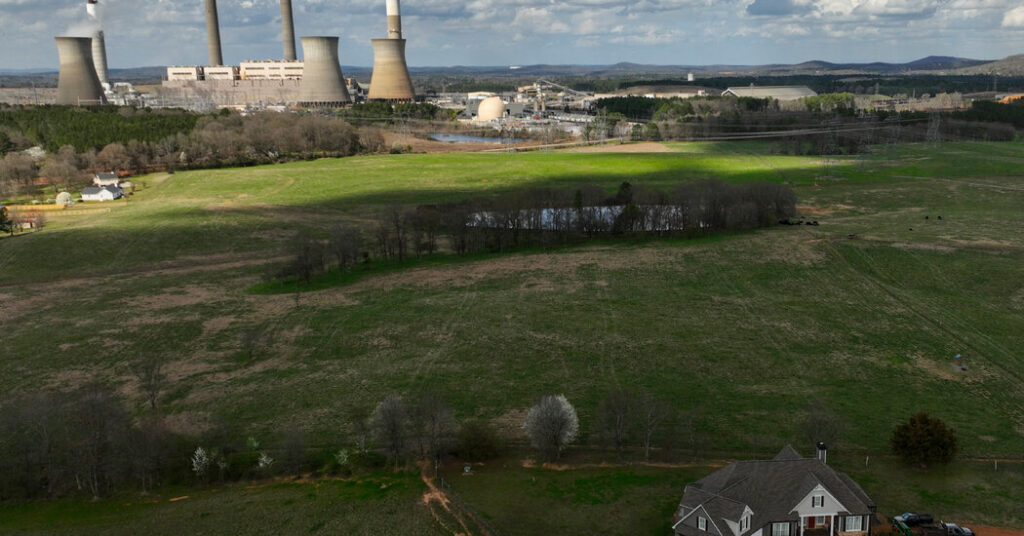
Coal-fired power plants across the country released more mercury last year as power demand surged, reversing a yearslong downward trend in the emissions of a toxic metal that impairs brain development.
Mercury emissions from coal-burning plants increased by roughly 9 percent in 2025, compared with a year earlier, totaling more than 4,800 pounds, according to a New York Times analysis of data collected by the Environmental Protection Agency.
At the same time, the Trump administration launched a series of moves that experts say may make those emissions climb even higher this year and beyond.
The administration has encouraged the burning of more coal, which emits more carbon dioxide and other pollutants than other fossil fuels, while also blocking tighter pollution controls on coal-burning plants that were supposed to take effect by 2027. It has directed the Pentagon to buy more coal-powered electricity and reopened millions of acres of federal land to mining while working to stymie nonpolluting energy, like wind and solar power.
It also ordered some coal-burning power plants to scrap their plans to close, compelling them to remain open instead.
Most were set to close at the end of 2025. But the J.H. Campbell plant in Michigan, which should have retired on May 31, 2025, was ordered by the Energy Department to keep operating. From June through December last year, it emitted 36 pounds of mercury.
Under President Trump, the E.P.A. also canceled the more stringent limits the Biden administration had sought to place on emissions of mercury and other heavy metals from coal-fired power plants by 2027, maintaining a set of looser restrictions that took effect in 2012 under President Barack Obama.
At a contentious hearing on Capitol Hill two weeks ago, Lee Zeldin, the administrator of the Environmental Protection Agency, defended the weakening of pollution limits on power plants that burn coal.
Representative Josh Harder, Democrat of California, said Mr. Trump’s rollback would pump up to 1,500 additional pounds of mercury into the air. He cited E.P.A. data that compared emissions under Mr. Trump to the levels that would have been if Biden-era standards had stuck.
Mr. Zeldin said that number wasn’t accurate. “Rip it up,” he told Mr. Harder. “Have your dog pee on it.”
Before last year, mercury emissions from coal plants in the United States had been on a decline since 2018, the earliest year for which complete data was available. The only exception was 2021, when economic activity surged following the worst of the Covid pandemic lockdowns.
The rise of mercury emissions in 2025 was driven by an increase in the amount of coal burned. Experts said that demand from power-hungry data centers, as well as volatile natural gas prices, had spurred utility companies to burn more coal.
Coal’s resurgence has contributed to a rebound in emissions of planet-warming carbon dioxide, as well as hazardous pollutants like particulate matter and sulfur dioxide, which can harm the lungs.
But an increase in mercury is particularly alarming.
A potent neurotoxin that settles into waterways and accumulates in the food chain, particularly in fish, mercury can cause premature cardiovascular mortality in adults. In children and fetuses, it can cause developmental delays and permanent I.Q. deficits.
The toxic metal was once used in household items like batteries, paint and thermometers, but was phased out in the 1990s and 2000s, leaving coal plants as the largest industrial source of airborne mercury pollution in the United States.
As the head of the environmental group Waterkeeper Alliance, Robert F. Kennedy Jr., now Mr. Trump’s health secretary, campaigned against mercury pollution from coal plants. He has talked about being diagnosed with mercury poisoning, most likely from eating tuna contaminated with the dangerous metal. In testimony before Congress, Mr. Kennedy called mercury “the most powerful neurotoxin we know of in the universe.”
President Trump, on the other hand, frequently praises what he calls “beautiful, clean coal.” And Mr. Zeldin has argued that tougher limits on mercury pollution would have regulated the coal sector “out of existence,” destroying “reliable American energy.”
In a statement, Taylor Rogers, a White House spokeswoman, said President Trump remained “committed to restoring and strengthening the coal industry which has been viciously attacked by climate activists for years.”
Lynn R. Goldman, a pediatrician and professor of environmental and occupational health, called the rise of mercury emissions “shocking.”
“A tiny amount of mercury goes a long way,” Dr. Goldman said. “Mercury is magnified in the food chain, and so it ends up getting more and more concentrated as it moves up into, say, fish that people eat.”
The result, she said, are changes to intellectual development and behavior in children that might not be noticeable in the doctor’s office.
The E.P.A. first regulated mercury from coal plants in 2012, and mercury emissions from the power sector dropped by 86 percent within five years, according to the agency.
At that time, a subset of coal plants that burn lignite, the dirtiest coal, were allowed to meet looser limits after the coal industry argued that effective pollution controls didn’t exist.
In 2024, the Biden administration rejected that argument and moved to require lignite coal-burning plants to meet the same standards as other coal plants. That would have lowered lignite plants’ legal emissions limit by 70 percent. The Trump administration has repealed those restrictions for lignite plants.
In 2025, mercury emissions from lignite plants appeared to decline moderately. Carlos E. Romero, director of the Energy Research Center at Lehigh University, said the amount of mercury released by a coal plant could be affected by a range of reasons, including the mercury content of the coal itself. Lignite plants continued to make up for a disproportionate amount of mercury emissions, contributing more than 20 percent of total mercury emitted last year, though they accounted for less than 5 percent of electric power generated at coal plants. They are expected to remain a significant source of mercury emissions.
The Trump administration estimated that loosening limits on pollution would save the industry about $120 million a year in compliance costs.
Dr. Romero, an expert on pollution controls, said that some plants had invested in controls ahead of the tougher Biden-era standards, and were expected to keep those controls running. But units without the most stringent mercury controls could see their emission rates drift upward.
Antelope Valley Station in North Dakota is one of dozens of coal-burning plants that no longer has to meet stringent pollution standards by 2027. Mercury emissions recorded for that power plant increased by 14 percent in 2025 as it generated more power.
The Basin Electric Power Cooperative, the operator of the Antelope Valley plant, had argued that complying with the stricter rules would require expensive new equipment and could force it to scale back operations, hurting grid reliability and threatening national security.
Andy Buntrock, a spokesman for Basin Electric, said its plants complied with state and federal regulations.
A coalition of environmental groups has taken the Trump administration to court over its regulatory rollbacks.
The rise in mercury “adds to the growing evidence that, as the administration has made a significant effort to bring back coal, it is making us sicker,” said Amanda Levin, director of policy analysis at the Natural Resources Defense Council, who has also analyzed the data.
The biggest increase in mercury emissions came from a decades-old Rockport Generating Station in Spencer County, Ind., on the banks of the Ohio River. There, mercury emissions surged to 73 pounds in 2025 from 28 pounds in 2024, an increase of more than 160 percent as the plant generated 90 percent more electric power.
Indiana has seen an expansion of large artificial intelligence data centers that require constant power, which has driven up demand for coal. The Rockport plant is scheduled for retirement in 2028, which environmental groups said diminished incentives to invest in pollution controls.
Scott Blake, a spokesman for American Electric Power, Rockport’s operator, said the plant’s pollution control equipment met legal obligations. He also noted that one of the plant’s units was off line for maintenance in 2024 and then returned to service the next year, increasing the amount of coal that was burned.
Public health experts say savings for the industry ignore the economic impact of additional pollution, including health care costs associated with cardiovascular disease and developmental problems in children; researchers at Harvard had calculated that keeping stricter limits on mercury pollution from lignite plants alone would have resulted in $200 million a year in public health benefits in just the first year.
“The economic arguments are very flawed, because they don’t capture the public health costs,” said Elsie Sunderland, a professor of environmental chemistry at Harvard, who conducted the research.
She said the Trump administration’s policy rollbacks threatened to reverse decades of progress, for example, in lowering concentrations of mercury in the blood of American women of childbearing age, which would in turn affect fetus’s brains.
Mira Rojanasakul contributed reporting.
Methodology
The Times analyzed hourly Mercury and Air Toxics Standards (MATS) data for coal-fired power plants from the E.P.A.’s Clean Air Monitoring Program database, starting in 2018, the earliest year for which complete MATS data are available. Power plant units with less than 25 megawatts of generating capacity, or that qualify for status as “low emitting,” are not subject to the MATS Rule and are therefore not included in the emissions data.
To identify plants that burn lignite coal, The Times consulted the E.P.A.’s National Electric Energy Data System, data from the Energy Information Administration (E.I.A.) and state agencies. The Times also used E.I.A. data to calculate changes in fuel consumption and net generation.
Irena Hwang is a data reporter at The Times, using computational tools to uncover hidden stories and illuminate the news.
The post As Coal Rebounds, More Mercury, a Potent Toxin, Is in the Air appeared first on New York Times.