The protagonist in the novel “It Was Either That or Die” departs Haiti on an epic journey through South America, the perilous Darién jungle and a United States on the cusp of President Trump’s return to power. But once in the United States, he continues to flee — to Canada.
“It was on that day that I decided to leave — like pulling out a tooth, like cutting off an arm, like saying goodbye to one’s mother tongue,” he says at the start of his odyssey.
A work that explores the personal toll of global migration — and depicts the United States not as a dream destination, but a dehumanizing place to escape from — the novel has brought sudden acclaim to its author, Thélyson Orélien, 37, who left Haiti for Montreal after the devastating 2010 earthquake.
The rights to the novel, “C’était ça ou mourir,” in its French original, have already been sold in 23 countries, all but one before the book’s recent publication in Quebec. Scribner is planning to publish a U.S. translation in 2028.
Though only a few chapters deal explicitly with the United States, they have fueled interest in the novel in a world riveted by the often violent crackdown on migrants there.
The novel’s protagonist finds “fear, not hysterical, not exaggerated, but very real” among Haitians in the United States before the start of Mr. Trump’s second term.
“I had only one thing on my mind: leaving,” the protagonist says before heading to Canada’s most famous unofficial border crossing, Roxham Road. “I thought of Canada the way a shipwrecked man thinks of a plank of wood. I didn’t imagine it as paradise — I’d stopped believing in that a long time ago — but as a place where I could finally breathe.”
For years, thousands of people entered Canada through Roxham Road, a rural border crossing between Quebec and New York State. Until 2023, a loophole in an immigration agreement between Canada and the United States allowed asylum seekers who crossed there to avoid being sent back immediately to the United States.
Mr. Orélien finds parallels between Roxham Road and the Underground Railroad, the secret network of abolitionists helping Black slaves flee to free states and to Canada. Today, just as in the past, Mr. Orélien sees “two forces in the United States: you can find people who don’t accept the other and you can also find people who accept the other.”
“But maybe now, the idea in power, the one driving and directing everything, is the idea that the other is somebody who’s come to eat Americans’ dogs and cats,” he added with a laugh, referring to Mr. Trump’s false claim during the 2024 presidential campaign that Haitian immigrants were eating people’s pets in Springfield, Ohio.
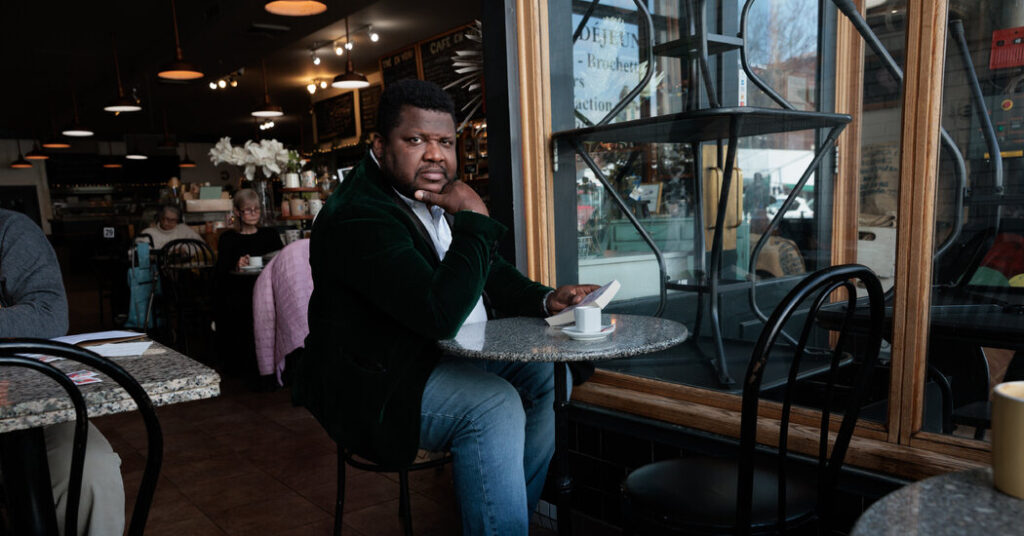
Recently, on a typical Montreal day suspended between winter and spring, Mr. Orélien spoke for several hours in Côte-des-Neiges, a neighborhood that has long welcomed immigrants, refugees and exiles from Haiti, Vietnam, Chile and other corners of the world. He said he featured the neighborhood in the novel to underscore the “universality of migration.”
At a café called La Brûlerie Urbaine, Mr. Orélien still seemed a bit bewildered by the sudden attention.
“People in the media were talking about the buzz,” he said. “But now I feel much more at ease because people are actually reading it.”
Though he had previously published some poetry and prose, Mr. Orélien was little known when his manuscript — featuring the story of Jonas Dorléon, a 29-year-old high school history and geography teacher — was picked out of the slush pile last summer at Éditions du Boréal, Quebec’s most prestigious publisher.
La Presse, a news site in Quebec, said that “Jonas in the belly of America” taps into “the overheated debate over immigration.” Le Devoir, a newspaper, said that as Mr. Trump makes fighting illegal immigration a priority and that as the debate over immigration is becoming more polarized worldwide, Mr. Orélien brings “a gust of humanity.”
The topic speaks to the times — a reflection of how America’s image in the world is changing, for the worse. Never in Boréal’s 63-year-history had the rights to one of its books been sold so widely before publication.
The novel, written in the first person, tells how Jonas leaves Haiti after gangs burn down his neighborhood in Port-au-Prince. It details the progressive psychological impact of migration, from the moment of uprooting through endless episodes of humiliation.
The plastic shopping bag Jonas takes on his trek — containing a photo of his mother, a notebook of his poetry, a book by the Haitian poet René Depestre, and a clean pair of underwear — points to his efforts to cling to his humanity and dignity. It also shows what the poor and migrants across the world often do, what Mr. Orélien describes as “working many miracles with a few small things.”
Though Mr. Orélien did not come to Canada through a journey like the one at the center of the novel, he and Jonas have similar backgrounds and sensibilities.
The third child of five siblings, Mr. Orélien grew up in Gonaïves, a city in northern Haiti, in a middle-class Protestant family that spoke Créole at home. His father, an accountant with a deep interest in theology, would bring his work home, poring over rolls of paper on the kitchen table.
The father imbued his son with a love of Homer and Alexandre Dumas, the French writer whose paternal grandmother was an enslaved woman from what is now Haiti.
His mother, a seamstress, made sure her children did well at a private Catholic school. She encouraged Mr. Orélien’s precocious love for writing, especially poetry. During blackouts, Mr. Orélien would write under a streetlamp next to a hotel or a gas station.
“She’d look at me and say, ‘You know, what you’re doing could take you far,’” Mr. Orélien recalled.
Gonaïves’s history as the cradle of Haitian independence filled locals with a sense of the nation’s tragic history. Or, as Jonas says, “Haiti was the first Black country to gain independence, even though each day reality made me doubt whether we had ever been liberated.”
One day, when he was a young boy, Mr. Orélien heard on the radio, “Manman piti mare vant” — a Créole expression meaning that mothers had to tighten their belts. Mistakenly believing that she was about to be killed, the boy bolted toward the church where his mother happened to be.
“I crossed National Highway No. 1,” he recalled. “I was in my underwear, barefoot, bare-chested. I was running, people were chasing me, no one could catch me.”
Mr. Orélien went to university in Port-au-Prince. The house where he was living collapsed during the 2010 earthquake; he survived because he happened to be outside, using the Wi-Fi from a building across the street.
Afterward, with relatives already in Canada, Mr. Orélien was able to get a visa and, eventually, permanent residence.
He studied at the Université de Montréal in Côte-des-Neiges, where he found links to the Haitian diaspora and to an earlier generation of exiles. Many of them met at the café where Mr. Orélien spoke recently, the eponymous setting of “La brûlerie,” a 2004 novel by the Haitian-Canadian writer Émile Ollivier, who died in 2002.
“That novel made me love this place, and it helped me meet a lot of people,” he said.
Some would tell him stories that would be absorbed into the novel. Mr. Orélien also heard stories from refugees while on research trips to the United States, or from those sheltered in Montreal’s Olympic Stadium during a sudden influx in 2017.
It was after a visit to Florida in 2017 — as efforts against illegal immigration increased at the start of Mr. Trump’s first term — that Mr. Orélien felt compelled to begin his novel. In Florida, he saw ICE agents stop people presumably suspected of being in the country illegally.
“I saw somebody abandon his car in the middle of the road and flee,” Mr. Orélien said. “I thought that was strange. We’re in the United States, after all, the country that used to tell us that we had to be a democracy and gave lessons to impoverished countries. Why? Why was this happening?”
Norimitsu Onishi reports on life, society and culture in Canada. He is based in Montreal.
The post Quebec Novelist Shines a Harsh Spotlight on Migration, and on Trump’s America appeared first on New York Times.