WHEN THE FOREST BREATHES: Renewal and Resilience in the Natural World, by Suzanne Simard
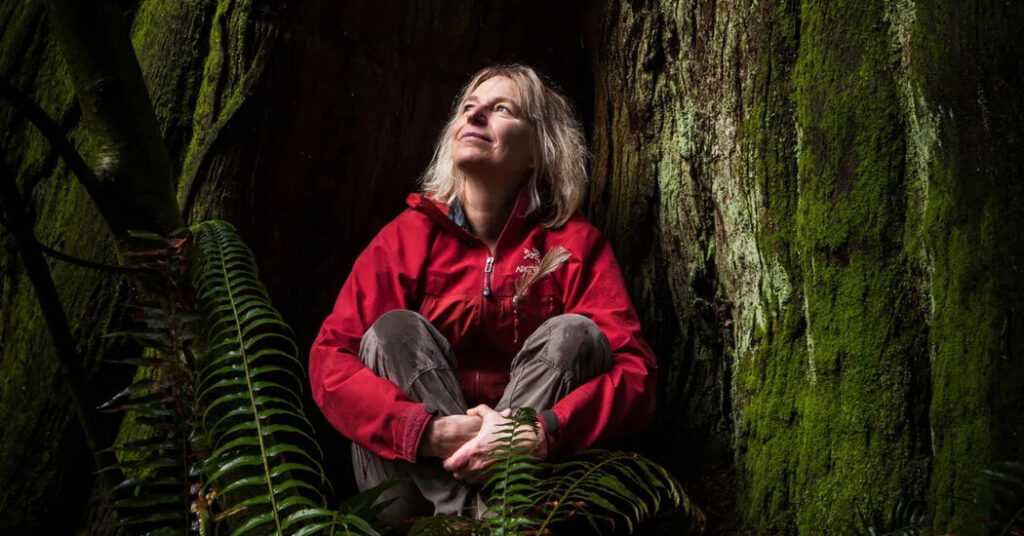
It’s the summer of 2023 and the Canadian forest ecologist Suzanne Simard is sitting tucked in the knobby embrace of an Amazonian tree trunk, imagining that she too is a tree as she “reached out with leaves unfurling to greet the sun.” She can feel the rat-a-tat of woodpeckers on her bark, the stretch of her roots in the soil below. She draws strength from a sense of family: “The trees were in my blood. They were my kin.”
But in Simard’s new book, “When the Forest Breathes,” trees are not just supportive relatives. They are teachers and healers, capable of communication and perception, a woodland congregation in which young trees grow “in halos” around their elders. Back in Canada, she describes a forest visit that further amplifies that sense of magic, a moment in which she stands beneath aged cedars, “the supernatural trees, the grandmothers,” listening as they whisper wisdom on the breeze.
All of which brings a heady, inspirational quality to her writing as she urges readers to hear the forest as she does. “Nature is waiting for us to listen,” she writes, “and to learn.” The siren quality of her message is almost tangible, as is the allure of gaining knowledge from the Zen master inhabitants of the ancient forests.
And yet. I find myself considering the message in my annoyingly cautious, science-writerly way. Would I find it inspiring to be pecked by a woodpecker? Probably not. Have I ever thought of myself as a tree? Probably never. Is this the measured language we hear from most scientists? Not even close. Simard emphasizes this point in the book: her growing sense of alienation from the methodologies of Western science, its tendency to obsess over small details and, as she sees it, miss the forest for the trees. “I found myself longing to push back against these rigid boundaries,” she writes, and to find “other ways of seeing and knowing the natural world.”
This longing derives in part from her collaborations with Indigenous scientists on Canadian forest management, which led her to deeply admire their more holistic approach to nature. She cites studies showing that “Indigenous-held land,” including forests, “contained some of the most biodiverse and carbon-rich ecosystems in the world.” Amid perilous global climate change, Simard is drawn to their loving attitude to nature as her “philosophical and spiritual home.”
Increasingly, she feels more anchored in their worldview than in that of her longtime research community. A professor of forest ecology at the University of British Columbia, Simard published her first semi-autobiographical book, “Finding the Mother Tree,” in 2021, and it became an international best seller. In it she wove her central theory about the forest — that trees “talk” to one another through an underground network of connective fungi, fostering an intergenerational system in which older trees protect and help the younger ones — with her own experience of grief and illness, emphasizing the parallels between the lives of trees and those of humans.
Despite the book’s rapturous public reception, the scientific community’s response was often unenthusiastic. Other biologists accused her of exaggerating the evidence for cooperation among organisms at the expense of “the important role of competition in forest dynamics.” They worried she was selling a forest story that might be only partly true. And they disliked her use of anthropomorphizing descriptors like “mother tree,” which suggested these organisms should be valued for their similarities to humans, instead of for their own remarkable biology.
Simard admits to having been hurt and frustrated by these accusations, to which she responded with a point-by-point rebuttal in a scientific journal. She returns to these grievances in the new book, where she expresses resentment for the demeaning accusation of anthropomorphism (“the mere utterance of the word” in Western science “suggests the scientist who makes this blasphemous mistake is not an objective observer, but rather impure, intuitive and subjective, perhaps lacking integrity”), and the resistance to her efforts to do justice to the inherent poetry of the forest.
This book is not, however, a rejection of the insights that good science — including Simard’s own — can bring. She provides examples of experiments showing how the heavy machinery used by loggers destroys the ability of the forest floor to sequester carbon; and how clear-cutting of old-growth forests can turn wooded lands into places that release carbon into the atmosphere rather than absorbing it.
Given the urgency of climate change, Simard’s dissatisfaction with the standard research model is in many ways a dissatisfaction with communication. If we are to protect our endangered forests, she argues, then science needs to be less timid in its messaging. She urges her colleagues to take a lesson from the First Nations people who fight for what they believe. To “stand tall in the wind,” as the Mother Trees do.
WHEN THE FOREST BREATHES: Renewal and Resilience in the Natural World | By Suzanne Simard | Knopf | 310 pp. | $30
The post A Warning to Climate Scientists: Don’t Miss the Forest for the Trees appeared first on New York Times.