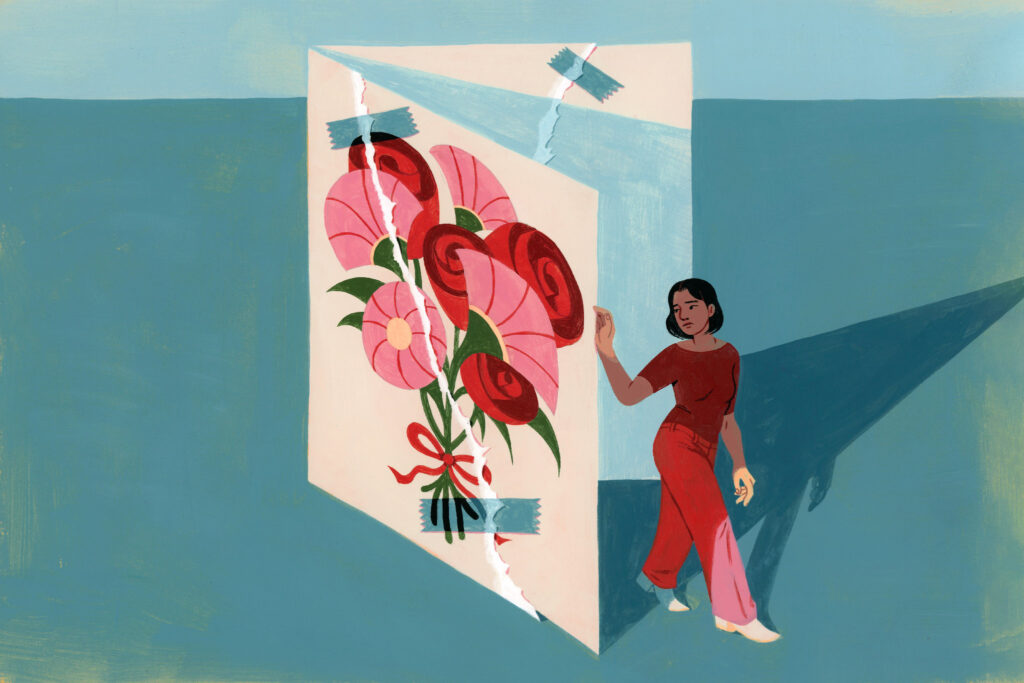
Holidays shine a bright light of comparison on what’s present and what’s missing in our lives. Mother’s Day can be great for those close to their mothers, tender for those loved and revered by their children and challenging for almost everyone else.
If you’re fortunate enough to see Mother’s Day as a cause for celebration, be grateful. Loving family relationships are not rare, but they’re hardly a given. That’s because we don’t always get what — or who — we want as family. Mothers (or caregivers in general) may struggle to understand or be as close to their adult children as they’d like. Adult children may struggle to forgive or forget the ways they felt hurt by the people who raised them. Separating ourselves from the reflection of our families is both a lifelong and, in some ways, impossible task — one our families may be incapable of helping us achieve.
Here are five scenarios that can make Mother’s Day feel challenging and some of the advice I give my patients who raise these issues in therapy.
Your once-close relationship has drifted apart
While many adult children have close, confiding relationships with their mothers, not all do. Time can alter family dynamics, and growing up can also mean growing apart. In a large study tracking relationships over time, researchers found that only about a quarter to one-third of adult children described their relationships with their mothers as consistently close and high-contact across the life course. Most relationships were more mixed: fluctuating between closeness and distance, shaped by stress, conflict, changing expectations, health problems, divorce, geography and differing values over time. The findings underscore that ambivalence and inconsistency are common features of family life — not necessarily signs of failure or pathology.
People grow and change in ways that can create distance as often as it brings them together. As a family therapist, it’s not unusual for me to hear a disappointed person say, “We used to be so close.” Most are not wrong in their observation — just unable to foresee the events that can weaken family ties.
For adult children who feel distant from a parent, Mother’s Day doesn’t have to require emotional closeness or a performance of feelings that aren’t there. A brief acknowledgment — a text, card or simple expression of goodwill — may feel more manageable and can preserve a sense of civility or connection without sacrificing boundaries. For parents, it can help not to interpret a minimal gesture, or even silence, as a definitive measure of your child’s love or the future of the relationship. Holidays tend to amplify expectations and disappointments; lowering the emotional stakes can sometimes protect the possibility of connection later on.
Mental illness or addiction issues are impacting the relationship
A parent’s or adult child’s mental illness, or current or past addiction issues can further complicate a relationship. While mothers are deeply affected by their children’s struggles, adult children may also be shaped by a mother’s addictions, mental illness or physical challenges. Such circumstances can limit the ability to repair hurtful behavior in the present or make amends for actions in the past. Whether because of mental illness or other factors, adult children who experienced their mother as hostile or rejecting earlier in life are more likely to carry mixed or negative feelings into adulthood, making time together far more challenging.
As with romantic relationships, we can sometimes expect too much meaning, healing and validation from someone who is carrying too many of their own burdens to meet us in those ways — even when their limitations are part of what has hurt us. Whether conflicted or cut off, time, distance or therapy can sometimes help families pull back far enough to see one another with the kind of compassion and clarity that involvement often obscures.
For adult children, Mother’s Day may feel emotionally complicated when a parent’s limitations — whether psychological, physical or relational — have made closeness difficult. In those situations, it can help to approach the day with modest expectations, focusing less on creating an idealized experience and more on what feels emotionally manageable and respectful. For mothers, it may help to recognize that an adult child’s distance or ambivalence is not always cruelty or rejection but sometimes a reflection of long-standing pain, confusion or emotional fatigue within the relationship.
Divisions, political or otherwise, have led to estrangement
The research suggests that parents and adult children who are in greater alignment on values tend to have closer relationships, while misalignment increases the likelihood of conflict. In a 2024 survey I conducted with the Harris Poll, a significant share of parents reported estrangement stemming primarily from differences in political allegiances. Values don’t just shape opinions — they define the emotional ground families stand on. When that ground shifts too far apart, relationships can begin to fracture.
On Mother’s Day, it may help both parents and adult children to resist turning the occasion into a referendum on those differences. Families are often better served by emphasizing shared history, affection or simple gestures of goodwill rather than trying to resolve deeply entrenched disagreements over politics, identity or values in a single interaction.
Closeness feels emotionally damaging or painful
Whether for political or other reasons, some adult children come to feel that staying in the relationship means compromising their own well-being. “I still love my mom,” is something I sometimes hear in my practice, “but it takes me weeks — sometimes months — to recover after I see her, so I’ve decided that I just can’t.” For these adult children, distance can bring a sense of relief and stability but often alongside grief, doubt or a lingering sense of loss.
For mothers, estrangement rarely feels like a solution. Most carry intense feelings of shame, sorrow and guilt — not only for the rupture but for the ways they fear they may have contributed to it. The loss can extend beyond the relationship itself, unsettling a core sense of identity. As one estranged parent told me, “No one calls me Mom anymore.”
For both mothers and adult children, Mother’s Day can be an opportunity to hold two truths at once: that distance may feel necessary, and that loss can still be real. Adult children may benefit from recognizing that protecting their well-being does not require erasing every feeling of love, gratitude or grief. Mothers, similarly, may need to resist viewing estrangement as a complete verdict on their worth or identity. Relationships often evolve slowly, and periods of distance do not always foreclose the possibility of greater understanding later on.
The holiday can magnify a sense of loss
For many people, Mother’s Day is painful not because of ongoing conflict but because of a profound loss. Some are grieving their mothers who have died; others are mourning children they’ve lost physically. Holidays can intensify absence by highlighting what once existed — or what never fully did. In those situations, it may help to approach the day less as a celebration one must perform and more as an opportunity to acknowledge grief with honesty and self-compassion. Sometimes the healthiest goal is not to push yourself to feel joyful but simply to directly acknowledge and accept what’s missing.
Much of what unfolds in family life has more to do with luck — both good and bad — than we care to admit. Understanding our limitations, and those of our families, can help us see what’s unlikely to ever change — and with time, patience and curiosity — what just might.
Joshua Coleman, PhD, is a clinical psychologist in the Bay Area, keynote speaker, author and senior fellow with the Council on Contemporary Families. His newest book is “Rules of Estrangement: Why Adult Children Cut Ties and How to Heal the Conflict.” His Substack is Family Troubles.
If you have a question for a therapist about mental health, relationships, sleep, dating or any other topic, email it to [email protected], and we may feature it in a future column.
The post I’m a therapist. Here’s how to cope if you find Mother’s Day difficult. appeared first on Washington Post.